
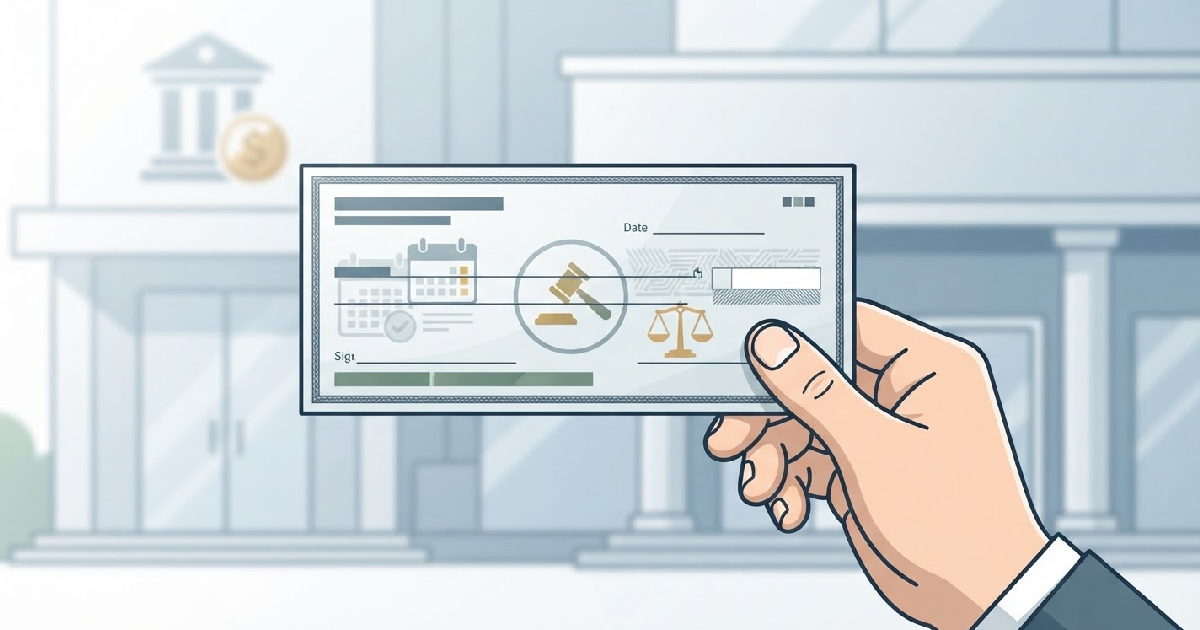
A post-dated cheque, written with a future date, serves as a common financial tool to manage cash flow or align payments with anticipated income, such as a payday. While seemingly straightforward, this practice carries significant legal nuances and potential criminal liabilities for the issuer.
Federal law does not always obligate banks to wait until the specified future date, meaning a cheque could be cashed early and trigger unexpected consequences.
Understanding post-dated cheque legality
Many individuals use these cheques to ensure funds are available in their account by a specific time, but a widespread misunderstanding of banking regulations can put both the cheque’s writer and its recipient at risk. Such situations might lead to charges like issuing a bad cheque if not handled correctly.
A common misconception suggests banks are legally bound to process a post-dated cheque only on its specified future date. However, federal law clarifies that banks are generally not required to delay cashing such cheques, as they are typically payable on demand. This means a bank can process a cheque early, irrespective of the date written on it.
For example, institutions like PNC Bank explicitly state they will not be held liable for processing post-dated cheques before their indicated date. This policy protects the bank, but it can leave the cheque writer vulnerable to unforeseen financial difficulties, including overdrafts.
The act of writing a post-dated cheque is generally legal in the United States, provided there is no intent to defraud the recipient. However, state laws can introduce variations, so it’s always wise to confirm local regulations. This helps ensure full compliance and avoids unintended legal complications.
Notification requirements for banks
For a bank to potentially incur liability if it processes a post-dated cheque prematurely and causes an overdraft, the customer must provide adequate notification. This communication needs to be timely and include sufficient information for the bank to act upon the notice effectively. Without such explicit and detailed communication, the onus often falls squarely on the cheque’s issuer.
Crafting a post-dated cheque correctly
Writing a post-dated cheque follows the same mechanical steps as writing a regular cheque, with one critical difference: the date. Every detail must be meticulously filled out to ensure the instrument accurately reflects your intentions, particularly the future payment schedule.
For comprehensive guidance on writing a cheque correctly, it’s essential to pay close attention to all fields. The future date you choose indicates when the cheque can theoretically be deposited or cashed by the recipient.
| Step | Action Required | Specific Detail |
|---|---|---|
| 1 | Write the date | Insert the desired future date in the top-right corner of the cheque. |
| 2 | Enter payee’s name | Write the full legal name of the recipient on the “Pay to the Order of” line. |
| 3 | Numerical amount | Write the payment amount in numerical form, including cents (e.g., “100.50”), in the dollar box. |
| 4 | Verbal amount | Spell out the amount in words, using a fraction for cents (e.g., “One hundred and 50/100 dollars”). |
| 5 | Memo (optional) | Briefly describe the payment’s purpose on the memo line, usually in the lower-left corner. |
| 6 | Sign your name | Affix your signature clearly on the designated line in the bottom-right corner. |
Criminal charges for insufficient funds
The most serious repercussions of post-dated cheques can emerge if they are cashed early and the account has insufficient funds. This scenario can result in overdraft fees for both the cheque writer and the recipient, and the cheque will likely be returned unpaid.
Crucially, if a post-dated cheque is issued with a deliberate intent to defraud the payee, and there are insufficient funds when presented, it could lead to criminal charges. These can include issuing a bad cheque or check fraud, carrying substantial legal penalties. Cheque dishonour liability can extend to various entities.
The presence of fraudulent intent is often a central element in such cases. For instance, courts might examine the circumstances surrounding the non-payment. This is particularly relevant for sole proprietary concerns liable in dishonour cases, highlighting the need for transparent financial dealings.
The importance of mutual agreement
For a post-dated cheque to serve its intended purpose effectively, both the drawer (the person writing the cheque) and the payee (the recipient) should establish a clear, documented agreement. This understanding should explicitly detail the terms under which the cheque is issued and when it is expected to be presented.
Without such a written agreement, disputes can easily arise, particularly if the bank processes the cheque early. A lack of formal understanding can complicate legal recourse and financial recovery for either party involved.
Managing payments: alternatives to post-dating
People commonly post-date cheques for practical reasons, such as delaying payments until funds are anticipated or avoiding immediate overdrafts. They also use them to align payments with specific events, like a payday or a bill’s due date. These are all valid financial management strategies.
However, the inherent risk that banks may process cheques early makes post-dating a less secure option. The potential for overdraft fees and legal entanglements often outweighs the perceived benefits, especially when more reliable alternatives are available.
Exploring better payment solutions
Given the uncertainties surrounding post-dated cheques, several more reliable alternatives exist for managing future payments. These methods offer greater control and predictability, mitigating the risks associated with early cashing and potential legal issues.
Scheduling online payments through banks or financial applications provides a precise way to ensure funds are debited on a specific date. Setting up formal payment plans directly with businesses also offers structured, agreed-upon repayment schedules. Communicating openly with recipients to arrange a mutually acceptable later payment date is often the simplest and most effective solution, avoiding the complexities of cheques entirely.
What defines a post-dated cheque?
A cheque is considered post-dated when the date written on it is set for a future time, meaning it’s after the actual day the cheque was prepared. This practice intends to prevent the cheque from being cashed or deposited immediately.
Can banks process a post-dated cheque before its indicated date?
Yes, banks are generally not required to wait until the post-date to process a cheque. Federal law permits them to cash or deposit cheques on demand, so they can process it before the future date written on the cheque.
What are the criminal consequences if a post-dated cheque bounces due to fraud?
If a post-dated cheque bounces due to insufficient funds and it’s proven that the issuer intended to defraud the recipient, criminal charges like issuing a bad cheque or check fraud can be pursued against the cheque writer.