
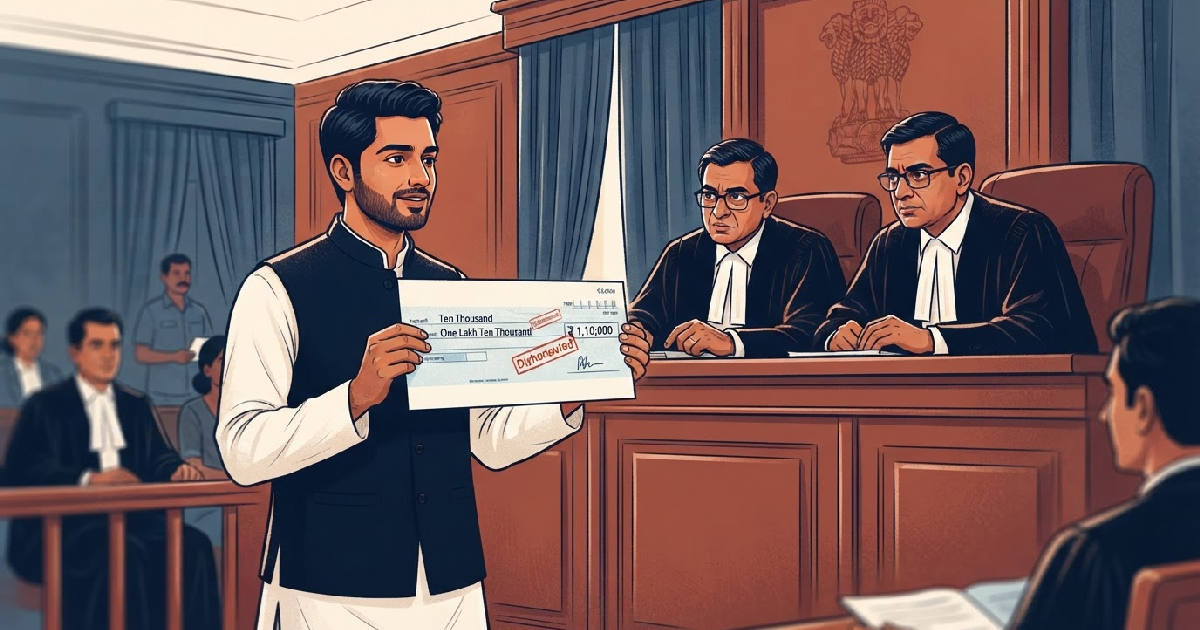
In a significant ruling, the Supreme Court of India has set aside the cheque alteration conviction of an individual named Rajasab. The apex court determined that when an alteration to a cheque is “patently clear” on its face, further evidence is not required to establish the tampering.
This decision, reported on July 25 and 26, 2026, overturns previous judgments and provides crucial clarity on cases under Section 138 of the Negotiable Instruments Act, 1881.
Supreme Court overturns cheque alteration conviction
A bench comprising Justice Sanjay Kumar and Justice Sanjeev Sachdeva delivered the judgment in the case of Rajasab v. Hulagappa. The original dispute involved a cheque that was visibly altered from an initial amount of ₹10,000 to ₹1,10,000, leading to a conviction that has now been annulled.
The Supreme Court’s decision marks a pivotal moment for jurisprudence concerning negotiable instruments. Justices Sanjay Kumar and Sanjeev Sachdeva meticulously examined the disputed cheque. They found undeniable evidence of material alteration.
This physical inspection revealed that the words “One Lak” had been interpolated before “Ten Thousand only.” Additionally, the numeral “1” was clearly inserted before “10,000” in the amount box. These changes undeniably transformed the cheque’s value from ₹10,000 to ₹1,10,000.
The Rajasab v Hulagappa ruling
The core of the Supreme Court’s reasoning centered on the patent clarity of these alterations. The bench stated that when such modifications are obvious, lower courts should not have demanded additional proof. This observation underscores a practical approach to evidence in such cases.
The ruling directly benefits Rajasab, who was previously convicted, and mandates a refund of the compensation amount. The respondent, Hulagappa, has been directed to return ₹1,10,000 to Rajasab within four weeks, reflecting the financial implications of this legal reversal.
Visible changes don’t require more proof
The Supreme Court explicitly observed that “When the alteration of the cheque is patently clear on the face of it, the Courts below ought not to have insisted on any further evidence in that regard.” This sets a clear precedent for how visible alterations should be treated in court.
The bench concluded, “The material alteration of the cheque was manifest.” This strong wording reinforces the idea that evident tampering makes the instrument invalid. It streamlines the judicial process for similar disputes going forward.
The journey through lower courts
Rajasab’s legal battle wasn’t a short one; it traversed multiple judicial tiers before reaching the Supreme Court. Each lower court had previously affirmed his conviction, despite consistent arguments about the cheque’s integrity.
This prolonged legal journey highlights the complexities and varying interpretations of cheque dishonour cases. The Supreme Court’s final verdict brings a definitive end to this particular dispute.
Trial court’s original judgment
The initial conviction of Rajasab occurred on August 11, 2014, by the Trial Court in Koppal. This court had accepted the complainant’s assertion that the cheque was legitimately issued for ₹1,10,000, overlooking the alleged alteration.
The conviction was then upheld by the District & Sessions Judge, Koppal, who dismissed Rajasab’s appeal on March 25, 2019. These rulings show a consistent failure at the lower levels to recognize the significance of the patent material alteration.
Karnataka High Court’s reduced fine
The High Court of Karnataka, Dharwad Bench, in its judgment dated April 25, 2025, also upheld the conviction. However, it did acknowledge some discrepancy by reducing the fine amount.
The High Court lowered the fine from ₹1,15,000 to ₹1,10,000. While this adjustment might have seemed a minor concession, it did not address the fundamental issue of the cheque’s material alteration, which the Supreme Court ultimately highlighted.
Understanding material alteration in negotiable instruments
The concept of material alteration is fundamental to the validity of any negotiable instrument. A cheque, as a negotiable instrument, must maintain its original form to be legally enforceable. Any unauthorized changes can render it void.
This principle safeguards the integrity of financial transactions and prevents fraudulent practices. It ensures that the instrument reflects the true intent and agreement of the parties involved.
Section 87 of the NI Act
Section 87 of the Negotiable Instruments Act, 1881, clearly states that any material alteration of a negotiable instrument renders it void. This applies to any party who did not consent to the alteration at the time it was made. It’s a cornerstone of the Act.
A material alteration is broadly defined as any change affecting the instrument’s operation. This includes modifications to the amount, date, or payee, or any change altering the rights or liabilities of the parties. Such changes fundamentally undermine the instrument’s legal effect.
RBI guidelines for cheque integrity
Adding another layer of protection, the Reserve Bank of India (RBI) has issued specific guidelines regarding cheque integrity. These guidelines, particularly those for Cheque Truncation System (CTS) cheques, prohibit any changes or corrections on cheques.
Only date validation, if necessary, is permitted. These strict rules reinforce the importance of maintaining an unaltered cheque for smooth and secure banking operations. They aim to reduce instances of fraud and disputes.
Legal precedents shaping the ruling
This latest Supreme Court decision didn’t arise in a vacuum; it builds upon a rich history of legal precedents concerning material alteration. Indian courts have consistently upheld the principle that altering key elements of a negotiable instrument can invalidate it.
These past rulings demonstrate a long-standing commitment to ensuring the authenticity and reliability of financial documents. They form the jurisprudential backbone for the current verdict.
Historical cases on altered instruments
As early as 1955, in Central Bank of India vs. Ram Narain, Indian courts established that altering a cheque’s date constitutes a material alteration. This highlights the sensitivity of even seemingly minor changes to the instrument.
More recently, the Supreme Court, in Bhaskaran Chandrasekharan v. V. Radhakrishnan, ruled that a materially altered cheque becomes void. This effectively means the holder loses the right to prosecute under Section 138. The Madras High Court also affirmed this principle regarding promissory notes, emphasizing consent as key.
The Kerala High Court, in a June 6, 2026, ruling, further reinforced this by upholding an acquittal where an unauthenticated date alteration was present. Even the Bombay High Court, on January 16, 2023, stated that a person cannot be held guilty under Section 138 if the instrument was altered without consent, a common theme in signed blank cheques cases.
Burden of proof shifts with clear alteration
While Section 139 of the NI Act usually presumes the existence of a legally enforceable debt, this presumption isn’t absolute. It’s rebuttable, meaning the accused can present credible evidence to counter it.
The Supreme Court’s current ruling strengthens this rebuttal mechanism. It emphasizes that a patently clear material alteration can, by itself, serve as sufficient evidence to invalidate the cheque. This effectively shifts the burden of proof to the prosecution to demonstrate consent for the alteration.
Implications for cheque dishonour cases
This ruling has significant implications for both complainants and defendants in cheque dishonour cases across India. It acts as a robust safeguard against potential misuse and fraud, ensuring that the legal process focuses on genuinely valid financial instruments.
The judgment emphasizes the need for meticulous scrutiny of cheques, not just their dishonour status. It reminds all parties of the importance of maintaining original documentation without unauthorized modifications.
Protecting against fraudulent claims
The Supreme Court’s decision offers a vital layer of protection against fraudulent claims. It prevents individuals from being unjustly prosecuted based on cheques that have been unilaterally altered to inflate their value.
By making it easier to challenge obviously altered cheques, the court is discouraging such practices. This supports the broader goal of maintaining integrity within the financial system and legal framework for cheque dishonour laws.
Refund orders and financial repercussions
The directive for Hulagappa to refund the ₹1,10,000 compensation to Rajasab within four weeks highlights the tangible financial consequences of this ruling. It underscores the court’s commitment to rectifying past injustices.
Rajasab also has the right to seek the release of any balance amount previously deposited in court, along with accrued interest. This provision ensures full restitution for the wrongly convicted individual, offering a clear path for recovery.
The broader legislative landscape of cheque bounce cases
Section 138 of the Negotiable Instruments Act, 1881, was enacted to promote financial discipline. It also intended to enhance the credibility of cheques as a mode of payment. It makes cheque dishonour a quasi-criminal offense, carrying significant penalties.
However, the Supreme Court’s recent judgment clarifies that this provision cannot be arbitrarily applied. It cannot be used when the very foundation of the complaint, the cheque itself, is compromised by unauthorized alterations.
Section 138 NI Act’s purpose and penalties
The NI Act, specifically Section 138, aims to transform cheque dishonour from a mere civil liability into a penal offense. This was intended to deter drawers from issuing cheques without sufficient funds. The penalties can be severe, including imprisonment up to two years or a fine up to twice the cheque amount.
Conditions for initiating action include the cheque being for a legally enforceable debt and the drawer failing to pay after receiving a demand notice. These strict provisions highlight the seriousness with which the law treats cheque bouncing.
Rebutting the presumption under Section 139
Section 139 of the NI Act places a legal presumption that the holder received the cheque for a valid debt. However, this presumption is rebuttable. The accused can demonstrate a “probable defence” with credible evidence.
The Supreme Court’s ruling strengthens this defense, especially when a material alteration is evident. It means defendants in cheque dishonour cases now have a clearer path to acquittal if they can prove unauthorized tampering, even if no additional expert testimony is presented for premature cheque bounce complaints.
Moving forward: vigilance and due diligence
This landmark decision by the Supreme Court serves as a crucial reminder for both individuals and financial institutions. Vigilance in handling negotiable instruments is paramount to avoid legal entanglements. It emphasizes the need for careful scrutiny of cheques at every stage.
For individuals, it underscores the importance of securely maintaining cheque books and promptly reporting any suspicious activity. For institutions, it reinforces the need for robust verification processes to detect alterations before processing.
The ruling also highlights the judiciary’s role in ensuring justice and preventing the exploitation of legal provisions. It prevents Section 138 from becoming a tool for complainants using fraudulently altered documents. This helps maintain public trust in the legal system’s fairness.
| Court Level | Decision Date | Original Cheque Amount | Altered Cheque Amount | Outcome for Rajasab |
|---|---|---|---|---|
| Trial Court (Koppal) | August 11, 2014 | ₹10,000 | ₹1,10,000 | Convicted |
| Appellate Court (Koppal) | March 25, 2019 | ₹10,000 | ₹1,10,000 | Conviction upheld |
| High Court (Karnataka) | April 25, 2025 | ₹10,000 | ₹1,10,000 | Conviction upheld, fine reduced to ₹1,10,000 |
| Supreme Court of India | July 25/26, 2026 | ₹10,000 | ₹1,10,000 | Conviction set aside |
What does “material alteration” of a cheque mean?
Material alteration refers to any change made to a cheque that affects its operation, such as modifying the amount, date, or payee, without the consent of the drawer. Such an alteration fundamentally changes the legal effect and integrity of the instrument, often rendering it void.
What is Section 138 of the Negotiable Instruments Act, 1881?
Section 138 of the NI Act addresses the dishonour of cheques due to insufficient funds or exceeding arrangements with the bank. It makes such an act a criminal offense, aiming to promote financial discipline and ensure the reliability of cheques as a payment method.
Why did the Supreme Court set aside Rajasab’s conviction?
The Supreme Court set aside Rajasab’s conviction because the cheque in question had a “patently clear” material alteration, visible on its face. The court ruled that when such an alteration is obvious, no further evidence is needed to prove it, thus invalidating the cheque for the purpose of a Section 138 prosecution.