
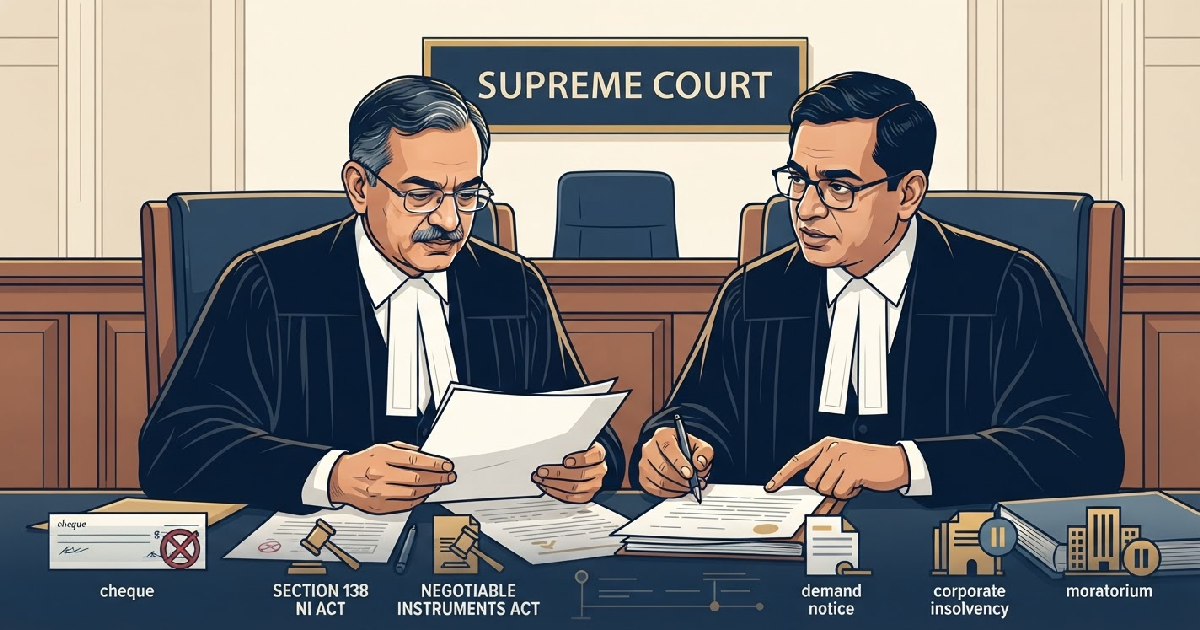
The Supreme Court clarifies that the cheque dishonour offence under Section 138 of the Negotiable Instruments Act, 1881, does not automatically arise upon cheque dishonour, as ruled on March 18, 2025. Instead, the legal cause of action for this offence materialises only if payment remains unpaid after 15 days following the receipt of a demand notice.
This pivotal decision, delivered by a bench comprising Justice Sudhanshu Dhulia and Justice Ahsanuddin Amanullah, came in the case of Vishnoo Mittal vs M/s Shakti Trading Company. It sets a crucial precedent, especially impacting cases intertwined with corporate insolvency proceedings and moratoriums.
Understanding when a cheque dishonour offence is committed
The Supreme Court’s judgment highlights a critical distinction: simply having a cheque returned unpaid doesn’t constitute a criminal offence under Section 138 NI Act. The law requires a specific sequence of events to unfold before criminal proceedings can be initiated against the drawer.
The court emphasised that the core of the offence is the failure to make payment within the stipulated 15-day period after receiving a formal demand notice. This timeframe provides a window for the drawer to rectify the situation before facing legal action, which is a key procedural safeguard.
The Vishnoo Mittal case explained
The case involved Vishnoo Mittal, who was a director of M/s Xalta Food and Beverages Private Limited. He issued cheques totalling approximately Rs 11,17,326 to M/s Shakti Trading Company, which were subsequently dishonoured on July 7, 2018.
A demand notice was issued on August 6, 2018, with the statutory 15-day payment period ending on August 21, 2018. Crucially, insolvency proceedings against M/s Xalta Food and Beverages Private Limited had already begun.
Impact of the IBC moratorium on criminal liability
A moratorium under Section 14 of the Insolvency and Bankruptcy Code, 2016 (IBC), was imposed on July 25, 2018. An interim resolution professional was appointed for the corporate debtor on the same day.
Despite this, M/s Shakti Trading Company filed a complaint under Section 138 of the NI Act against Vishnoo Mittal in September 2018. The Punjab and Haryana High Court had initially dismissed Mittal’s plea to quash these proceedings on December 21, 2021.
However, the Supreme Court ultimately sided with Mittal, quashing the cheque dishonour case against him. The Court reasoned that the cause of action for the offence, which arose on August 21, 2018, occurred after the moratorium was already in place.
This made the case legally unsustainable, as the director wouldn’t have been able to repay the amount during the moratorium period. This ruling reinforces the protective shield an IBC moratorium offers to corporate debtors and their directors.
Procedural requirements for Section 138 NI Act cases
The Supreme Court’s decision reiterates the strict procedural requirements that must be met to establish a valid cheque dishonour case. These steps are crucial for protecting both the payee and the drawer in commercial transactions.
Understanding these steps is vital for anyone involved in financial dealings where cheques are used. It underlines the importance of adhering to legal timelines and communication protocols to avoid complications.
Key steps before filing a complaint
For an offence under Section 138 to be properly constituted, several conditions must be fulfilled. First, a cheque must have been issued for a legally enforceable debt or liability and then dishonoured, typically due to insufficient funds or exceeding arrangements.
Second, the payee must send a written demand notice to the drawer within 30 days of receiving official intimation of the cheque’s dishonour from the bank. This notice formally requests the payment of the cheque amount.
Third, the drawer is given a 15-day window from the date of receiving the demand notice to make the payment. The offence under Section 138 is considered complete only if the drawer fails to make this payment within this specific grace period.
The critical 15-day notice period
The 15-day notice period isn’t just a formality; it’s a fundamental element that defines when criminal liability under Section 138 actually begins. If payment is made within these 15 days, no offence is deemed to have occurred, and no complaint can be filed.
This statutory period provides a final opportunity for the drawer to avoid criminal prosecution. It essentially transforms a civil default into a criminal one only after a clear refusal or inability to pay following formal notification.
Therefore, the cause of action for initiating legal proceedings arises precisely on the 16th day after the demand notice is received and payment remains outstanding. A complaint must then be filed before a Judicial Magistrate of the First Class within one month from that date.
Evolution of India’s cheque dishonour laws
The Negotiable Instruments Act, 1881, is one of India’s foundational commercial laws, predating India’s independence. It was enacted to provide a structured legal framework for instruments like promissory notes, bills of exchange, and cheques, facilitating smooth trade and commerce.
Initially, the Act lacked specific provisions to address cheque dishonour as a criminal offense. This changed with significant amendments much later, reflecting evolving financial practices and legal needs in the Indian economy.
Major legislative amendments to Section 138
Section 138 was specifically introduced into the NI Act by the Banking, Public Financial Institutions and Negotiable Instruments Laws (Amendment) Act, 1988, which came into force on April 1, 1989. This marked a pivotal shift, making cheque dishonour a criminal act punishable by law.
Subsequent amendments have further refined and strengthened the law. These legislative changes demonstrate a continuous effort to enhance the efficacy of cheques as reliable financial instruments and deter fraudulent practices.
| Year | Amendment Introduced | Key Change |
|---|---|---|
| 1989 | Section 138 NI Act | Cheque dishonour established as a criminal offence; maximum 1 year imprisonment |
| 2002 | Negotiable Instruments (Amendment and Miscellaneous Provisions) Act | Imprisonment extended to 2 years; offenses made compoundable (Section 147) |
| 2015 | Negotiable Instruments (Amendment) Act | Clarified territorial jurisdiction for complaints (Section 142(2)) |
| 2018 | Negotiable Instruments (Amendment) Act | Enabled interim compensation (Section 143A) and appeal deposit (Section 148) |
Purpose of criminalising cheque dishonour
The primary objective behind introducing and strengthening Section 138 was to instill greater trust and credibility in cheques within the financial system. It aimed to deter individuals from issuing cheques without sufficient funds, ensuring promptness and honesty in commercial transactions.
By attaching criminal liability, the legislature sought to provide a more robust mechanism for creditors to recover dues. This fosters a more secure environment for trade and business, blending punitive measures with a compensatory aspect.
Judicial precedents shaping cheque dishonour law
The Supreme Court has consistently issued rulings that have refined the understanding and application of Section 138, ensuring its provisions are applied stringently yet fairly. These judgments underscore the need for meticulous adherence to procedural steps and legal nuances.
These judicial clarifications play a vital role in guiding lower courts and legal practitioners. They help streamline the adjudication process and prevent any potential misuse of the law, ensuring legal certainty.
Strict compliance with notice and jurisdiction
One recurring theme in Supreme Court judgments is the insistence on the strict observance of the notice period. In Yogendra Pratap Singh v. Savitri Pandey (2014), the Court ruled that a complaint filed before the mandatory 15-day notice period expires is not maintainable. This reinforces the principle against premature cheque bounce complaints.
Moreover, the Court has been equally stringent regarding the content of the demand notice. In Kaveri Plastics v. Mahdoom Bawa Bahrudeen Noorul (2025), it was held that even a “typographical error” leading to a discrepancy in the demanded amount could invalidate the notice. The demand must precisely match the cheque amount.
Another area of clarification has been territorial jurisdiction. The Supreme Court has ruled that complaints under Section 138 must be heard by the court within the territorial jurisdiction of the payee’s home bank branch. This centralises the legal process for the aggrieved party, preventing forum shopping, as specified in earlier rulings on cheque bounce jurisdiction.
Re-presentation of cheques and multiple complaints
The Court has also addressed the practice of re-presenting a dishonoured cheque. It confirmed that re-presenting a dishonoured cheque within its validity period, followed by another dishonour, can create a fresh cause of action. This allows for a new statutory demand notice and subsequent legal action.
Additionally, a Supreme Court bench comprising Justices Sanjay Karol and Prashant Kumar Mishra ruled on January 29, 2026, that multiple complaints under Section 138 NI Act, stemming from the dishonour of several cheques from the same transaction, do not inherently constitute an abuse of process. Each dishonoured cheque can create a distinct and independent cause of action.
Implications for creditors and the judicial system
This latest ruling by the Supreme Court carries significant implications for both creditors seeking to recover dues and corporate entities facing financial distress. It mandates a careful consideration of legal timelines, particularly when insolvency proceedings are underway.
For corporate debtors, the imposition of a moratorium now acts as a definitive barrier to initiating Section 138 proceedings, offering a period of reprieve from such criminal actions. This aligns with the broader goal of the IBC to facilitate corporate resolution rather than individual criminal prosecution during a vulnerable phase.
Addressing India’s high pendency of cases
The Indian judicial system grapples with a massive backlog of cheque dishonour cases. As of December 18, 2024, approximately 43 lakh (4.3 million) cheque bounce cases were pending across various courts in India. Rajasthan accounted for the highest number with over 6.4 lakh cases.
Maharashtra, Gujarat, Delhi, Uttar Pradesh, and West Bengal are also listed among the states with high numbers of pending cases, though specific figures for these states were not provided. This high pendency stresses judicial resources and delays justice for many.
This ruling, by establishing a clearer definition of when an offence truly arises, could help in filtering out prematurely filed complaints or those that conflict with insolvency moratoriums. While it might not drastically reduce the overall number, it ensures that only procedurally sound cases proceed.
The Supreme Court has previously taken steps to expedite these cases, including forming committees and proposing special courts. Technology-oriented guidelines, issued in October 2025, also aim to streamline service and settlement through digital mechanisms like WhatsApp and UPI links, reflecting a concerted effort to manage the immense volume of cases.
Looking ahead: streamlining legal processes
This Supreme Court ruling marks another step towards refining the procedural landscape surrounding cheque dishonour cases. It underscores the judiciary’s commitment to clarity and fairness in the application of the law, especially where it intersects with other critical legal frameworks like insolvency.
The clear demarcation of when the cause of action arises will undoubtedly reduce litigation based on premature complaints, saving valuable court time. It also provides a stronger defense for individuals embroiled in corporate insolvency. Such clarity is vital for business confidence and legal predictability.
Future legislative or judicial interventions may continue to focus on accelerating the disposal of these cases, possibly through more widespread adoption of technology and specialised courts. These ongoing efforts reflect a push towards a more efficient and predictable legal environment for financial transactions in India.
What is Section 138 of the Negotiable Instruments Act?
Section 138 of the Negotiable Instruments Act, 1881, deals with the criminal offence of cheque dishonour. It makes the drawer of a cheque liable for prosecution if the cheque is returned unpaid due to insufficient funds and they fail to make payment after receiving a legal demand notice.
When does the offence under Section 138 actually arise?
According to the Supreme Court’s ruling, the offence under Section 138 does not arise merely upon the cheque’s dishonour. It is only constituted when the drawer fails to make the payment within 15 days of receiving a demand notice from the payee.
How does an insolvency moratorium affect a cheque dishonour case?
An insolvency moratorium imposed under the IBC can prevent a Section 138 NI Act case from proceeding against the director of a corporate debtor. If the cause of action for the cheque dishonour (i.e., the expiry of the 15-day notice period without payment) falls within the moratorium period, the case against the director may be quashed.