
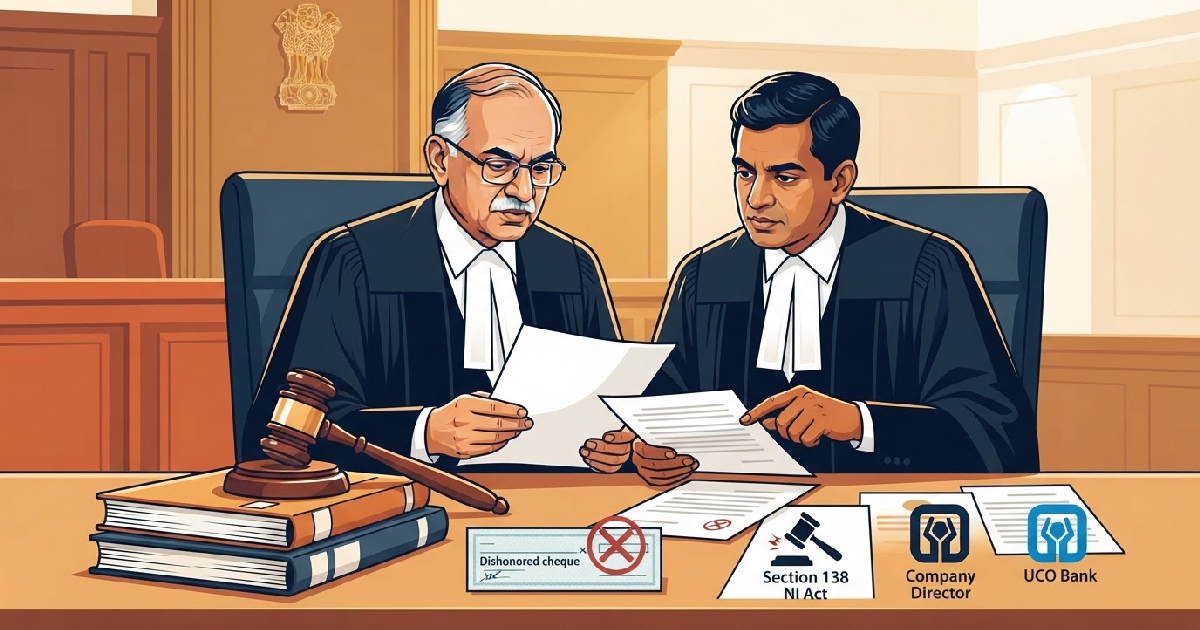
The Supreme Court is deciding if an IBC moratorium bars cheque bounce cases against directors under Section 138 of the NI Act.
This crucial referral, issued on May 27, 2026, by a bench comprising Justice J.B. Pardiwala and Justice K.V. Viswanathan, aims to provide an authoritative pronouncement on conflicting judicial interpretations.
Director liability in IBC moratorium cheque bounce cases
The decision stems from the case of Dineshchand Surana v. UCO Bank, where former Managing Director of Surana Power Ltd., Dineshchand Surana, faced a cheque dishonour complaint while personal insolvency proceedings were in motion. The Court is wrestling with the delicate balance between safeguarding distressed entities and upholding accountability for financial misconduct, especially concerning the personal liability of directors.
The referral highlights a persistent legal challenge: how do India’s insolvency statutes interact with laws designed to enforce financial discipline? The bench of Justice J.B. Pardiwala and Justice K.V. Viswanathan acknowledged the deep inconsistencies that have surfaced in various courts, including within Supreme Court precedents. This has made a more definitive pronouncement imperative.
This isn’t merely a procedural matter; the outcome will significantly affect directors of companies undergoing insolvency, creditors seeking their dues, and the broader stability of the financial system. The Court noted that while the criminal liability of directors under the NI Act is generally accepted, its precise interplay with an insolvency moratorium remains a complex and unresolved area.
Background of the Dineshchand Surana case
The impetus for this critical referral originated from the specifics of the Dineshchand Surana v. UCO Bank case. UCO Bank had initiated a cheque dishonour complaint against Dineshchand Surana. This followed the dishonour of a cheque for Rs. 5,03,21,250/-.
The cheque, dated March 26, 2015, was issued towards dues after the devolvement of an inland letter of credit for coal purchases. It was subsequently dishonoured on June 18, 2015, due to “Funds Insufficient.”
A statutory notice was issued to Surana on June 23, 2015, and when payment was not received, the bank filed a complaint under Section 138 NI Act before the Metropolitan Magistrate at Eg.
Core legal questions for the larger bench
The referring bench has articulated two primary questions for the larger three-judge bench to address. First, they ask whether proceedings under Section 138 of the NI Act are primarily quasi-criminal with a dominant criminal character, even if they arise from a civil debt dispute. This delves into the fundamental nature of the offense.
Second, the bench seeks to determine if the moratorium provisions under Part III of the IBC (Sections 96 and 101) should apply to the entirety of Section 138 proceedings, or only to their compensatory and recovery-related aspects. These questions are central to reconciling criminal accountability with insolvency protection.
Section 138 NI Act: Navigating the quasi-criminal framework
Section 138 of the Negotiable Instruments Act, 1881, is a cornerstone of India’s commercial law, specifically designed to foster confidence in cheque transactions. Introduced through a 1988 amendment, it criminalizes the dishonour of cheques under specific circumstances, mainly when a cheque bounces due to insufficient funds in the drawer’s account.
This provision acts as a significant deterrent against financial imprudence and protects payees from losses resulting from unpaid cheques. Its categorization as “quasi-criminal” has ignited considerable debate, particularly when juxtaposed with other legal frameworks like insolvency law. Understanding the legal framework for cheque dishonour cases in India is crucial here.
Dual nature: criminal penalties and compensatory aims
Courts have frequently described Section 138 offenses as a “civil wrong with criminal overtones.”
This hybrid nature means the underlying dispute originates from a civil debt, but the law imposes criminal penalties, such as imprisonment for up to two years or a fine up to twice the cheque amount, to compel payment and maintain commercial integrity.
It’s a statutory offense, not an offense under the Indian Penal Code, yet it carries serious consequences.
The referring bench in Dineshchand Surana explicitly expressed reservations about the “civil sheep in a criminal wolf’s clothing” characterization from an earlier Supreme Court judgment in P. Mohanraj. They emphasized that the predominantly criminal and deterrent facets of Section 138 might not have been fully acknowledged in previous rulings. This suggests a potential re-evaluation of its fundamental nature by the larger bench.
Judicial evolution on cheque dishonour proceedings
Before the landmark P. Mohanraj Supreme Court judgment in 2021, various High Courts and the National Company Law Appellate Tribunal (NCLAT) held differing opinions on whether the IBC moratorium applied to Section 138 proceedings. Courts in Bombay, Calcutta, and Madras had ruled that the moratorium did not bar criminal proceedings under Section 138, emphasizing their criminal nature.
The NCLAT, in Shah Brothers Ispat Pvt. Ltd. v. P. Mohanraj (July 31, 2018), initially stated that Section 138 proceedings were penal and not covered by the Section 14 moratorium, as they weren’t considered “money claims” or “recovery against the Corporate Debtor.” This historical context underscores the long-standing ambiguity that the Supreme Court now seeks to resolve.
IBC moratorium: its protective shield and limitations
The Insolvency and Bankruptcy Code (IBC), 2016, fundamentally changed India’s approach to resolving corporate and individual insolvency. A central element of the IBC is the imposition of a moratorium period once an insolvency process commences. This moratorium effectively freezes certain legal actions against the debtor, providing essential breathing room for restructuring or liquidation efforts.
The intention behind this protective measure is to prevent a disorderly rush by creditors and facilitate an organized resolution process. This process aims to maximize the value of assets and ensure a fair distribution among all stakeholders. The moratorium is crucial for keeping the debtor’s assets intact and preventing their dissipation during the resolution phase.
Corporate insolvency under Section 14
Under Section 14 of the IBC, a moratorium takes effect once an application for a Corporate Insolvency Resolution Process (CIRP) against a corporate debtor is admitted by the National Company Law Tribunal (NCLT). During this period, no new suits can be filed, nor can existing suits or proceedings be continued against the corporate debtor.
This also encompasses the enforcement of security interests, transfer of assets, and recovery of property against the company.
The moratorium applies strictly to the corporate entity itself, with the goal of ensuring its continuity as a going concern, thereby safeguarding employment and economic activity. However, the extent to which it should apply to the personal liability of directors has been a contentious issue. The Supreme Court has also made rulings impacting NI Act trials in other areas.
Personal insolvency: Sections 96 and 101
Part III of the IBC governs insolvency resolution and bankruptcy for individuals and partnership firms. Sections 96 and 101 outline the interim moratorium and moratorium provisions, respectively, in personal insolvency cases. An interim moratorium under Section 96 automatically begins upon the filing of an insolvency application by or against an individual debtor.
This temporary freeze prevents creditors from initiating or continuing legal action, including proceedings under the NI Act, against the individual debtor. Once the application is admitted, a full moratorium under Section 101 commences. The extent to which these personal moratorium provisions should shield a director from Section 138 NI Act proceedings is precisely what the Supreme Court’s larger bench will now deliberate.
Conflicting interpretations and the path forward
The legal landscape concerning the interplay between the IBC and the NI Act has historically been complex, marked by evolving interpretations and divergent views across various judicial bodies. This enduring ambiguity is a key factor driving the Supreme Court’s decision to refer the matter to a larger bench, seeking a conclusive resolution to the long-standing uncertainty.
The Court has previously clarified that a temporary moratorium for personal insolvency (Section 96 IBC) does not pause criminal prosecution under Section 138 of the NI Act against individuals, as seen in Rakesh Bhanot v. Gurdas Agro Pvt Ltd (April 1, 2025). This ruling underscored the personal nature of criminal liability, preventing individuals from using insolvency as a shield.
Revisiting the *P. Mohanraj* characterisation
A significant precedent was set by the Supreme Court’s three-judge bench ruling in P. Mohanraj v. Shah Brothers Ispat Pvt. Ltd. on March 1, 2021. In that landmark decision, the Court affirmed that the moratorium under Section 14 of the IBC *does* apply to proceedings under Section 138 of the NI Act, but *only* against the corporate debtor.
The Court famously characterized Section 138 proceedings as a “civil sheep in a criminal wolf’s clothing,” highlighting their compensatory aspect. Crucially, P. Mohanraj explicitly stated the moratorium would *not* extend to protect directors or other natural persons vicariously liable under Section 141 of the NI Act.
This distinction allowed criminal proceedings against individuals to proceed, even if the company was under insolvency, underscoring the complexities of Section 138 NI Act explained through key rulings.
Distinguishing criminal and compensatory aspects
The referring bench has proposed a two-tier understanding of Section 138 proceedings: a mandatory criminal aspect and a discretionary compensatory aspect. They believe the moratorium under Part III of the IBC *cannot* apply to the criminal aspect, as this would enable evasion of criminal liability. The criminal aspect includes potential imprisonment or fines.
However, the compensatory aspect, being civil in nature and directly affecting the financial recovery for creditors, might fall under the moratorium’s ambit. This nuanced approach suggests the larger bench will consider separating the punitive elements from the debt recovery elements within cheque dishonour cases.
Implications for corporate governance and financial stability
This referral to a larger bench carries substantial implications for corporate governance, the responsibilities of company directors, and overall financial stability in India. A definitive ruling will clarify the extent of personal liability for directors when their companies face insolvency, potentially strengthening the deterrent effect of the NI Act.
For creditors, a clear stance on the interplay between these laws will offer greater predictability in recovering dues, impacting commercial confidence. The Supreme Court’s eventual pronouncement will refine the balance between corporate rescue and individual accountability, a critical step for India’s evolving economic framework.
| Legal Provision | Nature of Proceeding | Applicability during Moratorium (Corporate Debtor) | Applicability during Moratorium (Director Liability) |
|---|---|---|---|
| Section 138 NI Act | Quasi-criminal (compensatory and punitive) | Generally barred (per P. Mohanraj) | Under Review by Larger Bench |
| Section 141 NI Act | Vicarious Liability for Directors | N/A (applies to individuals) | Under Review by Larger Bench |
| IBC Section 14 (Corporate) | Moratorium for Corporate Debtor | Bars proceedings against corporate debtor | Does not protect directors directly |
| IBC Sections 96, 101 (Personal) | Moratorium for Individual Debtor | N/A (applies to individuals) | Does not bar criminal prosecution (per Rakesh Bhanot) |
What is the primary purpose of an IBC moratorium?
The main purpose of an Insolvency and Bankruptcy Code (IBC) moratorium is to provide a temporary halt to all legal actions, suits, and proceedings against a distressed debtor, whether corporate or individual. This “breathing space” allows for focused restructuring or resolution processes without the pressure of ongoing litigation, aiming to maximize asset value and ensure fair distribution to creditors.
Are company directors automatically protected from cheque dishonour cases under an IBC moratorium?
Not automatically. While the Section 14 moratorium typically bars proceedings against a corporate debtor, the Supreme Court in P. Mohanraj held it doesn’t automatically shield directors or individuals vicariously liable under Section 141 of the NI Act. The current referral to a larger bench aims to definitively clarify the extent of this protection for directors during an IBC moratorium, especially concerning personal insolvency.
How does the IBC’s personal insolvency moratorium under Sections 96 and 101 differ from corporate insolvency?
The IBC’s personal insolvency moratorium, governed by Sections 96 and 101, applies to individuals and partnership firms, preventing legal actions against them. Corporate insolvency under Section 14 applies to companies.
While both provide a legal pause, their scope and the specific provisions that govern them differ based on whether the debtor is an individual or a corporate entity. The Supreme Court has specified that Section 96 does not pause criminal prosecution under Section 138 of the NI Act against individuals.