
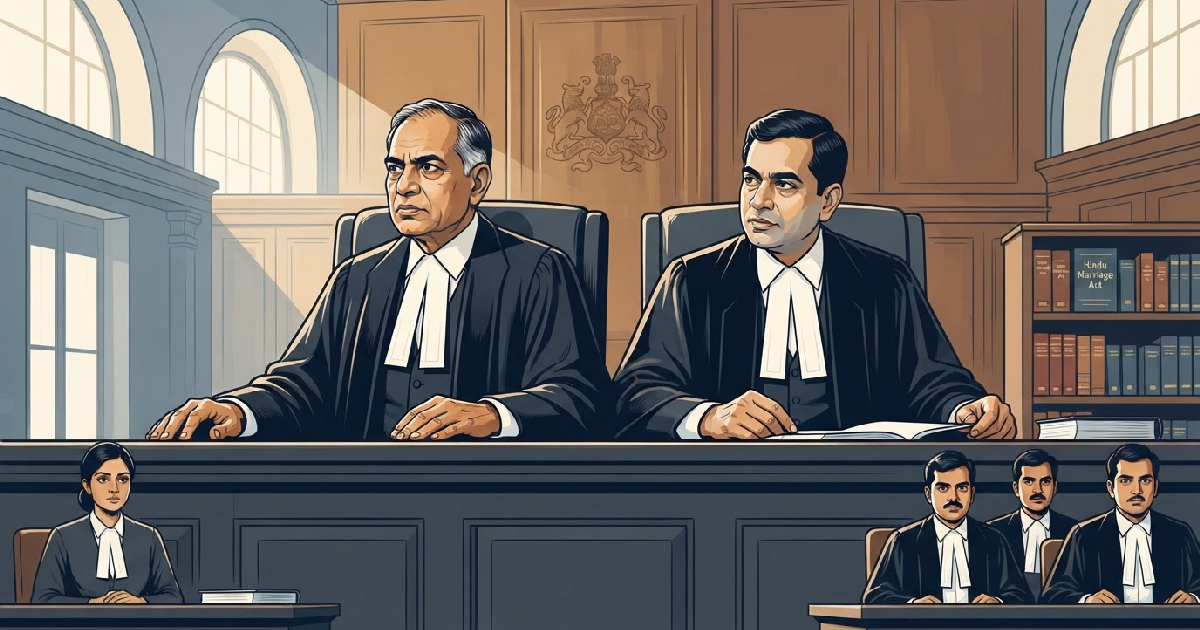
The Karnataka High Court recently delivered a significant ruling on July 15, 2026, dismissing a husband’s appeal for divorce in a marriage spanning 21 years. The court unequivocally stated that merely losing interest in a marital relationship does not constitute a valid ground for dissolution under the Hindu Marriage Act. This important Karnataka High Court divorce ruling reinforces the legal sanctity of marriage in India.
A Division Bench, comprising Justice D. K. Singh and Justice T. M. Nadaf, emphasized that marriage is considered a lifelong commitment, not a contractual arrangement that can be abandoned due to a change of heart. The ruling underscores a fundamental principle of Indian matrimonial law: individuals cannot benefit from their own conduct to secure a divorce decree.
Upholding Marital Commitments in Indian Law
The case centred on a husband seeking to end his 21-year inter-caste love marriage, which began in December 2003 and produced an almost adult daughter. His primary contention was a loss of interest, a claim the High Court found insufficient to justify divorce. This decision aligns with broader judicial efforts to protect the institution of marriage from unilateral disinterest.
The 21-year marriage and initial petition details
The legal journey for the couple, identified as M. v. B. M B. under Case Number MFA No. 4343 of 2026, began when the husband filed for divorce under Section 13(1A) of the Hindu Marriage Act. In response, his wife filed a counter-petition seeking restitution of conjugal rights, a legal mechanism aimed at compelling spouses to resume matrimonial cohabitation.
The complexity of these intertwined petitions highlighted deep fissures within their relationship, but the legal framework requires more than just dissatisfaction. The court has a long-standing view on the nature of marital obligations, a perspective that guides many of its decisions.
Family Court’s original decision and subsequent appeal
The Family Court in Mysuru initially heard both petitions concurrently. After a thorough examination of the evidence presented, the III Additional Principal Judge, Family Court, Mysuru, allowed the wife’s plea for restitution of conjugal rights and rejected the husband’s divorce petition. The court found that the allegations made by the husband against his wife lacked sufficient substantiation.
Unsatisfied with this outcome, the husband proceeded to appeal the Family Court’s decision to the Karnataka High Court. His argument pivoted on the assertion that despite the earlier decree, the parties had continued to live separately. He maintained that their marital life had effectively broken down, rendering reconciliation impossible.
However, the wife vehemently denied these claims during the appeal. She asserted that she had consistently cared for her husband and his parents. She also stated that she never insisted on living separately and had not behaved in any manner that would make cohabitation unfeasible. Her testimony painted a picture of a spouse willing to maintain the marriage.
Judicial Scrutiny of Divorce Grounds in India
The Division Bench, in its ruling, made it clear that a person cannot “take advantage of their own conduct to secure a decree of divorce under the Hindu Marriage Act.” This pivotal observation reinforces the principle that one cannot create grounds for divorce through their own actions or inactions. It suggests that individuals should not be rewarded for fostering estrangement.
Further, the court delivered a powerful statement on the enduring nature of marriage under Hindu law. They remarked, “Once the parties are married, the marriage is for life and one person cannot walk away from the marriage on the ground that he/she is left with no interest in the marriage with the other party.”
This highlights the judicial view of marriage as a sacred and permanent bond, rather than a temporary arrangement.
Fault-based system under Hindu Marriage Act
India’s legal framework for divorce, particularly for Hindus, is rooted in the Hindu Marriage Act, 1955 (HMA). This Act provides specific fault-based grounds upon which a marriage can be dissolved. Unlike some Western legal systems, merely falling out of love or losing interest isn’t typically a standalone reason to seek a divorce here.
The Act introduced the concept of divorce into Hindu matrimonial law, moving away from a purely sacramental view of marriage. It outlines precise circumstances under which a petitioner must prove one or more specific legal grounds. This system places the burden of proof on the spouse seeking the divorce to demonstrate a defined “fault” by the other party.
Grounds under the Hindu Marriage Act, 1955
Under Section 13(1) of the HMA, a spouse can petition for divorce on several distinct grounds. These include adultery, where one spouse engages in voluntary sexual intercourse outside the marriage. Cruelty, another significant ground, encompasses both physical violence and mental suffering that makes continued cohabitation unbearable.
Desertion is also a recognized ground, requiring one spouse to have abandoned the other without reasonable cause, consent, or intention to return for a continuous period of at least two years. Other grounds include conversion to another religion, incurable unsoundness of mind or mental disorder, suffering from a virulent and incurable venereal disease or leprosy, and renunciation of the world by entering a religious order.
Importantly, the HMA does not list “loss of interest” as any of these statutory grounds. This omission is central to the Karnataka High Court’s recent ruling. However, the Act also provides for divorce by mutual consent under Section 13B, allowing both parties to agree to dissolve the marriage after living separately for a year, though this still requires mutual agreement.
The Evolving Debate on Irretrievable Breakdown
While the Hindu Marriage Act specifies fault-based grounds, Indian jurisprudence has gradually acknowledged the concept of “irretrievable breakdown of marriage” (IBM). This refers to a situation where a marriage has deteriorated to such an extent that there is no reasonable prospect of reconciliation, regardless of who is at fault. It represents a practical acknowledgment that some marriages simply cannot be saved.
However, IBM is not explicitly codified as a statutory ground in the HMA. This creates a dichotomy where lower courts, including High Courts, must adhere strictly to the listed fault-based grounds, while the Supreme Court has greater latitude. The distinction is crucial for understanding why a “loss of interest” claim might succeed at the highest court but fail at the High Court level.
Supreme Court’s unique Article 142 powers
The Supreme Court of India holds extraordinary powers under Article 142 of the Constitution, allowing it to pass any decree or order necessary “for doing complete justice in any cause or matter pending before it.”
This unique authority enables the Supreme Court to grant a divorce on the ground of IBM, even if one party opposes it and statutory requirements are not fully met. It’s a power not available to High Courts or Family Courts, which remain bound by the specific provisions of the HMA.
Several landmark Supreme Court rulings have shaped the understanding and application of IBM. In Naveen Kohli v. Neelu Kohli (2006), the Supreme Court recognized IBM as a valid ground and recommended that the legislature amend the HMA to include it.
More recently, in Shilpa Sailesh v. Varun Sreenivasan (May 1, 2023), a Constitution Bench clarified that the Supreme Court can directly exercise its Article 142 powers to dissolve a marriage on IBM.
This can happen even if statutory requirements are not fully satisfied, by considering factors such as the duration of separation, the possibility of reconciliation, and the welfare of the spouses and children involved.
High Court’s adherence to statutory grounds
High Courts, including the Karnataka High Court, do not possess the Supreme Court’s inherent power under Article 142. They are strictly bound by the statutory grounds for divorce as enumerated in the Hindu Marriage Act, 1955. Therefore, a petitioner before a High Court must prove a specific fault (like cruelty, adultery, or desertion) as defined by law.
This structural difference means that while the spirit of justice may influence a High Court’s decision, it cannot override the letter of the law in the same way the Supreme Court can.
The law often needs to adapt to modern realities, and even the process of obtaining a divorce has evolved in India, particularly for NRIs seeking to dissolve marriages from abroad, with courts increasingly using technology to facilitate these proceedings.
Implications for Divorce Seekers in Karnataka
The Karnataka High Court’s recent judgment sends a clear message to individuals contemplating divorce: personal feelings of disinterest, without proven statutory grounds, will not be sufficient. It places a significant emphasis on the existing provisions of the Hindu Marriage Act, requiring petitioners to demonstrate adultery, cruelty, desertion, or other recognized faults.
For couples in Karnataka, this means that pursuing divorce solely based on a change of heart is unlikely to succeed. The ruling encourages reconciliation and highlights the legal system’s reluctance to easily dissolve long-standing marriages. It also means that legal counsel will need to carefully assess if a case fits within the defined legal grounds, rather than relying on subjective marital dissatisfaction.
Context of previous Karnataka High Court rulings
The Karnataka High Court has a history of rulings that underscore the sanctity and permanence of Hindu marriage. On December 25, 2025, a Division Bench of Justice Jayant Banerji and Justice Umesh M Adiga declined to grant a divorce to a woman who had alleged cruelty.
The bench reiterated that Hindu marriage is considered a sacred and enduring relationship, not a casual contract, and found her cruelty allegations to be unsubstantiated.
Another notable instance occurred on October 22, 2025, when the High Court dismissed a man’s divorce appeal that was also based on claims of cruelty. The court found that the issues raised were trivial and could have been resolved through discussion.
However, the court has also shown flexibility in procedural matters, such as allowing video conferencing for a senior citizen widow to record evidence from abroad.
The Karnataka High Court’s role in the judicial hierarchy
The High Court of Karnataka serves as the highest judicial authority within the state of Karnataka. Its principal bench is located in Bengaluru, with additional benches in Hubballi-Dharwad and Kalaburagi, ensuring regional access to higher justice. As of February 2022, the court operated with 45 judges against a sanctioned strength of 62, managing a substantial caseload.
Under the leadership of Chief Justice Vibhu Bakhru since July 19, 2025, the Karnataka High Court exercises superintendence over all courts and tribunals within the state, excluding those of the armed forces. It hears appeals against judgments from lower courts, a role that was further clarified when the court upheld the Civil Courts Act, shifting certain appeals to district courts.
Divorce Grounds Comparison
Understanding the distinctions between various divorce grounds, particularly within the Indian legal system, is crucial. The table below illustrates the applicability of different reasons for divorce across the Hindu Marriage Act and how they are typically viewed by the Karnataka High Court.
| Ground for Divorce | Recognized under Hindu Marriage Act, 1955? | Karnataka High Court’s General Stance |
|---|---|---|
| Adultery | Yes (Section 13(1)(i)) | Granted if proven with evidence. |
| Cruelty (Physical or Mental) | Yes (Section 13(1)(ia)) | Granted if the conduct makes cohabitation unbearable. |
| Desertion (2+ years) | Yes (Section 13(1)(ib)) | Granted if proven and continuous for statutory period. |
| Irretrievable Breakdown of Marriage | No (Judicially recognized by Supreme Court only) | Not a direct statutory ground for High Courts. |
| Loss of Interest in Marriage | No | Not a valid standalone ground. |
What was the core ruling by the Karnataka High Court?
The Karnataka High Court ruled that a husband cannot obtain a divorce simply because he has “lost interest” in his marriage. The court emphasized that marriage is a lifelong commitment under Hindu Law and not a contract that can be ended unilaterally due to a change of heart.
What are the statutory grounds for divorce under the Hindu Marriage Act?
The Hindu Marriage Act, 1955, outlines specific fault-based grounds such as adultery, cruelty (physical or mental), desertion for at least two years, conversion to another religion, incurable mental disorder, or suffering from a virulent and incurable disease. “Loss of interest” is not among these grounds.
How does the Supreme Court’s power differ from the High Court on divorce matters?
The Supreme Court of India can grant divorce on the ground of “irretrievable breakdown of marriage” using its special powers under Article 142 of the Constitution, even if one party opposes it. High Courts, however, are bound to the specific statutory grounds listed in the Hindu Marriage Act and cannot invoke this broader doctrine for divorce.