
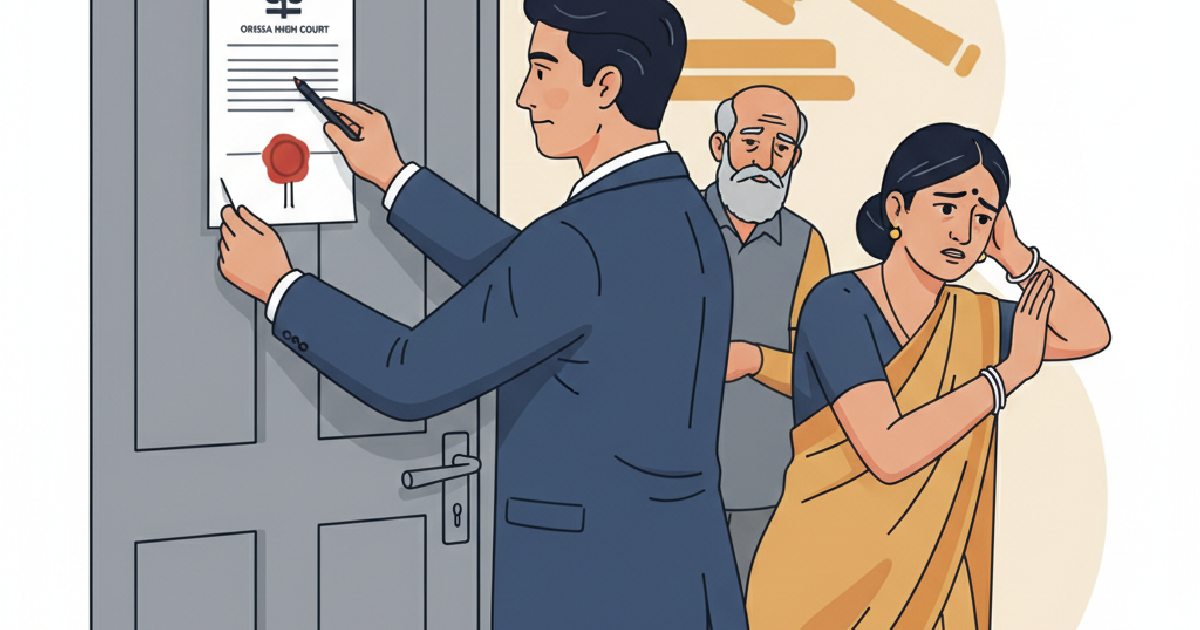
The Orissa High Court has clarified that the refusal by family members to accept a court notice, when followed by the proper procedural steps, constitutes valid and sufficient service. This ruling ensures that litigants cannot stall judicial proceedings by intentionally avoiding summons, reinforcing the principle that the wheels of justice must keep turning even when a party is obstructive.
In a detailed judgment, the court noted that when an addressee or their household refuses to receive service and the notice is subsequently affixed to a conspicuous part of the residence, a legal presumption of service arises.
Legal framework for service of notice in Orissa
This interpretation draws from a combination of the Code of Civil Procedure (CPC), the Indian Evidence Act, and the General Clauses Act, effectively closing a loophole often exploited in matrimonial and civil disputes. The decision, delivered by the Orissa High Court in Cuttack on April 6, 2026, stemmed from the case of Smt. Sunita Nayak vs Anup Kumar Tota.
The core principle articulated by the bench, comprising Hon’ble Mr. Justice Manash Ranjan Pathak and Hon’ble Mr. Justice Sibo Sankar Mishra, underlines that when an addressee refuses to receive summons or notice, and it is subsequently affixed to a visible part of their house, the Court can presume valid and sufficient service. This judicial stance is a critical aspect of ensuring that legal processes are not obstructed by deliberate evasions.
The foundation of deemed service
The court’s decision relies heavily on the procedural safeguards outlined in the Code of Civil Procedure, 1908. Specifically, Order V Rule 17 of the CPC provides a clear mechanism for when a defendant or their agent refuses to sign an acknowledgment of a summons. This rule is crucial in family law cases, where emotions often run high and parties may attempt to avoid engagement with the legal system.
In such instances, the serving officer is permitted to fix a copy of the summons on the outer door or another visible part of the premises where the person ordinarily resides or works. Once this “affixture” is complete and a detailed report is returned to the court, the service is deemed legally effective. The bench observed that conduct indicating deliberate avoidance, such as family members turning away a messenger, cannot be allowed to defeat the process of law.
Citing established legal precedents and acts
The legal basis for this presumption of valid service is multi-faceted. It is primarily derived from Illustration (f) of Section 114 of the Indian Evidence Act, which allows courts to presume the existence of certain facts. In this context, it permits a court to presume that a notice sent by post and returned as refused was indeed refused by the addressee. The ruling also integrates Section 27 of the General Clauses Act, which details the presumption of service in cases of postal delivery.
Furthermore, Order V Rule 9(5) and Order V Rule 17 of the Code of Civil Procedure are central to this judicial interpretation. These rules define the procedures for service and specify what constitutes valid service when personal delivery is complicated by refusal. This comprehensive legal backing underscores the robustness of the court’s position.
The case of Smt. Sunita Nayak vs Anup Kumar Tota
The specific facts of Smt. Sunita Nayak vs Anup Kumar Tota (MATA No. 154 of 2015) illustrate the practical application of this principle. The case involved an appeal by the appellant-wife challenging a Family Court judgment from May 18, 2015, which had dissolved her marriage. Fresh notice was issued to the respondent-husband through Speed Post with Acknowledgement Due and a Special Messenger.
The Special Messenger’s report chronicled what followed: upon reaching the respondent’s residence, family members present explicitly refused to accept the notice. They instructed the messenger to leave with the document. Consequently, following established procedure, the notice was then affixed to the outer door/grill of the respondent’s home. Two witnesses were present during this process, and a report detailing these events was submitted to the court.
Challenges of deliberate avoidance
The High Court carefully considered the implications of such refusal. It noted that the method of service employed, including affixture after refusal, is expressly recognized and validated under Order V Rule 17 CPC. The court highlighted that endorsements like “Left,” when coupled with a clear refusal by family members and subsequent affixture, strongly suggest a deliberate attempt by the respondent to avoid service. This conduct, the court emphasized, cannot be allowed to undermine the judicial process.
This situation often arises in complex family law disputes, where one party may try to delay proceedings by feigning ignorance or actively refusing to accept legal documents. The Orissa High Court’s ruling provides clarity and a firm stance against such tactics, ensuring that justice is not unduly deferred.
Broader implications for judicial process and litigants
This ruling from the Orissa High Court carries significant implications for civil and family law cases across India. It reinforces the general principle that once a notice is properly dispatched to a correctly addressed recipient, a presumption of due service arises. Actual physical receipt by the addressee isn’t always necessary for service to be considered valid, particularly when there’s evidence of deliberate avoidance.
The judgment clarifies that parties cannot simply refuse to accept court communications and expect legal proceedings to grind to a halt. This is especially true for endorsements on returned notices. While terms like “not found,” “not in station,” “addressee has left,” “not available in the house,” “house locked,” or “shop closed” might initially suggest failed service, they do not automatically defeat it.
Preventing calculated delays
Instead, these endorsements must be considered within the broader context of the attempt at service. If a person or their family actively refuses a notice, or if circumstances strongly suggest an intentional evasion, the court may still deem the service valid. This prevents litigants from using procedural loopholes to indefinitely delay resolution, a common tactic in cases involving divorce, child custody, or property disputes.
The court’s emphasis on recording explicit satisfaction before accepting substituted service underscores the need for due diligence from process servers and judicial officers alike.
| Mode of Service | Condition for Deemed Service | Relevant Legal Provision |
|---|---|---|
| Personal Delivery | Refusal by addressee or adult family member, followed by affixture | Order V Rule 17 CPC |
| Speed Post with A.D. | Returned with endorsement of “refusal” | Section 27 General Clauses Act; Section 114(f) Evidence Act |
| Special Messenger | Family members refuse notice, followed by affixture | Order V Rule 17 CPC |
The legal framework: CPC and evidence act
The Code of Civil Procedure, 1908 (CPC) is the bedrock of civil litigation in India, with Order V specifically delineating the rules for issuing and serving summons. Its primary purpose is to ensure that defendants are properly notified of legal actions against them, thus upholding the fundamental principle of natural justice: audi alteram partem, or “hear the other side.” This ensures that no person is condemned unheard.
Proper service of summons is not merely a formality; it is essential for the court to acquire jurisdiction over the person of the defendant, without which any subsequent decree might be legally unsound. The CPC carefully balances the right of a defendant to receive notice with the need to prevent obstructionist tactics that could indefinitely stall legal proceedings. When a notice is refused, especially through family members, the law has provisions to ensure the process continues.
Balancing rights and responsibilities in service
The various modes of service outlined in the CPC are designed to ensure effective notification. Personal service, where the summons is delivered directly to the defendant, remains the preferred method, embodying the clearest form of direct communication. However, recognizing the practical challenges, the CPC includes provisions for alternative methods, such as service on an adult family member. Order V Rule 15 CPC allows for service on any adult member residing with the defendant if the defendant is absent and unlikely to be found within a reasonable timeframe, and has no authorized agent.
Furthermore, service by post, typically registered post with acknowledgment due, plays a critical role. If such a notice, correctly addressed and prepaid, is returned with an endorsement of “refusal,” it can be presumed to be valid service. This presumption is buttressed by Section 27 of the General Clauses Act, 1897, and Illustration (f) of Section 114 of the Indian Evidence Act, 1872. These legal provisions together create a robust framework that supports the court’s ability to infer proper service under specific circumstances.
Substituted service as a last resort
When all ordinary methods fail, and the court is satisfied that the defendant is willfully avoiding service, it can resort to what is known as substituted service under Order V Rule 20 CPC. This is considered a last resort and includes methods such as affixing a copy of the summons in a prominent place in the courthouse and at the defendant’s last known residence, or even publishing the summons in a local newspaper.
The Supreme Court has consistently held that substituted service is not an ordinary mode and should only be employed in exceptional circumstances after the court is thoroughly convinced of the defendant’s deliberate evasion.
This approach ensures that while procedural fairness is maintained, the legal system retains its capacity to function efficiently despite the challenges posed by uncooperative parties. The Orissa High Court’s recent judgment builds upon these established principles, providing clarity specifically on how refusal by family members ties into the broader concept of deemed service. It highlights the judiciary’s commitment to preventing procedural delays from thwarting justice.
Ensuring fair trial while preventing evasion
The Orissa High Court’s ruling is a reaffirmation of a long-standing legal principle vital for the smooth functioning of the justice delivery system. The court has clearly indicated that intentional refusal, whether by the party itself or by family members, will not be allowed to become a shield against legal proceedings. This is particularly relevant in the context of family law matters, which often involve sensitive and contentious issues.
For instance, if a party in a divorce proceeding attempts to avoid receiving summons, the case could be indefinitely stalled, causing immense distress and injustice to the other party. By clarifying that refusal by family members constitutes valid service when proper affixture follows, the court safeguards the interests of the party seeking legal redress and upholds the efficiency of the judicial process. This mechanism ensures that trials can proceed without undue delay, maintaining the legal system’s integrity.
The need for judicial vigilance and documentation
However, the court’s insistence on “explicit satisfaction” before substituted service is crucial. This means that process servers and courts must meticulously document every attempt at service, particularly in cases of alleged refusal. The accuracy of the Special Messenger’s report in the Smt. Sunita Nayak vs Anup Kumar Tota case was paramount in validating the service. Details such as the date, time, identities of witnesses, and the exact location of affixture are all critical components of a credible report.
Without thorough documentation, the validity of deemed service could be challenged, leading to further delays and appeals. This dual emphasis – on preventing evasion and ensuring rigorous procedural adherence – highlights the balanced approach taken by the judiciary. It serves as a reminder to all parties involved in legal disputes about the importance of engaging with court processes rather than attempting to circumvent them.
Frequently Asked Questions
What happens if I refuse to accept a court notice?
If you or an adult living in your home refuses to accept a court notice, the process server can affix the notice to your door or another conspicuous part of your residence. Under Order V Rule 17 of the Code of Civil Procedure, and supported by the Orissa High Court ruling, this will likely be considered valid service, meaning the court can proceed with the case despite your refusal.
Does refusal by family members effectively stop legal proceedings?
No, refusal by family members to accept a court notice, if properly documented by the process server and followed by affixture, does not stop legal proceedings. The Orissa High Court has stated that such actions are deemed valid service, ensuring that judicial processes are not impeded by deliberate avoidance tactics.
How can I ensure my court notice delivery is properly handled?
To ensure proper handling of court notice delivery, parties should either personally accept the summons or ensure an adult family member at their residence is available to do so. If you anticipate being away, it’s advisable to inform the court or appoint an authorized agent to receive notices on your behalf to avoid the presumption of deliberate avoidance and subsequent ex-parte proceedings.