
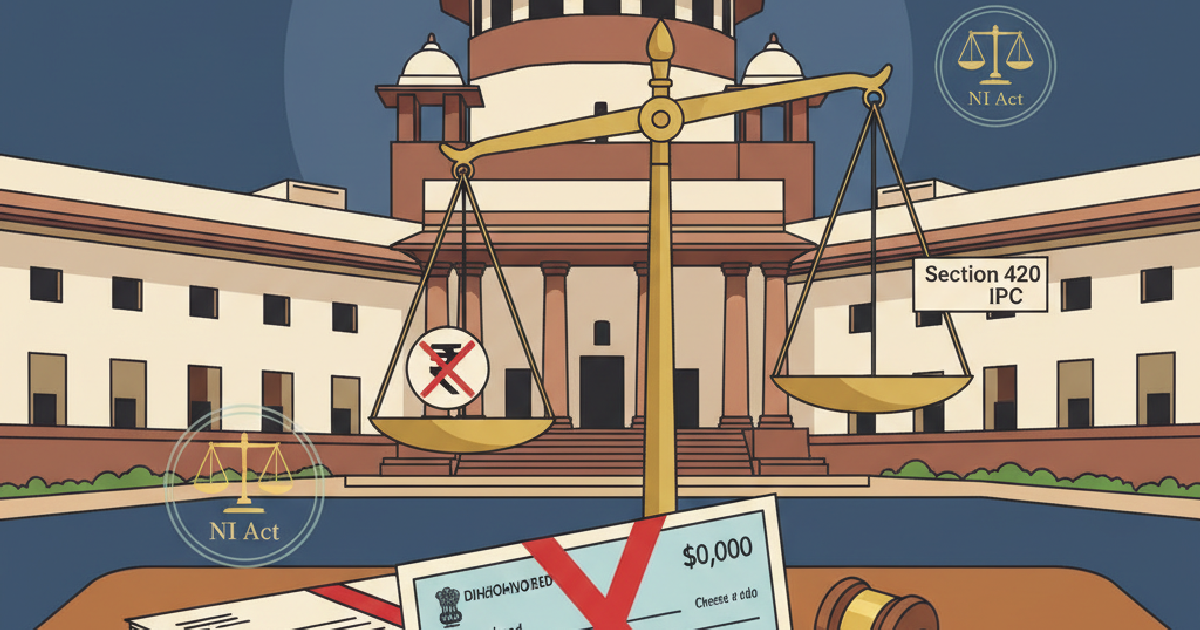
In a significant articulation of India’s legal framework, the Supreme Court of India has consistently maintained that the gravity of complaints filed under the Negotiable Instruments (NI) Act, 1881, cannot be equated with the severity of offenses prosecuted under the Indian Penal Code (IPC) or other conventional criminal statutes. This crucial distinction underscores the unique, primarily compensatory character of cheque dishonor cases within the country’s justice system.
The apex court’s position, initially articulated on September 24, 2021, by a bench comprising Justice NV Ramana, Justice Surya Kant, and Justice AS Bopanna, reiterates that these cases are essentially civil wrongs draped in a criminal facade. Their fundamental purpose is to enforce financial discipline rather than to impose punitive retribution typically associated with heinous crimes.
The nuanced nature of Negotiable Instruments Act offenses
Offenses detailed under Section 138 of the Negotiable Instruments Act are often referred to as “quasi-criminal” in legal discourse. This terminology highlights their dual nature: while they involve criminal proceedings and potential imprisonment, their core intent remains the recovery of financial dues and the bolstering of trust in negotiable instruments like cheques.
The legislative history of Section 138, introduced by an amendment in 1988, clearly demonstrates this objective. Prior to this, a bounced cheque would only lead to civil liability. The 1988 amendment sought to instill greater accountability and ensure that cheques, as vital tools in trade and commerce, retain their credibility.
Unlike offenses under the IPC, which target “public wrongs” against society, a Section 138 NI Act complaint primarily addresses a private financial dispute. It’s a mechanism to compel payment, making the offense explicitly compoundable under Section 147 of the NI Act. This provision actively encourages settlements between the parties, prioritizing restitution over prolonged litigation and punishment.
Understanding the statutory presumption under Section 139
A cornerstone of cheque dishonor cases is the presumption enshrined in Section 139 of the Negotiable Instruments Act. This section posits that unless proven otherwise, a cheque issued by an individual is presumed to have been given for the discharge, in whole or in part, of a debt or other liability.
This legal presumption significantly shifts the burden of proof, requiring the accused to demonstrate that the cheque was not issued for a legally enforceable debt. Such a framework aims to streamline proceedings and discourage frivolous defenses, ensuring the sanctity of commercial transactions. For instance, the Supreme Court has confirmed that signed blank cheques imply debt under the Negotiable Instruments Act.
However, the existence of this presumption doesn’t absolve the complainant entirely. They still need to establish the basic facts of the cheque’s issuance and dishonor. But once those foundational elements are met, the legal onus largely falls on the accused to present a convincing rebuttal to avoid conviction.
Concurrent prosecutions: NI Act and IPC offenses
The distinction between NI Act and IPC offenses becomes particularly complex when considering situations where the same set of facts might give rise to charges under both statutes. On August 11, 2022, the Supreme Court referred a pivotal question to a larger bench: can an accused be tried separately under the Negotiable Instruments Act and the IPC for the same allegations, even after a prior conviction or acquittal?
This referral was necessitated by “conflicting” views emerging from previous judgments delivered by two-judge benches of the apex court. The legal community eagerly awaits clarification on this point, which has significant implications for prosecutorial strategy and the rights of the accused.
Conflicting judicial interpretations
One school of thought, previously endorsed by some benches, argues that Section 420 of the IPC (cheating) and Section 138 of the NI Act possess distinct elements. Therefore, a subsequent prosecution under one statute would not be barred by proceedings under the other, even if they arise from the same transaction.
Conversely, another perspective contends that pursuing charges under both the IPC (e.g., Sections 406 for criminal breach of trust, or 420 for cheating) and the NI Act, based on identical facts, constitutes an abuse of the court’s process. This view often invokes Section 300(1) of the Code of Criminal Procedure (CrPC), which prohibits trying a person for the same offense twice after an acquittal or conviction.
As of March 20, 2025, a larger bench was expected to clarify the legality and procedural propriety of these concurrent prosecutions. This ruling will undoubtedly shape how financial fraud involving cheques is pursued in India’s legal system, providing much-needed clarity for courts and litigants alike.
Evolving victim rights and post-conviction settlements
The Supreme Court has progressively clarified the rights of complainants in NI Act cases, recognizing their position as ‘victims’ in the pursuit of justice. Moreover, its emphasis on settlement mechanisms reflects the compensatory spirit embedded within the Act.
In the landmark case of Celestium Financial v. A. Gnanasekaran Etc., a two-Judge Bench comprising Justice B.V. Nagarathna and Justice Satish Chandra Sharma significantly expanded the rights of complainants. They unequivocally held that a complainant under Section 138 of the NI Act qualifies as a ‘victim’ under Section 2(wa) of the CrPC.
This pronouncement is a game-changer. It empowers complainants to directly file appeals against acquittals without needing to seek special leave under the more arduous Section 378(4) of the CrPC. This change streamlines the process for those who have suffered economic loss due to dishonored cheques, making justice more accessible.
The paramountcy of voluntary settlements
Beyond empowering victims, the Supreme Court has also consistently affirmed the importance of settlements in NI Act cases. The legislative intent behind Section 147 of the NI Act is to encourage resolutions that prioritize the recovery of funds.
The Court has repeatedly ruled that if a complainant voluntarily enters into a compromise deed and accepts the settlement amount, the conviction under Section 138 of the NI Act cannot stand. This applies even if the conviction has been upheld by lower courts. This approach reflects the quasi-criminal nature, where restitution often outweighs punitive measures.
Such rulings encourage disputing parties to reach an amicable solution, reducing the burden on the judicial system. It provides a practical pathway for closure for both the issuer of the dishonored cheque and the recipient, ensuring the underlying debt is addressed.
Liability of partners in partnership firms
The intricate legal landscape of business entities and personal liability has also seen recent clarification from the Supreme Court. Specifically, questions arose regarding the maintainability of complaints when a partnership firm’s cheque bounces, but the firm itself isn’t explicitly named as an accused party.
In a judgment delivered on July 14, 2025, in the case of Dhanasingh Prabhu v. Chandrasekar, a two-Judge Bench of Justices B.V. Nagarathna and Satish Chandra Sharma provided crucial clarity. They held that complaints under Section 138 of the NI Act are indeed maintainable even when only the partners are arraigned as accused, without explicitly naming the partnership firm.
The Court’s reasoning centered on the legal status of a partnership firm. It clarified that such a firm lacks a separate legal personality distinct from its partners. Therefore, initiating proceedings against the partners alone is considered sufficient, as notice to the partners can be reasonably construed as notice to the firm itself. This simplifies the process for complainants while reinforcing accountability within partnership structures.
Here’s a comparison of how different offenses are treated under Indian law:
| Feature | Negotiable Instruments Act (Section 138) | Indian Penal Code (e.g., Section 420) |
|---|---|---|
| Nature of Offence | Quasi-criminal, primarily civil wrong with criminal overtones | Criminal, public wrong against society |
| Primary Objective | Ensure payment, enforce financial discipline, encourage restitution | Punishment, deter future misconduct (penal retribution) |
| Compoundability | Compoundable under Section 147 NI Act | Generally non-compoundable, or compoundable with court’s permission for lesser offenses |
| Burden of Proof (Initial) | Presumption under Section 139 shifts burden to accused after basic facts established | Prosecution must prove guilt beyond a reasonable doubt |
| Complainant Status | Qualifies as ‘victim’ under Section 2(wa) CrPC | Victim status varies; often the State is the prosecutor |
Implications for commercial transactions and legal strategy
The Supreme Court’s consistent approach to the Negotiable Instruments Act as distinct from traditional criminal law carries profound implications for India’s commercial landscape. It signals a judicial preference for resolution and financial accountability, rather than purely punitive measures, in cases of cheque dishonor.
This judicial stance offers a clearer roadmap for businesses and individuals engaged in cheque-based transactions. It encourages diligent compliance with financial commitments, knowing that legal recourse, while carrying criminal implications, prioritizes the restoration of funds. Moreover, it reinforces the crucial role of settlements in achieving speedy and effective justice.
For legal practitioners, these rulings necessitate a tailored approach to litigation. Understanding the “quasi-criminal” classification allows for more strategic handling of cheque bounce cases, focusing on the distinct legal presumptions and the avenues for compounding offenses. Lawyers representing accused parties might also look to rulings on the maintainability of premature complaints to challenge certain proceedings. The Supreme Court has ruled courts cannot hear premature cheque bounce complaints, setting a clear procedural boundary.
Looking ahead: continued evolution of cheque dishonor law
The legal framework surrounding negotiable instruments in India is dynamic, continually evolving to address modern commercial realities. The ongoing deliberation by a larger bench regarding concurrent prosecutions under the NI Act and IPC is a testament to this adaptive process. Its eventual decision will provide vital clarity on the interplay between civil-criminal remedies for similar financial transgressions.
Further, the proactive role of the Supreme Court in defining the rights of complainants as ‘victims’ and streamlining the appeal process indicates a commitment to ensuring timely justice. This includes rulings like those clarifying NGO signatory criminal liability under Section 138 of the Negotiable Instruments Act when they have plenary control.
The judiciary aims to strike a balance: upholding the sanctity of financial instruments while recognizing the unique nature of these disputes as fundamentally different from malicious criminal intent. This approach safeguards commercial trust without unduly burdening individuals with the full weight of the criminal justice system for what are essentially payment defaults.
Frequently Asked Questions
What is the core difference in gravity between an NI Act offense and an IPC offense?
The Supreme Court differentiates them by noting that NI Act offenses are “quasi-criminal” and primarily intended to ensure payment, making them less grave than IPC offenses which are considered “public wrongs” against society, focused on punishment and deterrence.
Can partners be held liable for a firm’s bounced cheque if the firm isn’t named in the suit?
Yes, in the case of Dhanasingh Prabhu v. Chandrasekar, the Supreme Court ruled on July 14, 2025, that complaints under Section 138 of the NI Act are maintainable against partners even if the partnership firm itself isn’t explicitly accused, as firms lack a separate legal personality.
What does it mean for a NI Act offense to be “compoundable”?
An offense being “compoundable” means the parties involved can settle the matter outside of court, often through an agreement where the accused pays the due amount. This settlement leads to the quashing of criminal proceedings, even after conviction, reflecting the compensatory focus of the NI Act.