
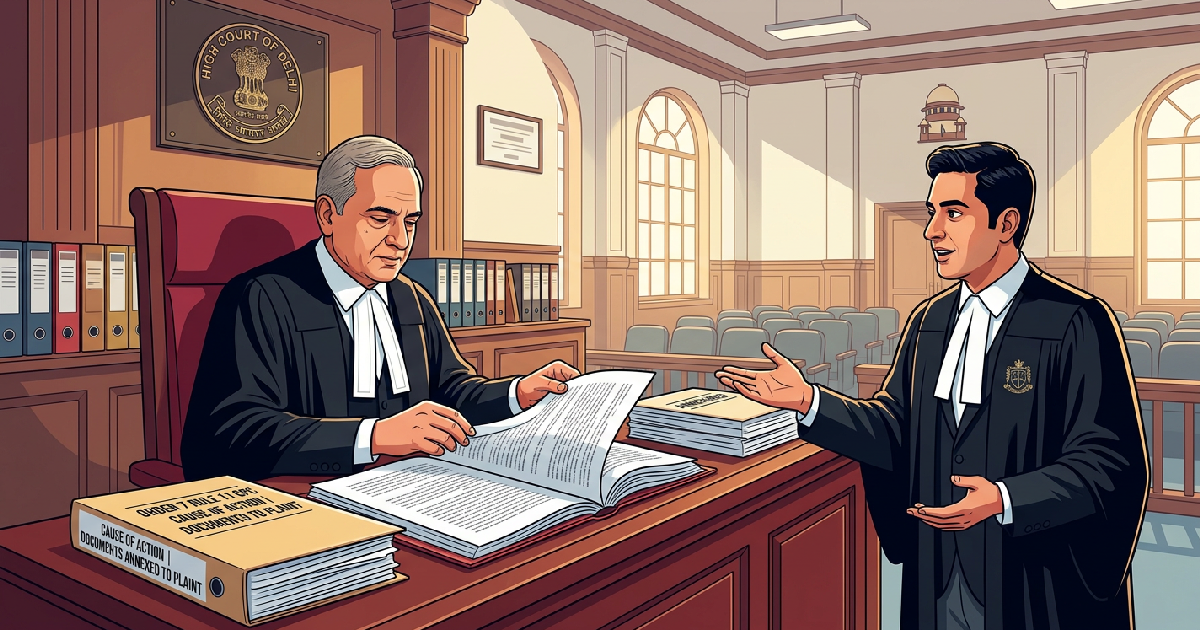
The Delhi High Court has ruled that documents annexed to a plaint must be considered when determining if a suit discloses a “cause of action” under Order 7 Rule 11 of the Civil Procedure Code (CPC). Justice Ravinder Dudeja delivered this interpretation on May 10, 2025, in the case of Gurmeet Singh Sachdeva v. Skyways Air Services Pvt. Ltd. (CM(M) 147/2024). The decision clarified that a plaint cannot be viewed in isolation when defendants seek a summary rejection of the lawsuit.
The ruling emerged from a petition challenging a district court’s refusal to reject a money recovery suit. The defendant, Gurmeet Singh Sachdeva, argued the plaint lacked material particulars and failed to establish a valid cause of action. However, the plaintiff, Skyways Air Services Pvt. Ltd., had submitted ledger accounts and other records to support claims of unpaid dues for logistics services. Justice Dudeja held that these documents are integral to assessing the validity of the claims at the preliminary stage.
This clarification ensures that the “bundle of facts” constituting a cause of action is evaluated through the lens of all materials presented by the plaintiff. It prevents the dismissal of otherwise meritorious claims due to technical drafting omissions within the body of the plaint itself. “Since the respondent has placed on record all the relevant documents, it cannot be said that plaint does not disclose the cause of action,” Justice Dudeja stated in the order.
Judicial standards for assessing cause of action under Rule 11
Order 7 Rule 11 CPC provides courts with a powerful mechanism to terminate litigation before it reaches trial. This power is intended to weed out frivolous suits that lack a legal basis. However, the Delhi High Court emphasized that this authority must be exercised sparingly. The court must assume the statements in the plaint are true and check only if those facts, if proven, would entitle the plaintiff to relief.
The inquiry at this stage is strictly limited. The court must confine itself to the averments made in the plaint and the accompanying documents. It is well-established that plaints cannot be rejected based on defenses or written statements provided by the defendant. The goal is not to predict the final outcome of the trial but to ensure there is a triable issue of fact or law present from the outset.
Recent rulings in 2026 have underscored that complex legal questions cannot be decided via summary rejection. For instance, on January 6, 2026, the Delhi High Court set aside a rejection order involving the Delhi Land Reforms Act. The court noted that determining which law applies — such as the Land Reforms Act versus the Hindu Succession Act — requires a full trial rather than a summary determination under Rule 11.
Analysis of grounds for rejection under Order 7 Rule 11 CPC
The Civil Procedure Code outlines specific scenarios where a judge may dismiss a case before the trial begins. While the absence of a cause of action is the most common ground, other procedural failures can also lead to rejection. Courts often distinguish between terminal failures and rectifiable errors, such as fee issues where the court must allow an opportunity to rectify fee deficiencies before dismissal.
| Ground for Rejection | Key Requirement under CPC | Standard of Evidence |
|---|---|---|
| No Cause of Action | Fail to disclose material facts | Plaint and annexed documents only |
| Undervaluation | Relief value is under-reported | Subject to correction within time |
| Barred by Law | Prohibited by specific statute | Statement in plaint must show bar |
| Insufficient Fee | Requisite court fee not paid | Mandatory opportunity to pay |
Restrictions on partial rejection and constitutional remedies
A critical principle upheld by the Delhi High Court and the Supreme Court is the prohibition of partial rejection. In a ruling on January 28, 2026, the court reiterated that a plaint cannot be dissected into parts. If a cause of action survives even partially, the entire suit must proceed. This prevents fragmented litigation and ensures that the court does not prematurely adjudicate the merits of individual claims before evidence is recorded.
The Supreme Court of India has also tightened the rules regarding how these challenges reach higher courts. On February 5, 2026, in P. Suresh v. D. Kalaivani, the apex court ruled that defendants cannot use Article 227 of the Constitution to bypass the standard Order 7 Rule 11 process. This was seen in a similar context where the existence of a triable issue prevented the summary dismissal of a suit.
The May 2025 decision by Justice Dudeja remains a cornerstone for how trial courts handle documentary evidence at the filing stage. By allowing annexed records like ledgers or contracts to be used to establish a cause of action, the court protects plaintiffs from losing their day in court due to minor formalistic errors. It maintains the balance between filtering out baseless suits and protecting the right to a fair trial.
Frequently Asked Questions
Can the court look at the defendant’s written statement under Rule 11?
No, the court must strictly restrict itself to the pleadings and documents filed by the plaintiff. Averments made in a defendant’s written statement or any documents presented by the defense are considered irrelevant at the stage of deciding an application under Order 7 Rule 11 CPC.
What happens if a plaint is rejected for lack of cause of action?
The rejection of a plaint is considered a drastic power. If a plaint is rejected, the lawsuit is dismissed before the trial. However, this is typically done only when the plaint, even if assumed to be true, fails to disclose any material facts that would entitle the plaintiff to the relief sought.
Is partial rejection of a lawsuit permitted under the CPC?
No, the law does not permit the partial rejection of a plaint. A court cannot reject certain parts of a claim while allowing others to continue. Under the rules established by the Supreme Court and followed by the Delhi High Court, the suit must either be rejected in its entirety or proceed as a whole.