
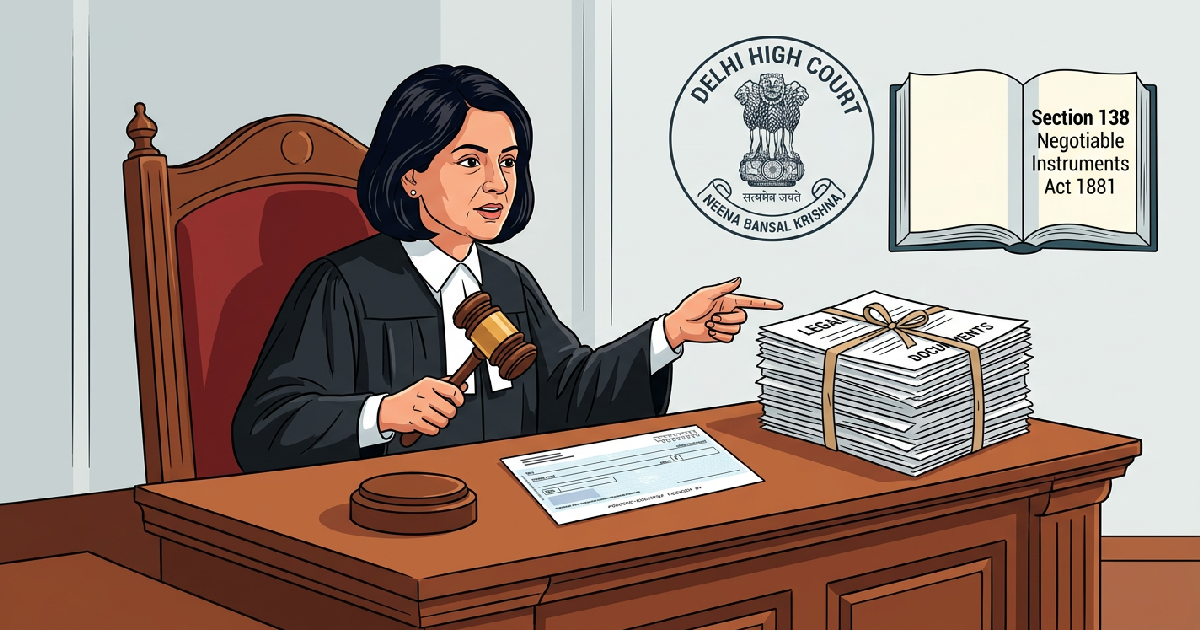
Justice Neena Bansal Krishna of the Delhi High Court ruled on November 12, 2025, that post-dated cheques (PDCs) issued as security for financial liabilities can attract criminal prosecution under Section 138 of the Negotiable Instruments Act, 1881, once the underlying liability crystallizes into a legally enforceable debt. The court clarified that while a cheque may be termed “security” at the time of issuance, it assumes the character of a negotiable instrument meant for debt discharge if a financial obligation exists on the date the cheque is presented for payment.
The single-judge bench emphasized that the primary factor in determining liability is the existence of an enforceable debt on the presentation date. According to the court, if a cheque is given for a contract or loan and that liability matures later, the cheque effectively becomes an instrument issued to discharge that debt. This interpretation aligns with broader judicial trends across India, such as when the Supreme Court upheld cheque bounce cases for cash loans, reinforcing the mandate that financial instruments must be backed by sufficient funds when debts are due.
This ruling provides significant clarity for commercial transactions where security cheques are standard practice. Justice Neena Bansal Krishna reasoned that the nature of the cheque—whether for security or discharge of debt—depends entirely on the circumstances at the time of presentation. If the debt is equal to or greater than the amount on the cheque, the drawer cannot escape the provisions of the Negotiable Instruments Act simple by labeling the instrument as “security.”
Crystallization of debt turns security into discharge
The court’s decision centered on the concept of crystallization, where a potential future liability becomes a fixed, legally enforceable debt. Justice Neena Bansal Krishna noted that a cheque originally given as security matures into a negotiable instrument under Section 138 if a financial obligation arises after the issuance but before presentation. Advocate Rajnish Kumar Gaind represented the petitioner, while Advocate Umakant Kataria appeared for the respondent in the proceedings.
During the hearing, the court further clarified that factual disputes, such as whether the cheque amount exactly matches the existing liability, are matters to be decided during a trial. Such arguments cannot be used to quash a summoning order at the preliminary stage. This maintains a rigorous standard for debtors, similar to how directors remain liable for cheque bounces even during corporate insolvency proceedings, ensuring individuals remain accountable for the instruments they sign.
The ruling also referenced the Supreme Court’s 2021 stance in Sripati Singh v. The State of Jharkhand. In that case, the apex court observed that if a loan is backed by security cheques and the borrower fails to maintain funds after the liability matures, the protection of the “security” label is lost. The Delhi High Court has now firmly integrated this principle into its local jurisprudence.
Limitations on security cheque encashment
While the court expanded the applicability of Section 138, it also established boundaries to prevent the misuse of security cheques. In a judgment delivered on October 27, 2025, in Sri Sai Sapthagiri Sponge Pvt. Ltd. v. The State (GNCT of Delhi), Justice Neena Bansal Krishna quashed five complaints under the NI Act. The court found those cheques were given for a specific purpose that did not result in a legally enforceable debt.
The court held that if the purpose for which the security was originally given is not met, the cheques cannot be encashed for liabilities that may have subsequently arisen. This ensures a balance between protecting creditors and preventing the arbitrary use of post-dated instruments. This procedural fairness is a cornerstone of the act, much like how the Supreme Court requires delay condonation before taking cognizance of time-barred complaints.
| Case Name | Presiding Judge | Key Date(s) | Primary Legal Finding |
|---|---|---|---|
| Security Cheque Crystallization Case | Justice Neena Bansal Krishna | Nov 12, 2025 | Security cheques attract Section 138 once liability crystallizes. |
| Manmohan Gaind v. Negolice India Pvt. Ltd. | Delhi High Court | Dec 9, 2025 (Judgment) | Cheque valid if subsisting liability exists on presentation date. |
| Sri Sai Sapthagiri Sponge Pvt. Ltd. v. The State | Justice Neena Bansal Krishna | Oct 27, 2025 | Complaints quashed; cheques used for non-enforceable liabilities. |
Legal context and procedural precedents
The Delhi High Court’s findings build upon established principles regarding post-dated cheques. According to the Supreme Court in Goa Plast (P) Ltd. v. Chico Ursula D’Souza, a PDC is treated as a bill of exchange until the date mentioned on it arrives, at which point it becomes a cheque. Section 138 applies if it is dishonored after that effective date, provided a debt exists.
In the *Manmohan Gaind v. Negolice India Pvt. Ltd.* case, the judgment (dated November 11, 2025, but delivered on December 9, 2025) reinforced that a security cheque constitutes a legally enforceable instrument if liability remains on the date of presentation. This string of rulings emphasizes that the “security” defense is not a blanket immunity against criminal prosecution for bounced cheques in India’s commercial courts.
Frequently Asked Questions
When does a security cheque become a negotiable instrument under Section 138?
A security cheque becomes a negotiable instrument when the underlying liability from a contract or loan crystallizes into a legally enforceable debt. If the debt exists on the date the cheque is presented for payment, it is no longer considered mere security but an instrument for debt discharge.
Can a court quash a summoning order because the cheque amount exceeds the debt?
No, the Delhi High Court ruled that whether a cheque amount was for the existing liability or an excess amount is a matter of trial. This specific factual dispute cannot be considered at the summoning stage and must be argued during the full case proceedings.
What happens if a security cheque is used for a purpose other than its original intent?
In the Sri Sai Sapthagiri Sponge Pvt. Ltd. case, the court held that security cheques given for a specific purpose cannot be encashed for a liability that arises subsequently. If no legally enforceable debt existed for that specific purpose, the complaints under Section 138 are liable to be quashed.