
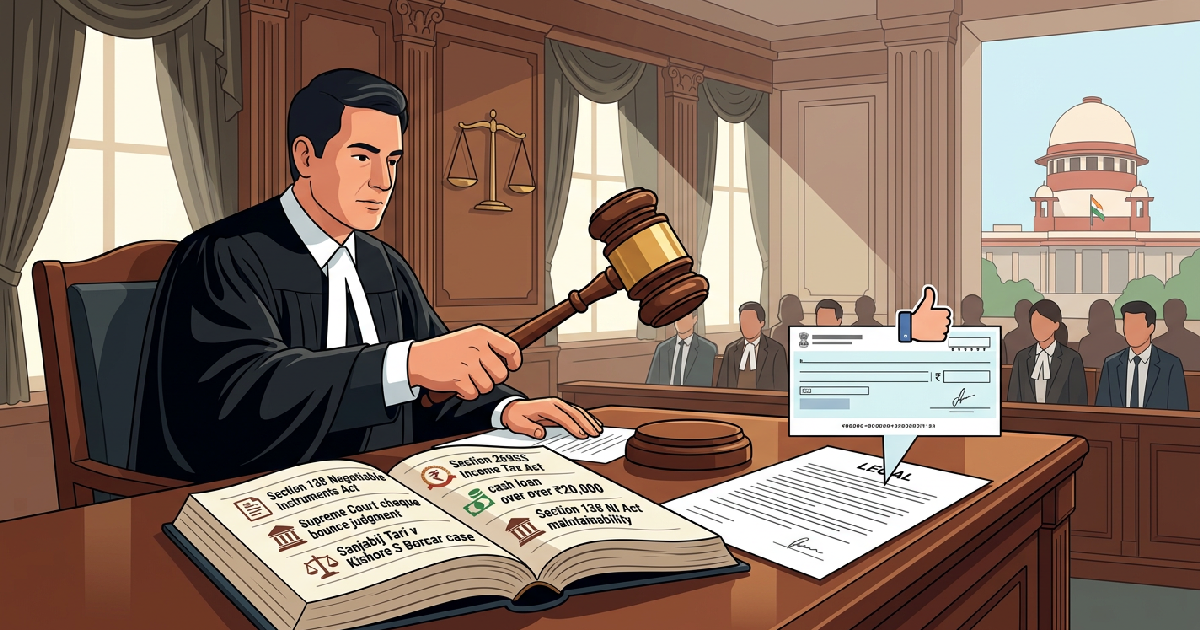
The Supreme Court of India delivered a landmark judgment on September 25, 2025, ruling that a cheque bounce case under Section 138 of the Negotiable Instruments Act, 1881, is maintainable even if the underlying cash loan exceeds ₹20,000. In the case of Sanjabij Tari v. Kishore S. Borcar & Anr., a Division Bench comprising Justice Manmohan and Justice N.V. Anjaria set aside a previous Kerala High Court ruling that had categorized such debts as legally unenforceable. The court clarified that while cash transactions above this limit may violate transparency rules under the Income Tax Act, they do not automatically nullify a borrower’s obligation to honour a cheque.
The decision specifically addresses the intersection between Section 138 of the Negotiable Instruments (NI) Act and Section 269SS of the Income Tax (IT) Act, 1961. The bench found that the purpose of the NI Act is to provide credibility to cheques as a reliable substitute for cash. By maintaining the validity of these complaints, the court ensures that technical tax violations cannot be used as a shield by debtors to escape criminal liability for dishonoured payments.
This ruling brings much-needed clarity to the legal standing of private loans in India. It effectively prevents defendants from using tax-related technicalities to rebut the legal presumptions that usually favour the holder of a cheque. The court noted that when a statutory notice is not replied to, it must be presumed that the cheque was issued toward the discharge of a liability.
Supreme Court reverses Kerala High Court stance on cash loans
The controversy stemmed from a past ruling by the Kerala High Court in P.C. Hari v. Shine Varghese & Anr., where Justice P.V. Kunhikrishnan had argued that a cash transaction over ₹20,000 was not a “legally enforceable debt.” The High Court had acquitted an accused respondent who borrowed ₹9,00,000 in cash, despite the Trial Court and Sessions Court previously convicting him. The Supreme Court has now explicitly rejected this interpretation, noting that it “cannot be countenanced.”
Justice Manmohan and Justice Anjaria emphasized that Section 269SS of the IT Act merely regulates the mode of transaction. A violation of this section is subject to a penalty under Section 271D of the same Act, which is equal to the loan amount. However, the bench clarified that neither section states that a transaction in breach of these rules is illegal, invalid, or statutorily void. The rules on cheque dishonour claims must remain separate from administrative tax penalties.
Under the new judgment, the conviction in the P.C. Hari case has been legally restored. The court directed the accused to pay ₹7,50,000 in 15 equated monthly instalments of ₹50,000 each. This reversal reinforces the strength of Sections 118 and 139 of the NI Act, which provide for a presumption in favour of the person holding the cheque.
Analyzing Section 138 maintainability and tax violations
The Bench also scrutinized the specific defenses used by the accused in Sanjabij Tari. The respondent had claimed he issued a signed blank cheque to assist a friend in obtaining a bank loan, an argument the court dismissed as “unbelievable and absurd.” The justices pointed out the logical fallacy of showing a cheque from an account with insufficient funds to convince a bank to grant credit.
| Statutory Provision | Governing Legislation | Legal Consequence or Penalty |
|---|---|---|
| Section 138 | Negotiable Instruments Act, 1881 | Criminal prosecution for cheque dishonour |
| Section 269SS | Income Tax Act, 1961 | Prohibits receiving cash loans above ₹20,000 |
| Section 271D | Income Tax Act, 1961 | Penalty equal to the amount of the cash loan taken |
The court’s focus remained on the fact that tax laws are intended to deter “black money” transactions through financial penalties, not to invalidate legitimate underlying debts. A lender may still be visited by a tax penalty, but they do not lose their right to prosecute for a bounced cheque. This distinction protects the commercial utility of negotiable instruments in the broader economy.
National guidelines for expedited cheque bounce proceedings
Alongside the verdict, the Supreme Court issued mandatory guidelines to streamline the disposal of Section 138 cases across India. High Courts and District Courts must implement these reforms no later than November 1, 2025. These measures are designed to tackle the systemic delays that often cripple the efficiency of summary trials in the Indian judicial system.
A major change involves the service of summons. Courts are now directed to use electronic means, including WhatsApp, email, and SMS, alongside traditional methods. Additionally, the court authorized the “dasti” mode, where the complainant can personally serve the summons. This modernization is intended to prevent accused parties from stalling trials by evading the postal service.
The court further clarified that civil compromise decrees do not bar prosecution under the NI Act in many circumstances. The primary objective remains the speedy recovery of funds and the administrative punishment of those who undermine the banking system’s integrity by issuing cheques without sufficient coverage.
Frequently Asked Questions
Can a cheque bounce case still be filed if the loan was given in cash?
Yes. The Supreme Court has ruled that even if a cash loan exceeds the ₹20,000 limit set by the Income Tax Act, a cheque bounce case under Section 138 of the Negotiable Instruments Act remains maintainable. The tax violation does not make the debt “unenforceable” in criminal court.
What are the penalties for violating the ₹20,000 cash loan limit?
While the debt remains enforceable, the parties involved may face penalties under Section 271D of the Income Tax Act. This penalty is typically equal to the amount of the cash loan taken. The Supreme Court clarified that this tax penalty is the exclusive remedy for such violations, rather than the invalidation of the loan itself.
When do the new Supreme Court guidelines for these cases take effect?
High Courts and District Courts are required to implement the new procedural guidelines, including the use of electronic summons via WhatsApp and email, no later than November 1, 2025. These reforms aim to speed up the resolution of the massive backlog of cheque bounce cases in India.