
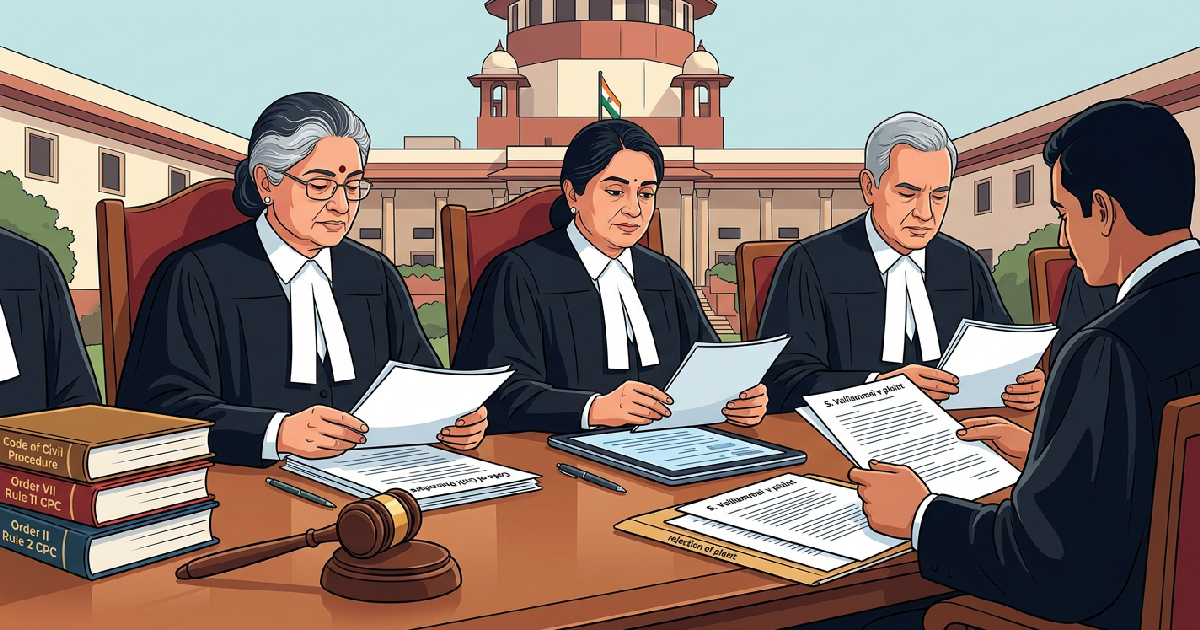
The Supreme Court of India has ruled that a plaint cannot be rejected under Order VII Rule 11 of the Code of Civil Procedure (CPC) on the grounds that the suit is barred by Order II Rule 2 CPC. In a judgment delivered on April 16, 2026, the bench comprising Justice B.V. Nagarathna and Justice Ujjal Bhuyan clarified that such a determination requires a trial and cannot be made at the preliminary stage by comparing different sets of pleadings. The decision came in the case of S. Valliammai & Others v. S. Ramanathan & Another, effectively setting aside a previous order by the Madras High Court.
The litigation began with a family dispute over multiple properties. Originally, the owner, late M. Sokkalingam, and his wife filed the first suit seeking an injunction against their son. Following the death of Sokkalingam, his widow and daughters instituted a second suit seeking to declare a Power of Attorney void, alleging it was executed through fraud, coercion, and undue influence. The defendants moved to have this second suit rejected, arguing it was barred because the claims should have been included in the initial litigation.
While the trial court initially allowed the suit to proceed, the Madras High Court intervened and rejected the plaint after performing a detailed comparison of the pleadings in both suits. The Supreme Court has now overruled this approach, noting that the inquiry under Order VII Rule 11(d) must be confined strictly to the statements made within the plaint itself. This ruling emphasizes the procedural safeguards that prevent cases from being dismissed before a proper evidentiary hearing.
Distinguishing between law bars and procedural restrictions
The Supreme Court highlighted a critical distinction between a suit being “barred by law” under Order VII Rule 11(d) and a plaintiff being precluded from certain reliefs under Order II Rule 2. Justice B.V. Nagarathna and Justice Ujjal Bhuyan noted that Order II Rule 2 does not create an absolute bar to filing a suit; rather, it prevents a person from being “vexed twice” for the same cause of action. Determining if causes of action are identical requires evidence that is typically only available during a trial.
The bench clarified that Order VII Rule 11(d) applies only when a legal bar is apparent from the face of the plaint. Because a plea involving Order II Rule 2 requires a comparative analysis of different suits, it falls outside the threshold scope of early rejection. This ensures that complex issues, such as those seen when the J&K High Court ruled Order VII Rule 11 CPC is inapplicable for triable property issues, are handled through full judicial scrutiny rather than summary dismissal.
Trial court decision restored in property dispute
By setting aside the Madras High Court’s order, the Supreme Court has restored the trial court’s decision, allowing the widow and daughters of late M. Sokkalingam to continue their legal challenge. The high court’s error lay in undertaking a deep dive into the previous pleadings at a preliminary stage. The Supreme Court emphasized that its current observations are limited to the maintainability of the suit and do not influence the final merits of the upcoming trial.
Proper adherence to these procedural limits is essential for the integrity of civil litigation. This is comparable to other strict procedural timelines, such as when the Telangana High Court clarified the 120-day limit for filing statements in commercial cases. In the present case, the court underscored that if the causes of action are different, Order II Rule 2 simply has no application, making a trial necessary to establish these facts.
| Judicial Stage | Court Involved | Decision on Plaint | Legal Basis Provided |
|---|---|---|---|
| Trial Stage | Subordinate Trial Court | Allowed to proceed | Rejected the defendants’ contention for early dismissal. |
| Revision Stage | Madras High Court | Plaint Rejected | Performed a comparative analysis of previous pleadings. |
| Appellate Stage | Supreme Court of India | Plaint Restored | Ruled that Order II Rule 2 bars cannot be decided under Order VII Rule 11. |
Preventing multiplicity of suits and protecting fair trials
The spirit of Order II Rule 2 CPC is to prevent a multiplicity of suits by requiring a plaintiff to include all claims arising from the same cause of action in one go. However, the Supreme Court stressed that this does not mean every possible claim against a defendant must be squeezed into a single lawsuit if the underlying causes of action differ. The ruling protects plaintiffs from having their cases dismissed prematurely based on technicalities that require factual proof.
The bench’s decision in S. Valliammai serves as a reminder that the power to reject a plaint is a drastic one that must be used sparingly. By confining the inquiry to the four corners of the plaint, the court ensures that the right to a trial is not bypassed by a defendant’s preliminary objections. This aligns with broader judicial views on maintaining trial standards, such as when the Supreme Court issued guidelines for summary judgments to ensure careful handling of commercial suits.
Frequently Asked Questions
Can a suit be rejected under Order VII Rule 11 due to Order II Rule 2?
No. The Supreme Court has ruled that a plaint cannot be rejected at the threshold stage under Order VII Rule 11 CPC solely because it might be barred by Order II Rule 2 CPC. This is because a plea under Order II Rule 2 requires comparing different lawsuits, which can only be done after evidence is presented during a trial.
What was the specific error made by the Madras High Court in this case?
The Madras High Court incorrectly undertook a detailed comparison of the pleadings from an earlier suit and the subsequent suit at the preliminary stage. The Supreme Court held that during an application for rejection of a plaint, the court must only look at the statements made in the current plaint, not external documents or previous pleadings.
Does this ruling mean Order II Rule 2 no longer applies?
Order II Rule 2 still applies and can be used as a defense. However, it cannot be used to get a case thrown out immediately under Order VII Rule 11. If the causes of action are indeed the same and the plaintiff failed to include claims earlier, the court can still decide on that issue after a full trial has taken place.