
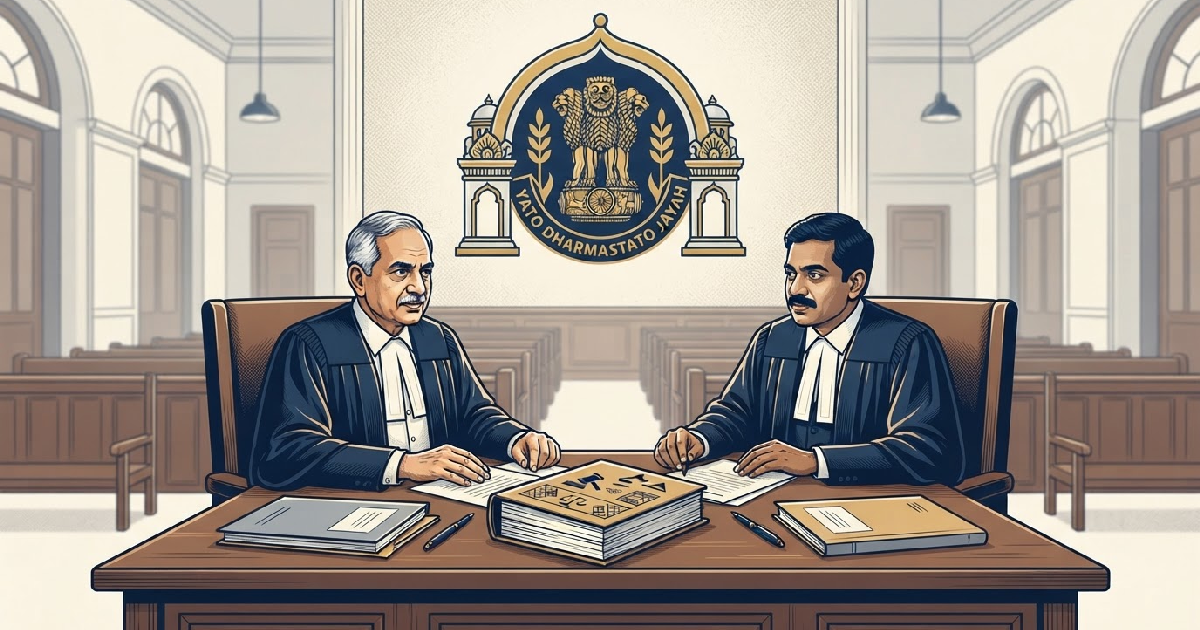
Special courts for MPs and MLAs cannot hear matrimonial disputes, the Supreme Court of India observed this week. This ruling comes even if one of the parties involved holds legislative office.
The bench, comprising Justice J.B. Pardiwala and Justice K. Vinod Chandran, clarified that these specialized MP/MLA courts were established solely to expedite criminal cases against lawmakers.
Supreme Court clarifies special court mandate
This clarification arose from a Special Leave Petition concerning a matrimonial dispute between Uttar Pradesh MLA Raghuraj Pratap Singh, also known as Raja Bhaiya, and his wife, Bhanvi Kumari Singh. The case, initially filed under the Protection of Women from Domestic Violence Act, 2005 (PWDV Act), had been moved to an MP/MLA court in Delhi.
The Supreme Court’s intervention underscores a critical distinction in judicial jurisdiction, re-routing the dispute back to a regular Metropolitan Magistrate court at Saket Courts, New Delhi, on July 22, 2026.
The Supreme Court made it clear that the special courts for legislators have a confined mandate. They’re specifically tasked with addressing criminal offenses, which include cases under the Indian Penal Code (IPC) and other special legislations. This ruling prevents the expansion of their purview into civil matters like marital disagreements, regardless of the public status of the individuals involved.
Narrow scope for legislators’ criminal matters
Justices J.B. Pardiwala and K. Vinod Chandran were unequivocal in their reasoning. They observed, “We are not convinced that a matrimonial dispute can be agitated before such a special Court merely for reason of one of the parties being a legislator.”
This statement highlights that these special courts are “offence-centric,” focusing on the nature of the crime, rather than “offender-centric,” which would imply jurisdiction over any case involving a legislator.
The primary intent behind establishing these special courts was to fast-track criminal proceedings. The goal was to tackle corruption and ensure public accountability by expediting trials against elected representatives. This focus on specific criminal matters underscores the courts’ specialized function within the broader judicial system.
The Raghuraj Pratap Singh case and its journey
The immediate catalyst for this Supreme Court observation was the ongoing matrimonial dispute involving Uttar Pradesh MLA Raghuraj Pratap Singh, representing the Kunda Constituency. His wife, Bhanvi Kumari Singh, initiated the legal proceedings under the Protection of Women from Domestic Violence Act, 2005.
The case had an unusual journey through the judicial system. It was originally filed before the Metropolitan Magistrate-02 (Mahila Court) in South District, Saket Courts, New Delhi. However, it was later withdrawn and subsequently filed before a special designated MP/MLA Court at Rouse Avenue in Delhi, reportedly for faster resolution.
The Delhi High Court had previously upheld the maintainability of these proceedings before the special designated MP/MLA Court. Its reasoning was that the special court effectively functioned as a Court of Magistrate, exercising jurisdiction under the Code of Criminal Procedure (Cr.P.C.) and the Bharatiya Nagarik Suraksha Sanhita (BNSS). This interpretation, however, has now been prima facie challenged by the apex court.
Genesis and purpose of MP/MLA courts
The establishment of special courts for Members of Parliament (MPs) and Members of Legislative Assembly (MLAs) represents a significant chapter in India’s judicial reform efforts. These courts were not spontaneously created but were the result of sustained pressure and directives from the Supreme Court itself.
Origins in judicial directives
The impetus for these specialized judicial bodies traces back to 2017. The Supreme Court of India issued key directives on November 1 and December 14 of that year. These orders were a direct response to a Public Interest Litigation (PIL) filed by advocate Ashwini Kumar Upadhyay.
The primary aim was to address the massive backlog of criminal cases involving sitting and former legislators. Such delays were seen as undermining public trust and accountability. The Court sought to ensure that elected representatives facing criminal charges would have their cases resolved swiftly, fostering greater transparency and preventing corruption.
Combatting pendency and corruption
When first established, 12 special courts were initially constituted across 11 states in India. Their jurisdiction was narrowly defined: to try criminal cases specifically against legislators under the Indian Penal Code and other special legislations.
The Supreme Court had stated, “Large pendency and delay occasioned, prompted this Court to pass orders directing designations of special Courts to ensure public accountability, promote vigilance and prevention of corruption.”
The Supreme Court had also emphasized that these courts exist for “offence-centric” cases, not “offender-centric” ones. This means the nature of the crime determines the court’s jurisdiction, not simply the status of the accused. This ruling reaffirms that distinction by preventing matrimonial disputes from entering these specialized channels.
For example, understanding what limits a second anticipatory bail plea highlights how different legal procedures are strictly defined.
Navigating jurisdictional complexities
The Supreme Court’s recent observation is a pivotal moment in clarifying the often-complex jurisdictional boundaries of specialized courts. The ambiguity surrounding MP/MLA courts has led to varied interpretations and applications across different judicial bodies over time.
Varied interpretations and precedents
The Delhi High Court’s previous decision regarding Raghuraj Pratap Singh’s case exemplified this ambiguity. It had argued that the MP/MLA court could hear the PWDV Act proceedings, based on these courts operating like a Magistrate’s Court. This perspective, however, deviates from the Supreme Court’s current, clearer intent for these special courts.
Conversely, other judicial precedents underscore that jurisdiction typically depends on the accused’s status at the time the offense was committed, not merely their current office. The Manipur High Court, in February 2024, held that its Special Courts for MPs/MLAs could try cases against former and sitting legislators, provided the establishing notification specified this. This illustrates the differing interpretations of judicial scope.
This evolving interpretation of court powers underscores the importance of clear judicial guidelines. Even in cases of general litigation, the Supreme Court has previously provided clarity on who can initiate proceedings, emphasizing the role of the plaintiff as Dominus Litis and limiting compulsory joinder of defendants.
Implications for justice delivery
The Supreme Court’s observation, while *prima facie*, holds significant weight for the future handling of cases involving public representatives. It reinforces the principle that judicial specialization should serve justice efficiently without blurring fundamental legal distinctions.
What this ruling means for litigants
With the consent of both parties, the Supreme Court directed the transfer of the specific matrimonial dispute involving Raghuraj Pratap Singh back to the Metropolitan Magistrate-02 (Mahila Court), South District, Saket Courts, New Delhi. This decision aligns with the Court’s view that such disputes belong in regular matrimonial forums.
The Mahila Court has been requested to endeavor to dispose of the transferred case within one year, with both parties directed to cooperate for its expeditious conclusion.
This swift action demonstrates the Court’s commitment to timely justice, even as it clarifies jurisdictional limits. The focus on clearing backlogs extends across the judicial system, with initiatives leveraging digital platforms for pending Supreme Court cases to keep litigants informed.
The open question of law
The Supreme Court explicitly stated that its observations were “merely prima facie and the question of law is kept open.” This means that while the current case is resolved, the broader legal question concerning the precise breadth of jurisdiction for specialized legislative courts remains open for future judicial consideration in appropriate cases.
This ruling indicates that the debate over the jurisdictional limits of MP/MLA courts, particularly concerning non-criminal matters, is not definitively settled. Further judicial scrutiny will likely be needed to fully delineate these boundaries. For now, the distinction between criminal and matrimonial matters remains clear.
| Court Type | Primary Purpose | Case Types Handled | Jurisdiction Basis |
|---|---|---|---|
| MP/MLA Special Courts | Expedite criminal cases against legislators | Criminal offenses (IPC, special legislations) | Status of accused as legislator AND nature of crime |
| Metropolitan Magistrate Court (Mahila Court) | Hear cases involving women, domestic violence | Matrimonial disputes, PWDV Act cases | Territorial jurisdiction, subject matter |
| Regular District Courts | General civil and criminal justice | All civil cases, various criminal cases | Territorial jurisdiction, pecuniary limits, subject matter |
Can an MP/MLA court handle any case involving a legislator?
No, MP/MLA courts are specifically designed to expedite criminal cases against legislators. They do not have the jurisdiction to hear civil matters, including matrimonial disputes, even if a legislator is involved.
What was the original purpose of MP/MLA courts?
The original purpose of MP/MLA courts was to address the backlog of criminal cases against sitting and former legislators, ensuring swift judicial resolution for offenses allegedly committed by them and thereby promoting accountability and transparency.
What happens to matrimonial disputes involving legislators now?
Matrimonial disputes involving legislators are to be heard by the appropriate regular civil courts or family courts, as per the established judicial procedure, and not by the specialized MP/MLA courts. The Supreme Court has specified that such cases, like the one involving Raghuraj Pratap Singh, should be transferred to relevant magistrate courts for resolution within a specified timeframe, ideally one year.