
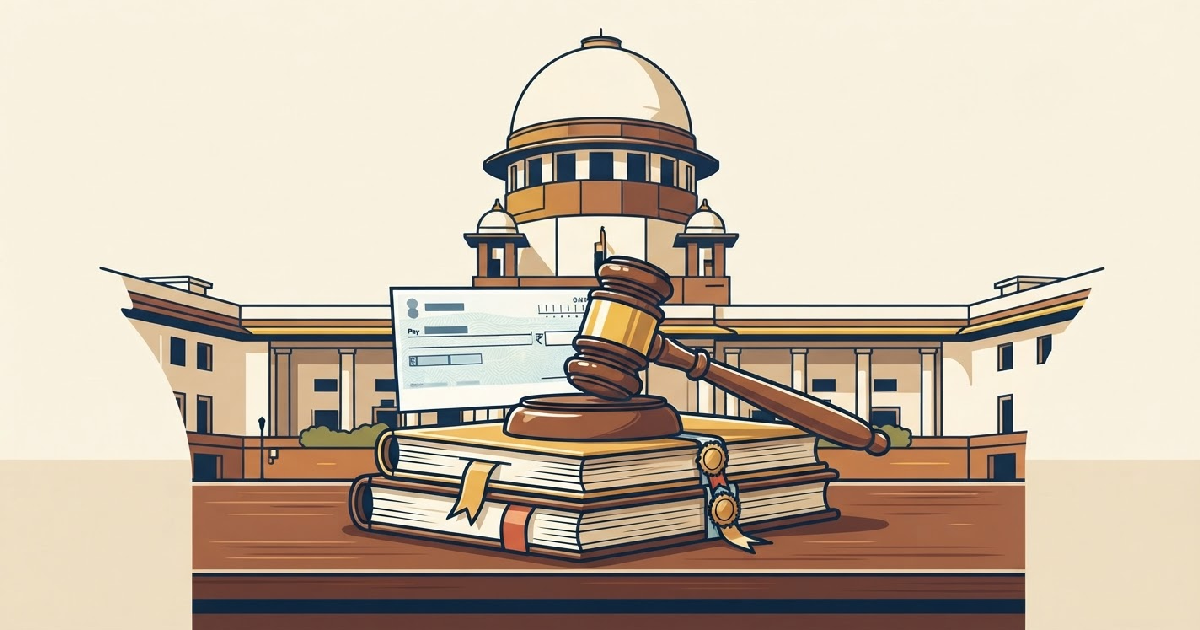
India’s Supreme Court, in a September 25, 2025 ruling, confirmed that cheque dishonour liability under the NI Act remains valid even if the loan violates IT Act cash limits. A bench comprising Justice Manmohan and Justice N.V. Anjaria resolved a long-standing legal conflict, thereby strengthening the commercial sanctity of cheques.
This landmark ruling, issued in the case of Sanjabij Tari v. Kishore S. Borcar & Anr, definitively clarifies the scope of enforceability for debts even when they stem from transactions non-compliant with fiscal regulations. The verdict aims to restore public trust in cheques and streamline the adjudication of related criminal cases across the country.
Supreme Court ruling on cheque dishonour and loan limits
The Supreme Court’s judgment firmly distinguishes between a breach of fiscal regulations and the fundamental enforceability of a commercial debt. It ensures that the underlying debt, even if received in cash beyond the Income Tax Act’s stipulations, remains valid for prosecuting cheque dishonour under the NI Act. This principle prevents debtors from using tax non-compliance as a shield against their payment obligations.
The decision overturns previous conflicting interpretations by various High Courts, most notably the Kerala High Court’s stance in P.C. Hari v. Shine Varghese. Such earlier rulings had permitted debtors to argue that a cash loan exceeding tax limits was not a “legally enforceable debt,” complicating Section 138 proceedings.
The core of the Negotiable Instruments Act
Section 138 of the Negotiable Instruments Act, 1881, serves as a cornerstone for commercial certainty in India. It criminalizes the dishonour of a cheque issued in discharge of a “legally enforceable debt or other liability.” Parliament introduced this provision to instill credibility in cheques as a reliable alternative to cash payments.
The Supreme Court emphasized the legislative intent behind the NI Act: “to restore the credibility of cheques as a trustworthy substitute for cash payment.” This foundational goal must be protected, preventing the subversion of commercial law by technical fiscal arguments.
Statutory presumptions and burden of proof
Key to cheque dishonour cases are Sections 118 and 139 of the NI Act, which establish statutory presumptions. Once the drawer admits to executing a cheque, it’s presumed to be for consideration and in discharge of a legally enforceable debt. The burden then shifts to the accused to rebut this presumption.
The Court stressed that merely relying on a complainant’s breach of a fiscal statute, like Section 269SS of the IT Act, is no longer sufficient to meet this burden. The defence must produce material evidence to demonstrate the non-existence of the debt or financial incapacity, rather than merely a tax violation.
Reconciling tax law and commercial debt enforcement
At the heart of the legal debate was the interplay between Section 138 of the NI Act and Section 269SS of the Income Tax Act, 1961. Section 269SS, introduced in 1984, prohibits accepting loans or deposits of ₹20,000 or more in cash, requiring such transactions through banking channels or electronic systems.
This regulatory measure targets black money circulation and promotes transparency in financial transactions. However, its penal nature, which includes a 100% penalty under Section 271D for violations, does not declare the underlying loan contract void or illegal.
Distinction between penalty and void transaction
The Supreme Court drew a crucial distinction between a breach that attracts a statutory penalty and one that renders a transaction null and void. “Further neither Section 269SS nor 271D of the IT Act, 1961 say that any transaction by violation thereof shall be illegal, invalid or void by statute,” the bench observed.
This means a contravention of Section 269SS leads to a fiscal penalty but doesn’t invalidate the debt itself.
Consequently, the Court firmly rejected the argument that a cash transaction above ₹20,000 becomes illegal and void, thus falling outside the definition of a “legally enforceable debt.” This ruling ensures that tax compliance failures, while punishable, don’t undermine legitimate commercial agreements.
The prior legal landscape and conflicting interpretations
Before this Supreme Court intervention, judicial opinions diverged significantly across India. The Kerala High Court, in its July 25, 2025, ruling in P.C. Hari v. Shine Varghese, had adopted a restrictive interpretation.
That court held that a debt created by a cash transaction exceeding ₹20,000, violating Section 269SS of the IT Act, could not be considered a “legally enforceable debt” under the NI Act. It reasoned that criminal courts should not indirectly “legalise such illegal transactions” or facilitate the conversion of “black money into white money.”
Overturning the Kerala High Court’s stance
The Supreme Court explicitly set aside the conclusion of law reached in P.C. Hari.
Its verdict in Sanjabij Tari v. Kishore S. Borcar clarified that a contravention of Section 269SS “would not render the transaction unenforceable under Section 138 of the NI Act or disprove the presumptions under Sections 118 and 139 of the NI Act because such a person is subject to be called down by a penalty only as prescribed.”
The Sanjabij Tari case itself involved a friendly loan of ₹6,00,000 advanced by Sanjabij Tari to Kishore S. Borcar, which resulted in a dishonoured cheque. The Supreme Court reinstated Borcar’s conviction, overturning the Bombay High Court at Goa’s prior acquittal, which had questioned the loan’s enforceability due to alleged IT Act violations.
Impact on lending, borrowing, and fiscal policy
This Supreme Court ruling establishes a system of dual liability. While the debt remains recoverable under the NI Act, the party accepting the cash loan faces significant repercussions under tax law. Section 271D of the IT Act mandates a penalty equal to 100% of the loan amount accepted in cash.
This framework ensures that both commercial integrity and fiscal compliance are maintained, albeit through different legal channels. The possibility of a substantial tax penalty acts as a strong disincentive against large cash transactions, aligning with the Union Government’s “Digital India” initiative to curb black money.
Consequences for lenders and borrowers
For borrowers, the message is clear: a cheque issued against a debt, even one initially transacted in cash beyond permissible limits, is legally binding. Defences based on the lender’s tax non-compliance will no longer hold up in cheque dishonour proceedings. This reinforces accountability and the seriousness of issuing cheques.
Lenders, while having their commercial claims upheld, must still be wary of the tax implications of accepting large cash loans. The ruling subtly pushes all parties towards more formal, traceable financial channels, fostering greater transparency in India’s economy.
Judicial reforms to expedite cheque cases
Beyond clarifying the legal interpretation, the Supreme Court acknowledged the “staggeringly high” pendency of Section 138 cases, which constitute nearly 50% of the total trial court backlog in some jurisdictions. To address this, the Court issued a comprehensive set of mandatory directions, effective November 1, 2025.
These directives aim to streamline the disposal of cheque dishonour cases and promote early settlements. The Court pragmatically described the offence under Section 138 as a “civil sheep in a criminal wolf’s clothing,” signalling a drive for more efficient resolution.
Technological interventions and settlement incentives
Key reforms include intensified service of summons, utilising electronic modes like WhatsApp and email, in line with the Bhartiya Nagarik Suraksha Sanhita, 2023 (BNSS, 2023). Principal District and Sessions Judges are also directed to set up dedicated online payment systems, such as QR codes or UPI links, to facilitate immediate payment of cheque amounts upon receipt of summons.
This encourages settlement at the earliest stage, reducing the burden on courts. Additionally, graded costs for settling offences by compounding have been introduced, offering zero cost for settlement before defence evidence and a maximum of 10% of the cheque value if settled before the Supreme Court.
| Statute | Relevant Sections | Primary Purpose | Cash Transaction Limit/Offence | Consequence of Violation |
|---|---|---|---|---|
| Negotiable Instruments Act, 1881 (NI Act) | Section 138, 118, 139 | Ensuring cheque credibility in commercial transactions | Dishonour of cheque against legally enforceable debt | Imprisonment up to 2 years and/or fine up to twice the cheque amount |
| Income Tax Act, 1961 (IT Act) | Section 269SS | Curbing black money, promoting digital payments | Accepting cash loan/deposit of ₹20,000 or more | 100% penalty of the transaction amount under Section 271D |
| Income Tax Act, 1961 (IT Act) | Section 271D | Penalizing violations of cash transaction limits | Violation of Section 269SS | Penalty equal to 100% of the amount of loan/deposit taken in cash |
A firmer future for Indian commercial law
This landmark Supreme Court cheque dishonour ruling marks a significant step forward for India’s financial legal framework. It decisively reinforces the integrity of commercial instruments, ensuring that fiscal regulatory breaches, while punishable by tax penalties, do not undermine fundamental contractual obligations. The decision bolsters confidence in cheques as a reliable payment method and closes avenues for debtors exploiting legal technicalities.
The Court has drawn a clear line between criminal liability for cheque dishonour and civil penalties for tax non-compliance. This distinction offers crucial clarity for businesses, lenders, and individuals, promoting a more predictable legal environment for financial transactions across the nation. It reflects a commitment to faster dispute resolution and greater formalization of economic activities.
What did the Supreme Court rule regarding cash loans and cheque dishonour?
The Supreme Court of India ruled that a cash loan exceeding the ₹20,000 limit under the Income Tax Act, 1961, does not make the underlying debt unenforceable for the purpose of a cheque dishonour case under the Negotiable Instruments Act, 1881. This means borrowers are still liable for bounced cheques even if the original loan was in cash and violated tax rules.
What is the penalty for violating cash transaction limits under the Income Tax Act?
If a person accepts a loan or deposit of ₹20,000 or more in cash, they are liable for a penalty equal to 100% of the amount of that cash transaction. This penalty is levied under Section 271D of the Income Tax Act, 1961, although relief may be granted if “reasonable cause” for the failure is proven under Section 273B.
How will this ruling impact the judicial process for cheque bounce cases?
The Supreme Court has issued mandatory directions, effective November 1, 2025, to streamline the disposal of cheque dishonour cases. These include using electronic summons, implementing online payment systems for early settlement, and introducing graded costs to encourage compounding of offences, all aimed at reducing the massive backlog in trial courts.