
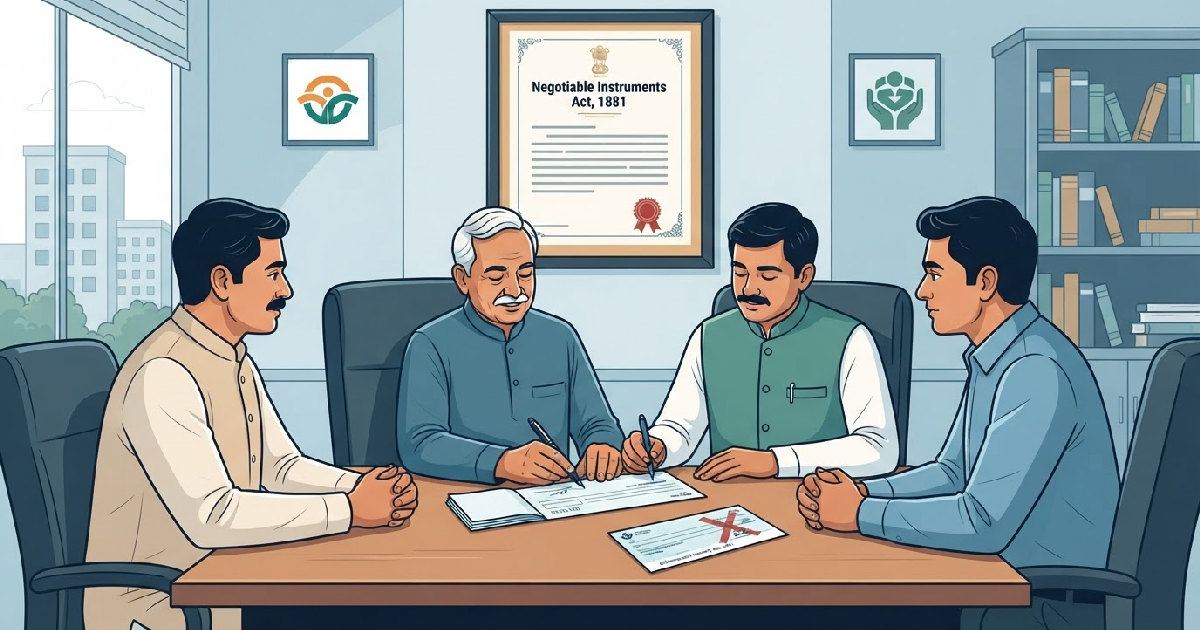
In India, society presidents, secretaries, and committee members can be held accountable in cheque bounce cases. This liability, however, isn’t automatic. It’s subject to precise legal conditions under the Negotiable Instruments Act, 1881 (NI Act).
For charges to proceed, the co-operative society itself must first be named as an accused. Crucially, the individual’s direct involvement and responsibility for the society’s financial affairs at the time of the offence must also be firmly established. This ensures a measured approach to legal proceedings.
Understanding cheque dishonour and co-operative structures
Defining key terms helps clarify India’s legal landscape. A cheque bounce, also known as dishonour of cheque, happens when a bank returns a presented cheque unpaid. This commonly occurs due to insufficient funds in the drawer’s account or when the amount exceeds the agreed bank arrangement.
In India, the dishonour of a cheque for these reasons constitutes a criminal offence. This is explicitly stated under Section 138 of the Negotiable Instruments Act, 1881. The law aims to uphold financial discipline within the country.
A co-operative society is a voluntary association of individuals. These members unite to fulfill shared economic, social, and cultural needs through a democratically controlled and jointly owned enterprise. Its core mission focuses on serving member interests rather than generating profit.
Establishing personal liability for society officials
Holding society officials personally liable in cheque bounce cases requires meeting specific criteria. The law doesn’t automatically assign blame based solely on an individual’s position. Courts demand clear evidence of their direct participation and oversight.
An officer’s direct involvement is paramount for establishing personal liability. This means proving the president, secretary, or committee member actively managed the society’s financial affairs. This involvement must also correlate with the period when the bounced cheque was issued.
Furthermore, their responsibility for the society’s financial operations during the offence period must be clearly demonstrated. This legal requirement safeguards against arbitrary accusations. It ensures that only those with actual financial oversight face charges.
The mandatory step of impleading the society
A fundamental legal prerequisite is that the co-operative society itself must first be impleaded as an accused. This step is non-negotiable. Without the primary entity being formally included in the legal proceedings, charges against its individual office-bearers cannot advance.
This principle ensures accountability begins with the organization. Only after the society is legally implicated do courts then evaluate the extent of individual responsibility among its leadership. It prevents premature targeting of individuals.
Navigating the legal implications
For leaders of co-operative societies, understanding these legal distinctions is crucial. It highlights the importance of clear financial protocols and well-defined roles within their organizations. Prudent financial management and transparent decision-making are key to mitigating personal legal risks.
The liability in these cases isn’t automatic; it depends on specific conditions. This framework ensures a focused application of the law. It demands that an individual’s direct involvement and responsibility are meticulously established for any prosecution to succeed. Without this concrete proof, charges are unlikely to hold.
Indian law provides safeguards to prevent indiscriminate prosecution of all society office-bearers. This protection helps against frivolous complaints. It ensures that individuals are not pressured without concrete evidence linking them directly to the cheque’s dishonour. The legal system seeks genuine culpability, not mere association.
The legal system carefully differentiates between collective organizational responsibility and individual criminal liability. Courts scrutinize evidence to confirm an officer’s actions directly led to the cheque’s dishonour. This process protects individuals who may hold titles but lack active financial control or direct involvement in the specific transaction. It emphasizes the need for procedural correctness.
The Negotiable Instruments Act, 1881, serves as the cornerstone for these legal proceedings. Section 138 of the NI Act specifically criminalizes the dishonour of cheques due to insufficient funds or exceeding bank arrangements. This section is vital for understanding cheque bounce laws in India.
Moreover, adhering to proper legal procedures, such as adhering to notice periods before filing a complaint, is paramount. Courts often emphasize the strict observance of these preliminary steps.
This stringent requirement ensures that only genuinely culpable individuals are brought to justice. It also reinforces the importance of careful adherence to legal timelines and mandates, preventing situations like premature filing of complaints. The law aims for precision in assigning legal fault and upholding due process.
Here’s a breakdown of the core conditions governing liability in cheque bounce cases for society officials:
| Condition for Liability | Legal Requirement | Implication for Officials |
|---|---|---|
| Society Impleaded First | Mandatory prerequisite. | Charges against individuals cannot proceed without this. |
| Direct Involvement Established | Proof of active financial management. | Mere designation isn’t enough; active role must be shown. |
| Responsibility for Financial Affairs | Must have oversight at time of offence. | Demonstrates specific authority over relevant transactions. |
| At Time of Offence | Involvement must coincide with cheque dishonour. | Ensures culpability is tied to the specific incident. |
Can a society president be automatically held liable if a society cheque bounces?
No, liability for a society president, secretary, or committee member is not automatic. The co-operative society itself must first be impleaded as an accused, and the individual’s direct involvement and responsibility for the society’s financial affairs at the time of the offence must be established.
What does “direct involvement” mean in cheque bounce cases for society officials?
Direct involvement means the individual had an active role and responsibility for the society’s financial affairs. This involvement must be clearly established and proven to have occurred at the specific time the cheque bounce offence took place.
What is the role of the Negotiable Instruments Act, 1881, in these cases?
The Negotiable Instruments Act, 1881 (NI Act), is the specific Indian law under which cheque bounce cases are prosecuted. Section 138 of this Act criminalizes the dishonour of cheques due to insufficient funds or exceeding bank arrangements, forming the legal basis for such charges.