
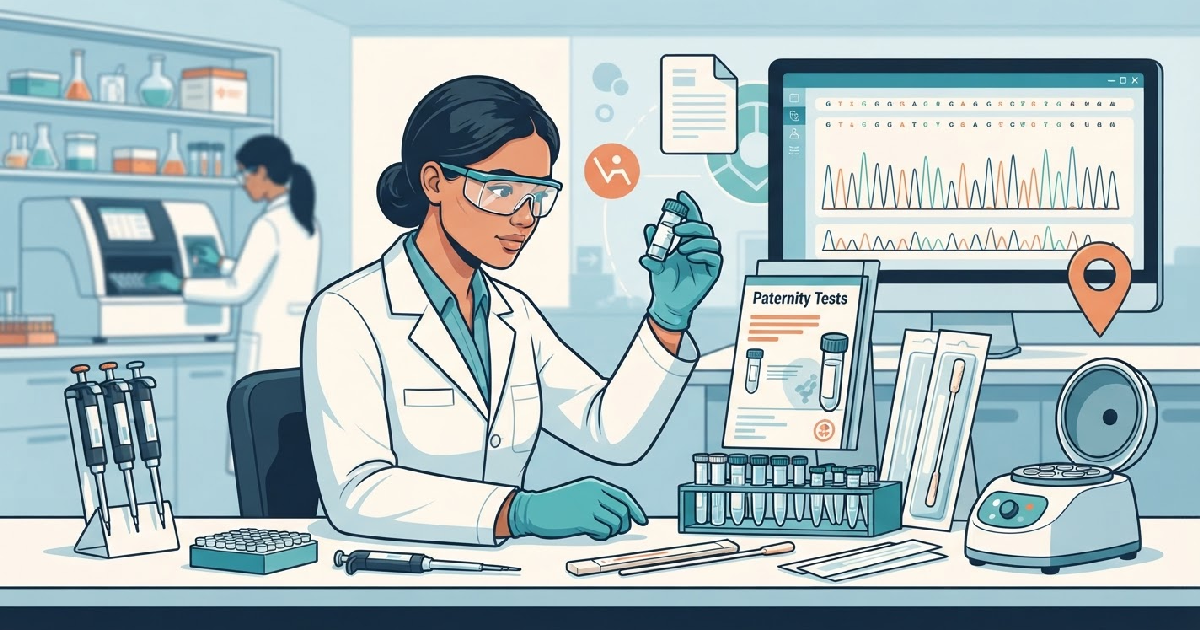
Understanding the intricacies of paternity tests is more critical than ever in 2026, as individuals seek definitive answers for personal reassurance or legal necessity. These scientific methods analyze specific genetic markers in DNA to establish biological fatherhood, comparing a child’s DNA profile with an alleged father’s.
Whether it’s for child support, custody battles, or simply peace of mind, knowing the right type of test and the stringent protocols involved can make all the difference in getting reliable, admissible results.
Distinguishing between types of paternity testing
Paternity tests broadly categorize into legal, court-admissible options and private, “peace-of-mind” tests. While both employ the same accurate DNA analysis techniques, their procedural differences, especially regarding sample collection and legal standing, are significant. Prenatal options also offer unique considerations.
Legal paternity tests admissible in court
For outcomes that will hold up in a courtroom, a legal paternity test is indispensable. Its results serve as official evidence for critical matters like child support, custody arrangements, inheritance claims, and immigration processes.
These tests demand a strict “chain of custody” to maintain integrity. A neutral, certified third party—such as a healthcare professional—collects samples, verifies identities using government-issued photo identification, and meticulously documents every step.
They’ll also photograph participants and ensure secure handling, preventing any tampering. This rigorous process guarantees the findings’ legal validity, with sealed samples sent directly to an accredited laboratory.
Private paternity for personal knowledge
Private paternity tests are designed purely for personal understanding, medical insights, or genealogical exploration. They offer a discreet way to confirm biological relationships without the formal requirements of a legal case.
You can collect samples at home using a kit bought online or from a local drugstore. Typically, these involve buccal (cheek) swabs, which are then mailed to a laboratory for analysis.
However, because there’s no identity verification or strict chain of custody, these results generally aren’t admissible in court. They provide an affordable route to personal clarity.
Non-invasive prenatal paternity tests
The Non-Invasive Prenatal Paternity (NIPP) test stands out as the safest option for determining paternity during pregnancy. It can be performed early, typically from 7 to 8 weeks into gestation.
This method requires a blood sample from the expectant mother and a cheek swab from the potential father. The test accurately analyzes fetal DNA circulating within the mother’s bloodstream, boasting reported accuracy rates of 99.9%.
Invasive methods, like amniocentesis (15 to 20 weeks) and chorionic villus sampling (CVS) (10 to 13 weeks), carry rare risks such as miscarriage. Given its safety and high accuracy, NIPP is now the preferred prenatal paternity testing approach.
The science behind DNA paternity analysis
At its core, paternity testing operates on the principle that a child inherits precisely half of its DNA from its biological mother and half from its biological father. This genetic blueprint forms the basis for all DNA comparisons.
Effective sample collection methods
The most common and least intrusive way to collect DNA samples is via a buccal swab. This involves gently rubbing a sterile cotton swab inside the cheek to gather cells containing the necessary genetic material.
For legal tests, a trained professional strictly adheres to a chain of custody during collection, verifying each participant’s identity. For at-home tests, individuals follow clear instructions, such as washing hands, avoiding food, and air-drying swabs before mailing.
While buccal swabs are standard, blood samples can also be used, though they are more invasive. In some non-legal scenarios, other DNA sources like fingernail clippings might be considered, provided their viability for DNA extraction is confirmed.
Laboratory processing and result interpretation
Upon arrival at the laboratory, DNA is carefully extracted from the samples and then analyzed. Technicians commonly utilize techniques like Short Tandem Repeat (STR) analysis to examine specific genetic markers, or loci.
These distinct regions of DNA are compared between the child and the alleged father. A greater number of matching markers significantly increases the probability of paternity.
If sufficient markers match, paternity is confirmed with a probability of 99.9% or higher, meaning the tested man is millions of times more likely to be the biological father than a random, unrelated individual. Conversely, three or more mismatches definitively exclude the alleged father with 100% certainty, with results typically available within one to two weeks.
The role of AABB accreditation in legal testing
The American Association of Blood Banks (AABB) plays a pivotal role in ensuring the reliability of paternity testing. This global organization sets stringent quality and operational standards for DNA testing laboratories worldwide.
AABB accreditation isn’t merely a certification; it’s a fundamental requirement for any legal relationship test. It guarantees the highest levels of quality, accuracy, and reliability, particularly when results are destined for court.
Many U.S. statutes and federal agencies, including USCIS for immigration cases, explicitly require AABB accreditation for legal relationship tests. These accredited laboratories undergo rigorous audits and assessments to maintain their esteemed status.
While other accreditations exist, such as ANAB, New York State Department of Health (NYSDOH), College of American Pathologists (CAP), and Clinical Laboratory Improvement Amendments (CLIA), AABB remains the essential benchmark for legally binding paternity results. Always verify this accreditation for any legal needs.
How to find a paternity test facility near you
Your search for a paternity test should begin by clarifying your specific need: do you require legally admissible results or simply personal knowledge? This initial decision will guide your choice of collection procedures and laboratory accreditations.
Locating AABB-accredited labs for legal cases
For any legal paternity test, it’s absolutely crucial to choose an AABB-accredited laboratory. The official AABB website provides a current, comprehensive list of these certified facilities, ensuring compliance with legal standards.
Reputable DNA testing companies like DNA Diagnostics Center (DDC), Labcorp DNA, and Universal Genetics offer extensive networks of AABB-accredited collection sites across the U.S. and globally. They can assist in scheduling appointments at approved local facilities convenient for you.
If your test is for legal purposes, consulting with an attorney can provide invaluable guidance. They can advise on specific state requirements and help recommend reputable, accredited facilities that meet all necessary criteria.
Essential verification steps before testing
When searching online for “paternity test near me,” utilize specific terms like “AABB accredited paternity test near me” to refine your results. Many major DNA testing providers offer online locators or customer service lines to help pinpoint nearby collection centers.
Always verify the laboratory’s accreditation, especially for legal purposes, and confirm that strict chain-of-custody procedures will be followed. Inquire about the total cost, which should include both collection fees and lab analysis, and ask about the typical turnaround time for receiving results.
Finally, understand the exact sample collection method—usually a buccal swab—and what identification you’ll need for your appointment, such as a valid photo ID. This diligence ensures a smooth and reliable testing process.
Debunking common paternity test misconceptions
One widespread misunderstanding is the belief that at-home paternity tests are inherently less accurate than those conducted for legal purposes. This isn’t accurate regarding the scientific reliability of the DNA analysis itself.
Both legal and private tests, when processed by accredited laboratories, achieve very high accuracy rates, confirming paternity at 99.9% or higher. They can also exclude an alleged father with 100% certainty.
The core difference lies in the collection process and its legal admissibility, not the scientific precision of the results. As long as a reputable, accredited lab handles the samples, accuracy remains consistently high, regardless of the test type’s purpose.
| Test Type | Purpose | Chain of Custody (for legal admissibility) | Accreditation Needed (for legal admissibility) | Typical Cost Range |
|---|---|---|---|---|
| Legal Paternity Test | Court (custody, support, immigration) | Strictly enforced | AABB | $300 – $800+ |
| Private Paternity Test | Personal knowledge, reassurance | No | Not applicable | $100 – $300 |
| Non-Invasive Prenatal Paternity (NIPP) | Prenatal confirmation | Not specified in research | Not specified in research | Not provided in research |
What is the difference between a legal and a private paternity test?
The primary difference lies in legal admissibility. A legal paternity test follows a strict chain-of-custody process with identity verification by a neutral third party, making its results valid in court for matters like child support or custody. Private tests, on the other hand, are for personal knowledge only, as they lack this formal collection procedure and are not court-admissible.
How accurate are paternity tests?
Both legal and private paternity tests, when processed by an accredited laboratory, are highly accurate. They can confirm paternity with a probability of 99.9% or higher. If the alleged father is not the biological father, the test can exclude him with 100% certainty, demonstrating their scientific reliability.
When can a prenatal paternity test be performed?
A Non-Invasive Prenatal Paternity (NIPP) test, which is the safest option, can typically be performed as early as 7 to 8 weeks into pregnancy. It requires a blood sample from the mother and a cheek swab from the potential father, analyzing fetal DNA present in the mother’s blood.