
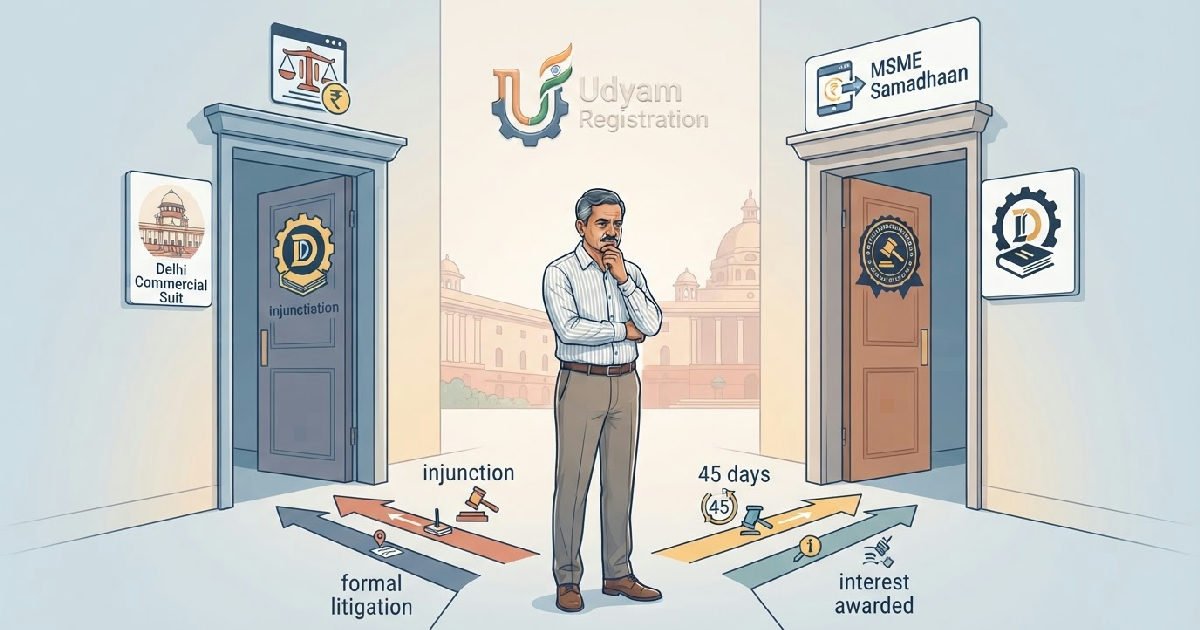
MSME payment recovery in India involves choosing between the MSME Samadhaan portal and a Delhi Commercial Suit, depending on Udyam registration and claim specifics. The strategic choice between these two principal legal avenues hinges significantly on an enterprise’s Udyam registration status and the specific nature of the claim.
Choosing incorrectly can prolong recovery efforts and incur unnecessary costs. Expert commercial lawyers in Delhi routinely scrutinise MSME status well before court fees are paid for commercial suits, underscoring the importance of understanding each route’s parameters before committing to a path. These factors are crucial when considering filing a commercial case.
Navigating India’s Payment Recovery Landscape: MSME Samadhaan vs a Commercial Suit
Delayed payments represent a persistent challenge for India’s vast MSME sector, impacting cash flow and hindering growth. Recognising this, the government established specific mechanisms to expedite the recovery of dues.
However, the legal landscape offers distinct pathways, each with its own advantages, limitations, and procedural requirements. Businesses must carefully assess their eligibility and objectives to determine the most effective strategy for recouping outstanding amounts.
The urgency of delayed payments
Timely payments are the lifeblood of micro and small enterprises. Prolonged delays can cripple operations, impede expansion plans, and even lead to insolvency. This economic reality underpins the imperative for robust and efficient MSME payment recovery mechanisms.
The legal framework aims to provide MSMEs with viable options, but navigating these without proper guidance can be complex and time-consuming. Understanding the nuances of each system is essential for operational stability and growth.
MSME Samadhaan: A Dedicated Legal Channel
The MSME Samadhaan portal, launched by the Ministry of MSME on October 30, 2017, operates under the Micro, Small, and Medium Enterprise Development (MSMED) Act, 2006. It was specifically designed to tackle the systemic issue of delayed payments owed to eligible micro and small enterprises.
This statutory mechanism offers a structured approach, prioritising conciliation and arbitration to resolve disputes quickly. The portal has become a cornerstone for smaller businesses seeking to enforce payment terms.
Eligibility and registration prerequisites
To avail themselves of MSME Samadhaan’s benefits, an enterprise must be registered under Udyam and engaged in manufacturing or service activities. Crucially, retail or wholesale traders, despite Udyam registration, cannot use the delayed payment provisions of the MSMED Act.
This was clarified by a Ministry of MSME Office Memorandum in July 2021. Furthermore, medium enterprises fall outside the purview of Chapter V of the MSMED Act for delayed payments. This is because Section 2(n) of the Act specifically defines a supplier as a micro or small enterprise. A valid Udyam Registration certificate is therefore essential for any benefits, including delayed payment recovery.
The MSME Samadhaan process and timelines
Claims are filed online through the MSME Samadhaan portal. From October 15, 2025, the Ministry of MSME directed that the MSME ODR portal would become the sole route for new delayed payment references, though Samadhaan continues for pending cases.
Once filed, the Micro and Small Enterprise Facilitation Council (MSEFC) of the concerned state examines the case. The process involves conciliation, and if a settlement fails, the matter moves to arbitration under the Arbitration and Conciliation Act, 1996.
The MSMED Act aims for dispute resolution within 90 days, offering a significantly faster route than traditional courts. However, actual resolution can sometimes extend to six to nine months, depending on the complexity and caseload.
Interest rates and buyer obligations
Buyers must pay MSME suppliers within the agreed-upon date, which cannot exceed 45 days from the date of acceptance or deemed acceptance of goods or services. If there’s no written agreement, payment is due within 15 days.
Should a buyer fail to pay within 45 days, they become liable to pay compound interest with monthly rests. This is calculated at three times the bank rate notified by the Reserve Bank of India (RBI). The interest starts accruing from the 46th day, not the invoice date.
For context, with an RBI bank rate of 6.5% in March 2023, the interest rate for delayed payments stood at 19.5%. By May 2024, an RBI bank rate of 6.75% meant the compound interest chargeable was 20.25% per annum.
Key advantages and limitations
MSME Samadhaan offers significant advantages, including its high interest rate, which is substantially higher than the typical 8-12% simple interest seen in civil suits. The requirement for a buyer to deposit 75% of the awarded amount when appealing an MSEFC decision also acts as a strong deterrent against frivolous challenges. Successful enforcing arbitration awards through this channel can be highly effective.
The process involves minimal statutory fees and is generally simplified, often manageable without extensive legal representation. Awards from the MSEFC can be executed directly through the District Collector, streamlining enforcement.
However, Samadhaan cannot grant injunctions, limiting its scope for specific urgent reliefs. It also explicitly excludes medium enterprises and traders, narrowing its applicability. Furthermore, the Limitation Act, 1963, applies to arbitration proceedings under Section 18(3) of the MSMED Act, meaning claims must be filed within three years from when the right to sue arises.
Delhi Commercial Suit: A Broader Legal Path
A Commercial Suit serves as a civil claim filed before a Commercial Court or the Commercial Division of a High Court in Delhi to recover money owed under a commercial transaction. This route is typically more encompassing and flexible than the MSME-specific mechanism.
It is primarily governed by the Commercial Courts Act, 2015, the Code of Civil Procedure, 1908 (CPC), and the Indian Limitation Act, 1963. This framework applies to any domestic or foreign claimant whose dispute meets the statutory “specified value” threshold. For instance, foreign companies filing a commercial suit must meet specific criteria for their plaint.
When to initiate a commercial suit
This legal avenue becomes necessary when a claim falls outside the purview of the MSMED Act. This includes cases involving medium enterprises, traders, or claims not directly related to goods or services supplied by a micro or small enterprise. For example, if a medium enterprise needs to recover dues, a commercial suit is its primary recourse.
A Commercial Suit is also the preferred option when an injunction or other specific relief is required that a Facilitation Council cannot provide. Additionally, if the MSME status or invoice date does not align with the MSMED Act’s specific provisions, parties will often resort to the commercial courts.
Process and associated costs
Before filing a suit, Section 12A of the Commercial Courts Act generally mandates pre-institution mediation, unless urgent interim relief is sought. The plaint is then filed at the registry of the appropriate Commercial Court or Commercial Division, with e-filing often accepted.
Court fees are calculated as a percentage of the suit value under state court fee legislation, which can be substantial. These fees, combined with the need for legal representation, significantly increase the overall cost compared to MSME Samadhaan.
The timelines for Commercial Suits can be extensive, ranging from 1-1.5 years to sometimes 5-7 years in certain courts, due to backlogs and procedural complexities. This extended duration often discourages smaller businesses with limited resources.
Disadvantages compared to MSME Samadhaan
Commercial Suits typically offer a lower interest rate, usually 8-12% simple interest, which is far less punitive for the defaulting buyer. The resolution process is also considerably longer and more resource-intensive, demanding dedicated legal counsel.
There is no mandatory deposit requirement for a defendant to appeal a commercial court judgment, unlike the 75% deposit for MSEFC awards. This makes appeals more accessible for defendants, potentially extending litigation. The need for a separate execution petition for civil decrees further adds to the procedural burden and time.
| Feature | MSME Samadhaan | Delhi Commercial Suit |
|---|---|---|
| Eligibility | Udyam Registered Micro/Small Enterprises (Manufacturing/Service) | Any entity (MSME or otherwise) |
| Jurisdiction | MSME Facilitation Council | Commercial Courts in Delhi |
| Process | Conciliation followed by Arbitration | Traditional litigation (summons, pleadings, evidence, judgment) |
| Interest Rate | Compound interest at 3x RBI bank rate | Typically 8-12% simple interest |
| Appeal Deterrent | 75% deposit required from buyer | No mandatory deposit for appeal |
| Cost | Minimal to no court fees | Significant ad valorem court fees |
| Timeline | Statutory limit of 90 days (actual 6-9 months) | Can take 1.5 to 7 years |
Strategic Choices: When to Opt for Each Route
The decision between MSME Samadhaan and a Delhi Commercial Suit is not one-size-fits-all. It requires a careful assessment of specific circumstances, including the nature of the claim, the parties involved, and the desired outcome. Understanding these distinctions is paramount for effective MSME payment recovery.
The primary consideration revolves around eligibility under the MSMED Act. If a business is a Udyam-registered micro or small enterprise supplying goods or services, MSME Samadhaan typically offers a more advantageous and streamlined path for delayed payments.
Crucial checks before proceeding
Always verify the Udyam registration status of the supplier and the invoice date to confirm eligibility under the MSMED Act. This initial check can prevent filing a claim through an unsuitable channel, saving time and resources.
It’s also critical to avoid duplicating efforts by filing both an MSME Samadhaan claim and a Commercial Suit for the same invoices without a clear, strategic plan. Commercial lawyers in Delhi regularly review MSME status before court fees are paid for a commercial suit, ensuring the correct pathway is chosen.
The impact of Section 43B(h) of the Income-tax Act
A significant incentive for timely payments to MSMEs comes from Section 43B(h) of the Income-tax Act, 1961. From assessment year 2024-25 (Financial Year 2023-24), this provision disallows a buyer from deducting sums owed to micro or small enterprises and paid beyond the Section 15 time limit, unless paid in the year of actual payment.
This means if a buyer delays payment beyond 45 days, they cannot claim the expense deduction in their tax filings for that year, potentially increasing their tax liability. This financial disincentive strongly encourages buyers to adhere to payment schedules for eligible MSMEs. This clause can sometimes compel debtors who were previously resistant to pay.
Expert Legal Assistance for Payment Recovery
Navigating the complexities of payment recovery in India often requires specialised legal expertise. MSME payment recovery lawyers are adept at resolving these disputes, guiding clients through the intricacies of both the MSMED Act and commercial litigation procedures.
These legal professionals assist with filing claims on the MSME Samadhaan Portal, provide representation before Facilitation Councils and courts, and draft essential legal notices. Their expertise extends to enforcing awards, ensuring businesses can effectively recoup their outstanding dues.
The right legal counsel ensures compliance with relevant acts and helps to strategise the most efficient recovery route. This professional guidance maximises the chances of a successful and timely resolution, allowing MSMEs to focus on their core business activities.
Who is eligible to file a complaint through the MSME Samadhaan portal?
Only Udyam-registered Micro and Small Enterprises, engaged in manufacturing or providing services, are eligible to file complaints for delayed payments through the MSME Samadhaan portal. Retail and wholesale traders, even if Udyam-registered, are excluded from these provisions.
What is the primary difference between MSME Samadhaan and a Delhi Commercial Suit for payment recovery?
The main difference lies in jurisdiction, process, and eligibility. MSME Samadhaan is a dedicated, government-backed mechanism for micro and small enterprises, offering a faster, cost-effective conciliation and arbitration process. A Delhi Commercial Suit is a general litigation process available to any entity, typically involving higher costs, longer timelines, and traditional court procedures within the commercial courts.
Can medium enterprises benefit from the delayed payment provisions under the MSMED Act via Samadhaan?
No, medium enterprises are not covered under Chapter V of the MSMED Act, 2006, which deals with delayed payments. The provisions for expedited payment recovery and statutory interest rates via MSME Samadhaan are exclusively for Micro and Small Enterprises.
Buyer has not paid and you are an MSME? WhatsApp or call for consultation.
Related: https://arpitmarwah.com/commercial-lawyers-in-delhi/