
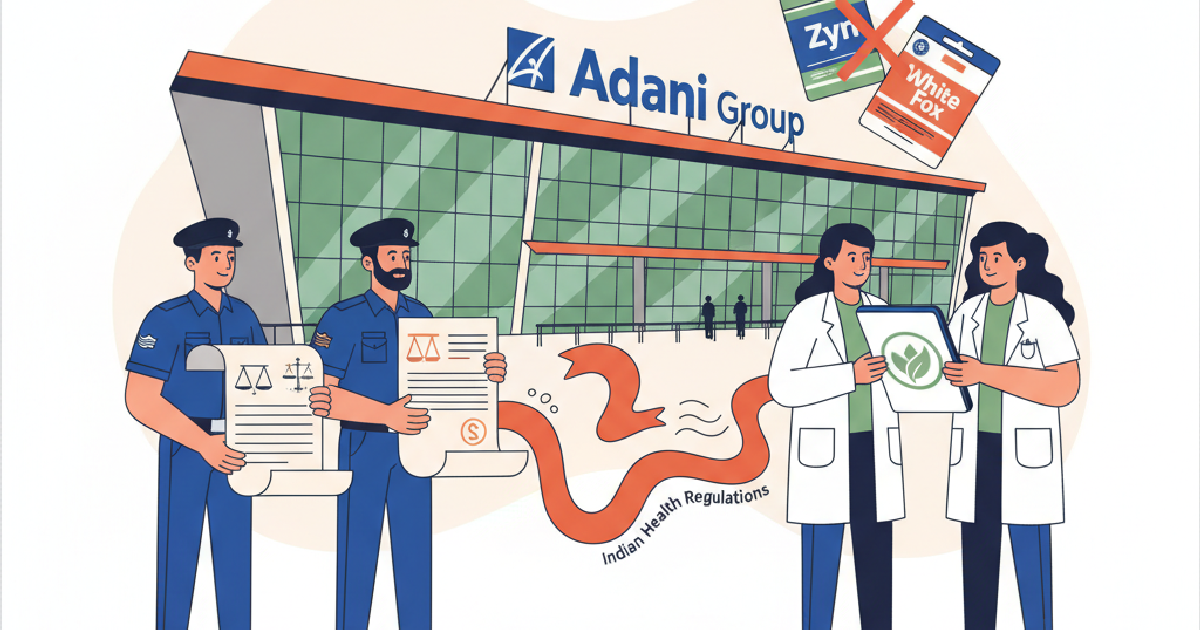
India Customs authorities have officially sided with the nation’s health ministry, intensifying a legal battle against Gautam Adani’s Adani Group over the controversial sale of nicotine pouches at Mumbai International Airport. This move marks the second government agency to formally challenge the conglomerate in the Mumbai High Court regarding products deemed illegal and a public health risk.
The dispute centers on duty-free shops at Chhatrapati Shivaji Maharaj International Airport (CSMIA), managed by the Adani Group. Customs has argued that special tax advantages for duty-free operations do not grant immunity from broader regulatory controls and Indian law.
Customs joins the legal challenge against Adani Group
The latest development sees the Indian customs department officially backing the health ministry. They’ve stated clearly that while duty-free shops enjoy tax exemptions, those benefits don’t place them outside the reach of national regulations.
This directly contradicts the Adani Group’s stance. The company has maintained that its shops, particularly in the international departure area, operate beyond the typical “Indian customs frontier” and are thus exempt from domestic Indian laws regarding product sales.
A June 22 filing to Mumbai judges from the customs department made their position clear. They emphasized that simply having tax advantages doesn’t shield these shops from the need to comply with all other regulatory frameworks in India.
This robust legal challenge from a second powerful government agency could significantly complicate Adani’s defense. It suggests a more coordinated effort by Indian authorities to enforce health and drug regulations, even in seemingly insulated international zones.
The heart of the dispute: where do regulations apply?
The core of this legal entanglement lies in differing interpretations of jurisdiction. Adani Group argues that goods sold in the international departure areas are meant for consumption outside India.
Their unit, Mumbai Travel Retail, operates over 30 duty-free shops at CSMIA. They contend that the Drugs and Cosmetics Act should not apply to these specific retail environments.
But the customs authorities have pushed back hard on this. They consider Adani’s interpretation “untenable,” highlighting that passengers taking possession of duty-free goods can consume them freely once they leave the airport.
The government’s primary concern revolves around public health. Nicotine pouches, including popular brands like Philip Morris’ Zyn and Swedish Smokeless Solutions’ White Fox, remain unapproved in India.
Timeline of a growing regulatory crackdown
The controversy began in March with an inspection by health officials. They found imported nicotine pouches being sold at the airport without the necessary approvals.
By April 2, an assistant drugs controller formally notified the airport’s customs authority. This letter cited an “investigation report” and specified that nicotine pouches fall under the definition of a drug, demanding valid registration and import licenses.
The Adani Group has been importing these products, with more than $29,000 worth of Zyn pouches and $7,700 worth of White Fox brand pouches brought in since August. This import activity preceded the current legal challenges.
In June, an Indian government study flagged nicotine pouches as a “new and largely unregulated public health concern.” This underlines the broader official anxiety about these products.
Just last month, a judge at the Bombay High Court issued a temporary ruling. It stated that “no coercive action” should be taken regarding the existing stock of nicotine pouches at the Mumbai airport’s duty-free shops. However, this didn’t resolve the underlying legality.
Adani Group’s defense and strategic implications
The Adani Group has consistently denied any wrongdoing. They’ve characterized nicotine pouches as a “recent innovation” not specifically covered by existing tobacco control laws.
Their legal challenge in Mumbai’s High Court aims to secure a declaration that the Drugs and Cosmetics Act does not apply to their duty-free operations or the sale of these pouches. The group maintains its legal challenge is valid, arguing customs had asked them to stop sales without an official warning notice in a July 13 filing.
This isn’t just about nicotine pouches. Adani Group operates eight airports across India and has ambitious plans for an $11 billion expansion, which heavily relies on offerings like duty-free retail.
Any adverse ruling here could set a precedent for how regulations apply to all duty-free operations within Indian territory. It could force a re-evaluation of product offerings across their extensive airport network.
Public health vs. commercial interests
The Indian government’s steadfast opposition isn’t just bureaucratic; it’s rooted in serious public health concerns. India grapples with a high incidence of tobacco-related deaths, with 1.35 million lives lost each year.
Allowing unapproved nicotine products, even in duty-free zones, poses a risk. It could expose international travelers, including Indian citizens, to products whose safety and quality haven’t been verified by national drug authorities.
The government views the sale of these products without proper licensing as a “substantive violation” of drug laws and a “serious public health risk.” This perspective is clearly shaping their legal strategy.
For its part, Philip Morris, the manufacturer of Zyn, reported that its sales in the U.S. doubled last year compared with 2023. This highlights the global popularity and market potential of these products, which Adani likely sought to capitalize on.
What the future holds for nicotine pouch sales in India
The legal tussle is set to continue, with the next hearing scheduled for July 28. The outcome of this case could have far-reaching implications, not just for the Adani Group but for all duty-free operators in India.
Should the court side with the government, it would affirm that Indian law applies universally, regardless of a store’s duty-free status. Selling a drug without a license could lead to severe penalties, including a prison term of at least three years and fines of at least 100,000 rupees ($1,049), or three times the value of confiscated drugs.
The Adani Group, with its considerable influence and massive investment in airport infrastructure, is unlikely to back down easily. This makes the ongoing court battle a crucial watch for both public health advocates and the business community.
Ultimately, the Mumbai High Court will weigh the arguments regarding jurisdictional boundaries against public health imperatives. Its decision will shape the regulatory landscape for emerging products in duty-free environments nationwide.