
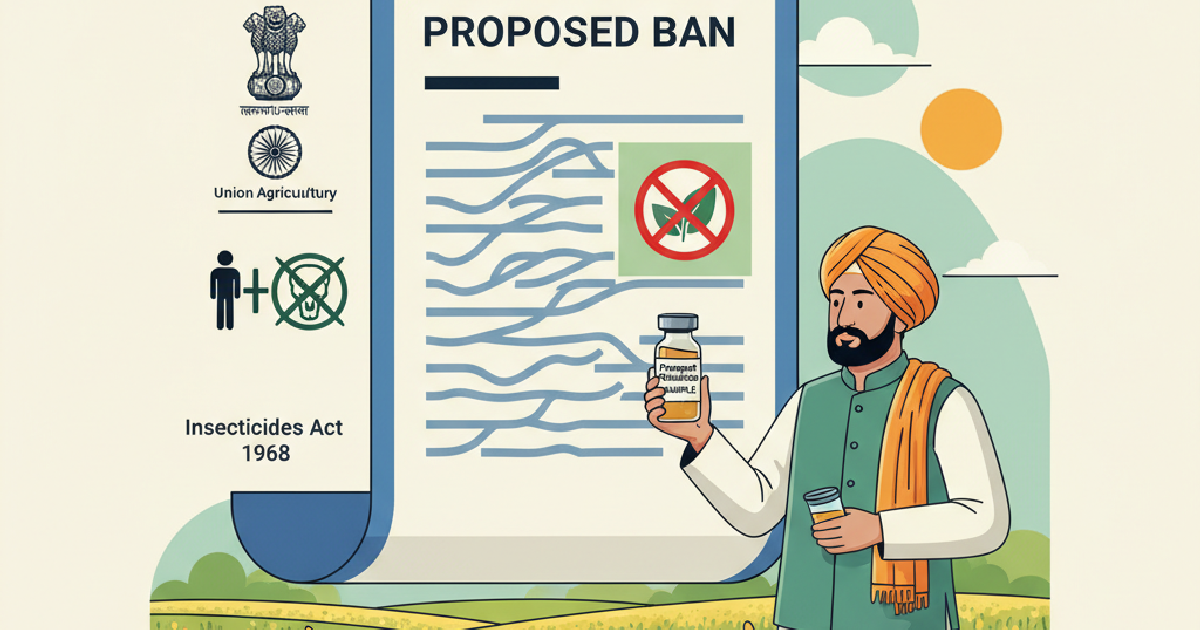
India’s Union Agriculture Ministry has put forward a proposal for a complete, nationwide ban on paraquat dichloride, a widely used agricultural herbicide and insecticide. The draft order, published in the Gazette of India on July 13, 2026, cites serious health concerns for both humans and animals associated with the chemical’s use.
This significant move comes after recommendations from an Expert Committee, formed on January 14, 2026, and the Registration Committee, which operates under Section 5 of the Insecticides Act, 1968. Stakeholders now have a 30-day window, until approximately August 12, 2026, to submit their objections or suggestions before a final order is issued.
India moves to outlaw paraquat dichloride
The proposed ban targets the entire lifecycle of paraquat dichloride within India, covering its manufacture, import, transport, distribution, sale, and use. This comprehensive prohibition fundamentally alters current agricultural practices and the chemical supply chain across the nation.
Upon the final order’s notification, all existing certificates of registration for paraquat dichloride, issued under Section 9 of the Insecticides Act, 1968, will become invalid. Any certificate holders failing to surrender these documents within three months will face legal action as per the Act’s provisions.
The Union Agriculture Ministry’s draft order, titled the ‘Banning of Paraquat Dichloride Order, 2026’, represents a definitive stance. It gives state governments explicit instructions to ensure rigorous enforcement within their respective territories, highlighting the severity of the perceived threat.
Grave health concerns drive regulatory action
The impetus behind the proposed ban is deeply rooted in extensive, well-documented evidence of paraquat’s extreme toxicity and the alarming absence of a specific medical antidote. This dual threat makes even accidental exposure potentially lethal, a concern frequently raised by medical professionals.
Researchers from Christian Medical College (CMC), Vellore, have consistently highlighted paraquat’s widespread availability in India, despite bans elsewhere. They point to its frequent misuse for self-harm and homicidal poisonings, contributing to thousands of deaths annually across the country.
The ingestion of even a small amount, perhaps a single sip, can trigger a cascade of organ failure, including acute respiratory distress, severe kidney injury, and liver damage. This often leads to irreversible pulmonary fibrosis, a condition critically known as ‘paraquat lung,’ and swift mortality.
Beyond immediate acute effects, a growing body of research connects paraquat exposure to long-term neurological damage. The chemical can infiltrate the brain, specifically targeting and damaging dopamine-producing neurons, a mechanism strongly associated with Parkinson’s disease development.
Furthermore, studies suggest potential links to non-Hodgkin lymphoma and childhood leukemia, compounding the public health concerns. The Registration Committee explicitly cited these documented adverse health effects and persistent poisoning incidents with high fatality rates in its recommendation.
A global trend against the dangerous chemical
India’s move to ban paraquat dichloride isn’t an isolated incident; it mirrors a decisive global trend. More than 70 countries worldwide have already implemented bans or stringent restrictions on the controversial herbicide, underscoring a widespread international consensus on its dangers.
The European Union famously banned paraquat in 2007, a decision that followed rigorous scientific review and legal battles. Other major agricultural nations like China prohibited its domestic use in 2017, and Thailand, Malaysia, South Korea, Taiwan, Brazil, Chile, and Peru have all enacted comprehensive prohibitions.
Even within the United States, a key agricultural player, the state of Vermont took action in May 2026, establishing a ban with a full prohibition slated by 2030. This robust international precedent clearly weighed heavily on the expert committees that recommended the Indian ban.
Domestically, several Indian states had previously attempted to curb its use through temporary measures. Telangana initiated a ban in March 2026, while Andhra Pradesh enacted a 60-day prohibition. Odisha had a similar temporary ban in 2023, and Kerala briefly restricted it in 2011.
However, these state-level actions often faced limitations in duration or scope, with Kerala’s ban even being overturned due to procedural issues. The proposed nationwide ban through central government action under the Insecticides Act, 1968, provides the comprehensive and permanent solution previously sought.
Agricultural impact and farmers’ concerns
While public health advocates largely welcome the proposed ban, it undoubtedly poses significant challenges for India’s vast agricultural sector. Kalyan Goswami, Director General of the Agro Chem Federation of India, expressed serious concerns, warning of potential “severe disruption” to farming operations.
Goswami emphasized paraquat dichloride’s role as the “third most widely used herbicide globally,” stressing its importance for farmers. He pointed out its effectiveness in controlling a broad spectrum of weeds, its cost-efficiency, and its ability to facilitate timely land preparation, crucial for crop cycles.
In India, the chemical currently holds approval for use on at least nine different crops, including staples like tea, potato, cotton, rubber, and paddy. Farmers in these sectors rely on its rapid action and effectiveness, particularly in no-till farming practices.
However, the government’s unwavering focus on protecting human and animal health appears to supersede these agricultural conveniences and economic arguments. This policy shift indicates a long-term commitment to safer farming practices, even if it necessitates short-term adjustments.
Manufacturers, importers, and distributors of paraquat dichloride will need to swiftly adapt their business models. They must consider alternative herbicides or agricultural methods as the three-month window for surrendering licenses approaches, following the final order.
The current consultation period, where stakeholders can submit their feedback to the Joint Secretary (Plant Protection) at the Ministry of Agriculture and Farmers Welfare, represents a critical final stage. Despite potential industry pushback, the momentum suggests India is set to join the growing list of nations phasing out this hazardous chemical.