
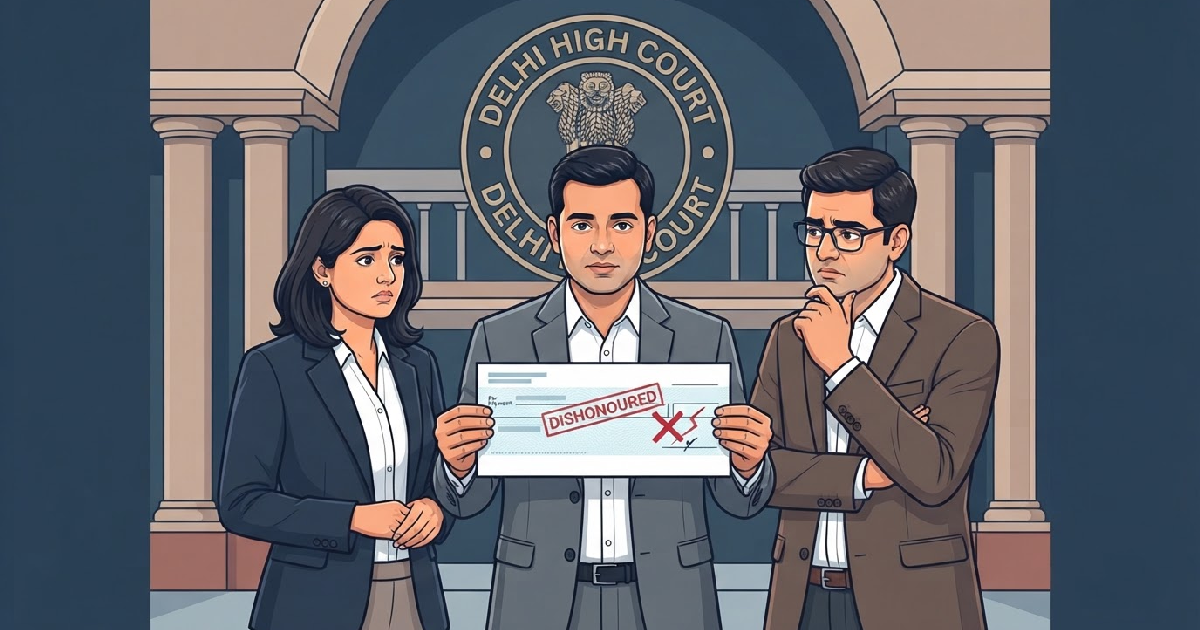
Presided over by Hon’ble Mr. Justice Amit Mahajan, the ruling stated that proceedings under Section 138 of the Negotiable Instruments Act, 1881 (NI Act) cannot continue against individuals once a moratorium under Section 14 of the IBC is in effect. The cases in question were CRL.M.C. 6170/2022 against Rukmani Gupta and CRL.M.C. 6178/2022 against Vipin Aggarwal & Anr.
Delhi High Court clarifies liability in cheque dishonour cases
The petitions sought to overturn a summoning order dated April 1, 2022, issued by the learned Metropolitan Magistrate, Rouse Avenue Court, Delhi. This order pertained to a complaint, CC No. 9170/2020, concerning an alleged offence under Section 138 of the NI Act.
Mr. P.S. Bindra, counsel for the petitioners, argued that his clients, including Petitioner No. 1, a suspended director, and Petitioner No. 2, an authorised signatory, were no longer responsible for the company’s affairs. He stressed that the imposition of the moratorium rendered the cheques incapable of encashment.
Background to the legal challenge
The roots of this dispute trace back to an order from the National Consumer Disputes Redressal Commission (NCDRC) on July 24, 2019. This directive, issued in Execution Application 93/2017, compelled the accused company, Today Homes and Infrastructure Pvt. Ltd., to issue six cheques.
Two cheques, each valued at ₹5,00,000/-, were presented to the bank on July 23, 2019, and were successfully honoured. However, the financial landscape shifted dramatically for the company shortly thereafter.
The crucial role of the Insolvency and Bankruptcy Code moratorium
On October 31, 2019, the company was formally admitted into Corporate Insolvency Resolution Process (CIRP) under Section 7 of the IBC. Critically, a moratorium, as stipulated by Section 14 of the IBC, was simultaneously imposed on this date.
This moratorium fundamentally alters the legal and financial status of the company, placing its management under the control of an Interim Resolution Professional (IRP). This legal protection shields the company from further legal action during the resolution period.
The specifics of the dishonoured cheques and company status
The cheques central to the current proceedings, bearing numbers 787733 and 787753, were dated January 15, 2020, and March 15, 2020, respectively. Each was for a sum of ₹10,00,000/-.
When these cheques were presented for encashment, they were returned by the bank. The bank’s stated reason for dishonour was ‘Drawer Signature to operate account not received’, a direct consequence of the moratorium.
From NCDRC order to CIRP initiation
The initial issuance of the six cheques by Today Homes and Infrastructure Pvt. Ltd. was a direct response to the NCDRC’s order. Two of these were cleared, indicating the company’s initial compliance.
However, the subsequent admission into CIRP marked a significant turning point, transferring all operational control away from the original signatories. This transition occurred well before the later cheques were presented.
Why the cheques bounced: ‘drawer signature not received’
The specific reason for dishonour, ‘Drawer Signature to operate account not received’, is highly significant in this context. It implies that the bank account was effectively frozen or its operational control transferred, rendering the former signatories’ authority null and void.
This is not a reflection of insufficient funds or a deliberate attempt to default by the original signers. Instead, it points to a systemic block due to the ongoing insolvency process.
Key dates and financial transactions
| Event | Date | Significance |
|---|---|---|
| NCDRC Order | July 24, 2019 | Led to initial cheque issuance |
| First Cheques Honoured | July 23, 2019 | Pre-moratorium, company in control |
| CIRP & Moratorium Imposed | October 31, 2019 | Management shifted to IRP |
| Cheque No. 787733 Dated | January 15, 2020 | Post-moratorium, dishonoured |
| Cheque No. 787753 Dated | March 15, 2020 | Post-moratorium, dishonoured |
Judicial precedent and legal arguments presented
The petitioners’ primary argument hinged on the legal framework established by the IBC. They contended that once an Interim Resolution Professional (IRP) is appointed, management of the corporate debtor’s affairs vests solely in the IRP, as per Section 17 of the IBC.
Therefore, the suspended director and authorised signatory ceased to have any role in managing the company’s bank accounts. This meant they couldn’t be held liable for actions taken or not taken post-moratorium.
Arguments from the petitioners’ counsel
Mr. Bindra emphasized that the offence under Section 138 of the NI Act requires that the accused be “in charge of” and “responsible for the conduct of the business of the company” at the time of the offence. This condition was not met after the moratorium was imposed.
He powerfully argued that the cheques were rendered incapable of encashment due to the moratorium, not due to any fault of his clients. The NCLT’s order blocked the account, removing control from the account holder.
Drawing lessons from Govind Prasad Todi case
Justice Mahajan referenced a coordinate bench ruling in Govind Prasad Todi & Anr. V. Govt. of NCT of Delhi & Anr. (2023 SCC OnLine Del 3717). This precedent strongly supported the current decision, having previously quashed summoning orders under similar circumstances.
In Govind Prasad Todi, it was explicitly held that once a moratorium under Section 14 of the IBC takes effect, proceedings under Section 138 of the NI Act against the corporate debtor cannot continue. This established a clear legal pathway.
That ruling also clarified that after CIRP admission, an Interim Resolution Professional becomes solely responsible for the company’s business. An email directive from the CIRP in that case explicitly barred debit transactions without approval, underscoring the shift in authority.
Far-reaching implications for corporate governance and individual liability
This judgment from the Delhi High Court provides significant clarity on the interplay between the Negotiable Instruments Act and the Insolvency and Bankruptcy Code. It solidifies the protective shield that the IBC moratorium offers to former management personnel.
The ruling confirms that personal culpability for cheque dishonour is effectively severed once a company undergoes a formal resolution process. This prevents individuals from facing legal action for circumstances beyond their control post-insolvency.
Protecting directors during insolvency
The decision safeguards directors and authorised signatories from vicarious liability in situations where their control over company finances has been legally curtailed. It acknowledges the drastic shift in responsibility that occurs with the appointment of an IRP.
This protection is crucial for encouraging participation in corporate rescue mechanisms without the added burden of individual criminal prosecution. It creates a more predictable legal environment for those involved in struggling companies.
What this means for creditors
While protecting individuals, the ruling also re-emphasizes that creditors’ recourse shifts once a company enters CIRP. Instead of pursuing individual directors for cheque dishonour, their claims must be addressed through the insolvency resolution process itself.
This streamlines the process, channeling all claims through the IRP and the NCLT, ensuring equitable treatment among creditors. It means they need to engage with the IBC framework, rather than parallel criminal proceedings.
Expert perspectives on the ruling’s future impact
Legal experts suggest this ruling will reinforce the supremacy of the IBC during corporate insolvency. It sends a clear message that the legal consequences of a moratorium are comprehensive, extending to criminal liabilities previously faced by individuals.
The decision might encourage more proactive engagement with the IBC framework for troubled companies. It offers a degree of certainty for executives during a tumultuous period, focusing efforts on resolution rather than personal defence.
However, it also underscores the importance for businesses and their legal advisors to thoroughly understand the precise timing of events surrounding cheque issuance and insolvency filings. Accurate record-keeping becomes even more critical in this nuanced legal landscape.
The emphasis on the reason for dishonour—specifically that the ‘Drawer Signature to operate account not received’ was a direct result of the moratorium—is particularly insightful. This clarifies that the core ingredients for an NI Act offence were not met.
What is the primary impact of CIRP on cheque dishonour proceedings?
Once a company enters the Corporate Insolvency Resolution Process (CIRP) and a moratorium under Section 14 of the IBC is imposed, cheque dishonour proceedings under Section 138 of the NI Act against the company’s former management are generally quashed. This is because the control and responsibility shift entirely to the Interim Resolution Professional (IRP).
Can a director be held personally liable for bounced cheques after a company enters insolvency?
No, typically not. The Delhi High Court ruling affirms that after a company enters CIRP and a moratorium is in effect, former directors and authorised signatories are shielded from personal liability for cheque dishonour. Their authority over company operations ceases, and subsequent dishonour due to insolvency-related account restrictions is not attributed to them.
What happens if cheques were issued before but dishonoured after the moratorium started?
Even if cheques were issued prior to the moratorium, if they are presented and dishonoured after the moratorium has commenced due to the company’s account being blocked by insolvency proceedings, the former directors or signatories are usually not held liable. The dishonour in such instances is a direct consequence of the legal insolvency process, not their individual actions.
Call or Whatsapp for free consultation.
Related Service: https://arpitmarwah.com/cheque-bounce-lawyers-in-delhi/