
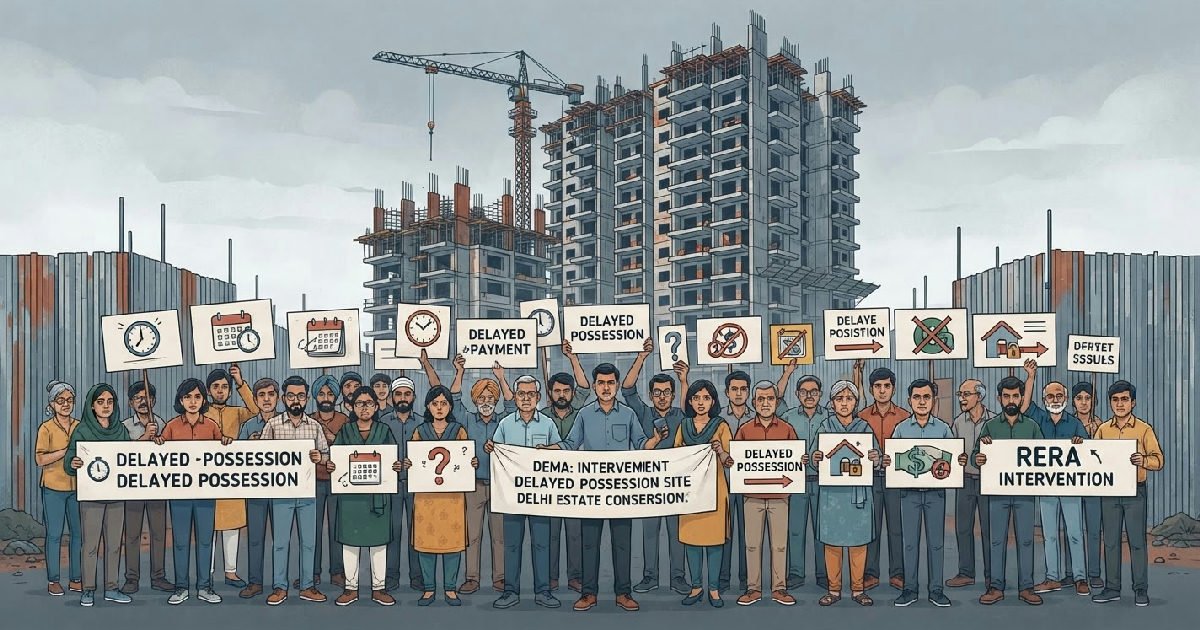
Homebuyers across Delhi NCR are increasingly caught in a challenging bind: their promised property possession dates are long past, yet builders continue to issue demands for further installment payments. In this scenario, one question often comes across- should you stop paying further installments if possession is delayed?
While the frustration is palpable and the urge to unilaterally cease payments might feel justified, doing so can trigger severe financial and legal repercussions, potentially leading to the cancellation of bookings and forfeiture of substantial amounts already paid.
Navigating Delayed Possession in Delhi NCR
More than 3 lakh homebuyers in the Delhi National Capital Region (NCR) are reportedly in this precarious situation, having paid upwards of 90% of their property’s cost.
The Real Estate (Regulation and Development) Act, 2016 (RERA), offers specific legal pathways for redressal in cases of delayed possession. However, neglecting payment obligations without proper legal consultation and documentation can leave buyers vulnerable. Property owners must understand that a silent stoppage of payments, even in the face of builder default, rarely serves their best interests.
The issue of delayed property possession has plagued the Delhi NCR real estate market for years. Builders often cite various reasons for these postponements, ranging from delays in obtaining crucial approvals and unforeseen construction slowdowns to outright builder defaults and problems securing Occupancy Certificates (OC). This leaves buyers in an untenable position, often servicing home loans for properties they cannot inhabit or rent out.
Under RERA, builders have clear legal obligations. They must complete projects within the timelines initially declared and agreed upon with homebuyers.
Should they fail to meet these deadlines, the Act mandates that builders either pay interest for the period of delayed possession or offer a refund with interest if the buyer opts to withdraw from the project.
Transparency is also key; builders are required to formally notify buyers of any delays, provide specific reasons, and communicate a new, realistic expected date of possession.
The Peril of Stop Paying Further Installments if Possession is delayed
While a builder’s failure to deliver on time is frustrating, homebuyers should exercise extreme caution before deciding to stop their home loan Equated Monthly Installments (EMIs). This seemingly direct response can lead to a cascade of negative consequences, often far outweighing the immediate relief of not paying. Lenders view these defaults seriously, and the fallout can affect a buyer’s financial health for years.
Missed EMIs can trigger late payment penalties, significantly increase the overall debt burden, and result in higher interest rates. More critically, it causes substantial damage to a homebuyer’s credit score, specifically their CIBIL score. A poor credit score can hinder future loan applications, from personal loans to vehicle financing, for an extended period.
Rishi Anand, MD & CEO of Aadhar Housing Finance Ltd, warns that “Missing EMIs can damage your credit score, increase debt burden with late fees, and lead to loan foreclosure or legal action.”
| Consequence of EMI Default | Impact |
|---|---|
| Late Payment Fees | Typically ₹500–₹1,000 per EMI, or 1% to 2% of EMI amount |
| Penal Interest Rates | Up to 2% to 4% per month on the overdue amount |
| Credit Score Reduction (1 day delay) | 25 to 30 points |
| Credit Score Reduction (1 month delay) | 75 to 100 points |
| Loan Classification as NPA | After 90 consecutive days of non-payment |
| Minimum Time to Auction | Approximately 105 days from first missed EMI |
| SARFAESI Act Notice Period | 60 days to clear outstanding amount after demand notice |
Beyond financial penalties and credit score degradation, continued non-payment can escalate to legal action by banks. Under the Securitisation and Reconstruction of Financial Assets and Enforcement of Security Interest (SARFAESI) Act, banks can take possession of the property and auction it off to recover their dues, often without requiring court intervention.
This process can be remarkably swift, with the minimum time from the first missed EMI to an actual auction potentially as short as 105 days.
RERA: Homebuyers’ Recourse Against Delays
Instead of halting payments unilaterally, affected homebuyers in Delhi NCR have a robust legal framework in RERA to pursue their claims. The Act, specifically Section 18, makes builders directly liable for delayed possession.
Buyers have two primary options: either withdraw from the project and claim a full refund plus interest, or continue with the project and demand interest for every month of delay. The Supreme Court has consistently supported homebuyers’ rights, stating that the right to a refund or interest is “absolute and unconditional.”
The statutory interest rate builders must pay for delayed possession is calculated as the State Bank of India’s (SBI) Marginal Cost of Funds-based Lending Rate (MCLR) plus 2%. This rate is symmetrical, meaning it matches the rate a builder would charge a buyer for late payments.
In some Haryana RERA orders, this rate has ranged from 10.45% to 10.85% annually. A notable case saw Haryana RERA ordering a specific builder to pay 11.01% interest, calculated from December 7, 2015, until possession, due to a delay exceeding nine years.
For exceptional delays, the Supreme Court has even ordered 18% interest in a high-profile case.
Homebuyers can also claim additional compensation of up to 10% of the property price if the delay is clearly attributable to the builder without valid justification. Filing a complaint with RERA is generally a more effective and legally sound strategy than stopping payments.
The RERA Adjudicating Officer is mandated to hear and decide a case within a 60-day timeframe under Section 71 of RERA, offering a relatively swift resolution process for many.
Strategic Considerations for Affected Homebuyers
When facing delayed possession, the recommended approach for homebuyers is to engage with the builder while simultaneously pursuing legal avenues. It is crucial to maintain detailed records of all communication with the developer, including letters, emails, and any notices regarding construction progress or delays. Documenting every payment made and every promise broken strengthens a homebuyer’s position should legal action become necessary.
Consulting RERA lawyers in Delhi is often the first logical step. Legal counsel can evaluate the specifics of the purchase agreement, assess the builder’s breaches, and guide the homebuyer through the process of filing a RERA complaint for interest, possession, or a refund.
Stopping payments unilaterally, as the initial advice suggests, should only be considered after receiving explicit legal advice and ensuring all risks are understood and mitigated.
Crucially, homebuyers should never ignore a demand for payment, even if they plan to pursue RERA. Paying the next slab amount solely due to a cancellation threat from the sales office, without any visible construction progress or written justification from the builder, is equally ill-advised.
Instead, any decision to withhold payments must be formally communicated in writing to the builder, clearly stating the reasons for non-payment, linking it to specific contractual breaches, and ideally, undertaken under legal guidance. This provides a clear paper trail and protects the buyer from accusations of default.
Understanding Builder Responsibilities and Legal Limits
RERA aims to curb exploitative practices by builders. One key provision prevents developers from demanding more than 10% of the total property cost as an advance payment before a formal sale agreement is signed. This protects buyers from committing excessive funds before legal formalities are complete and project details are solidified.
This regulatory framework ensures that builders bear more responsibility for project completion and adherence to timelines.
The Act also requires builders to formally notify buyers of any project delays, providing specific reasons and a revised, realistic possession date. This communication should be in writing. If a builder builder cancels allotment without adhering to the RERA guidelines, homebuyers still have strong recourse.
The law prioritises consumer protection and ensures that buyers are not left in the lurch due to developer negligence or malfeasance.
Outlook: Strengthening Homebuyer Protection
The consistent support from judicial bodies, including the Supreme Court, reinforces RERA’s mandate to protect homebuyers. Rulings like the one in Newtech Promoters (2021), where the Supreme Court affirmed the homebuyer’s right to refund or interest as “absolute and unconditional,” set strong precedents.
Such judgments send a clear message to developers: contractual obligations and promised timelines are not merely suggestions but binding commitments with significant financial implications for non-compliance.
The ongoing enforcement of RERA, coupled with the ability to file complaints with Consumer Forums for ‘deficiency in service’ and even initiate insolvency proceedings against developers under the Insolvency and Bankruptcy Code (IBC), provides a multi-pronged approach for buyers seeking justice.
These mechanisms collectively work to ensure that the residential real estate market in Delhi NCR, and indeed across India, becomes more transparent, accountable, and buyer-friendly. Homebuyers should proactively use these legal tools rather than resorting to actions that might compromise their own standing.
Can I stop paying installments if my property possession is delayed?
Unilaterally stopping installment payments without legal counsel is highly risky. While frustrated, it can lead to booking cancellation, forfeiture of paid amounts, severe damage to your credit score, and potential legal action by banks, including property seizure under the SARFAESI Act.
What interest rate can I claim for delayed possession under RERA?
Under RERA, builders must pay interest at the State Bank of India’s (SBI) Marginal Cost of Funds-based Lending Rate (MCLR) plus 2% for delayed possession. This rate is symmetrical to what the builder would charge for late payments from the buyer. In some cases, courts have ordered even higher rates, up to 18%.
What happens to my credit score if I stop paying my home loan EMIs?
Stopping home loan EMIs can severely damage your credit score. Even a one-day delay can reduce it by 25-30 points, and a month-long delay can cause a drop of 75-100 points. After 90 days of non-payment, your loan is classified as a Non-Performing Asset (NPA), making future credit difficult to obtain.
Next demand on a delayed NCR flat? WhatsApp or call for free consultation.