
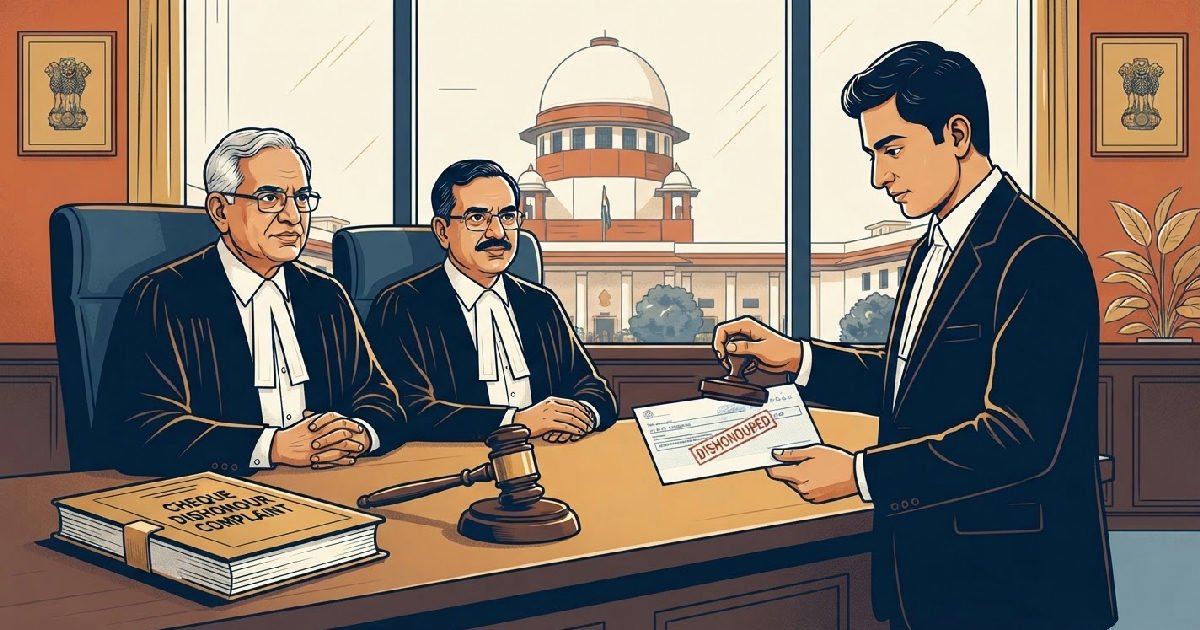
Criminal cheque dishonour complaints under Section 138 of the Negotiable Instruments Act, 1881, cannot be dismissed pre-trial if conditions are met, ruled the Supreme Court of India on April 7, 2026. Handed down on April 7, 2026, by a bench comprising Justices J.K.
A cheque dishonour complaint is often filed when a cheque is returned unpaid. Understanding the process is crucial for all creditors.
In a cheque dishonour complaint, the aggrieved party must follow specific legal procedures to ensure their claims are heard.
Maheshwari and Atul S. Chandurkar, the judgment underscores that determining whether a cheque was issued for a “legally enforceable debt” is a matter for a full trial, not for early dismissal.
The implications of a cheque dishonour complaint can be far-reaching for both the drawer and the payee.
Filing a cheque dishonour complaint is a legal remedy that can help recover debts effectively.
Every cheque dishonour complaint must include the essential details of the transaction involved.
The legal framework surrounding a cheque dishonour complaint helps maintain financial discipline.
Strengthening India’s Cheque Dishonour Law
Understanding the Negotiable Instruments Act is critical when navigating a cheque dishonour complaint.
A cheque dishonour complaint highlights the importance of maintaining sufficient funds in a bank account.
A timely cheque dishonour complaint can prevent prolonged disputes and facilitate quicker resolutions.
Each cheque dishonour complaint must adhere to specific legal timelines to be valid.
The validity of a cheque dishonour complaint is determined by the conditions set in the law.
In a cheque dishonour complaint, the drawer has the right to present a defense during the trial.
Defendants in a cheque dishonour complaint must provide sufficient evidence to counter the claim.
Understanding the ingredients of a cheque dishonour complaint can streamline the legal process.
The complexities of a cheque dishonour complaint often require legal guidance to navigate.
The outcomes of a cheque dishonour complaint can significantly impact financial relationships.
A cheque dishonour complaint serves as a reminder for individuals to fulfill their financial obligations.
This decision, arising from the case of Renuka v. State of Maharashtra & Anr., overturns rulings by both the Sessions Court and the Bombay High Court. It firmly reiterates the mandatory nature of the statutory presumption under Section 139 of the NI Act, ensuring that cheque dishonour cases proceed to a full evidentiary hearing once the initial legal requirements are met.
In the Renuka case, the cheque dishonour complaint showcases the importance of adhering to legal protocols.
Following the legal process of a cheque dishonour complaint ensures all parties are treated fairly.
A clear understanding of a cheque dishonour complaint can empower creditors during legal actions.
The rationale behind a cheque dishonour complaint hinges on the principles of accountability and responsibility.
Parties involved in a cheque dishonour complaint should be aware of their rights and obligations.
Successfully navigating a cheque dishonour complaint requires diligence and attention to detail.
The Supreme Court’s latest pronouncement is poised to significantly impact the handling of cheque dishonour complaints across India. It provides much-needed clarity for both complainants and judicial authorities, reinforcing the procedural integrity of the Negotiable Instruments Act.
For creditors, including numerous micro, small, and medium enterprises (MSMEs), the ruling offers a stronger legal recourse. It minimises the possibility of an accused party evading trial by simply claiming that the cheque was not backed by a legally enforceable debt at an early stage of proceedings.
This legal certainty is vital for the smooth functioning of commercial transactions and for upholding trust in financial instruments. The decision essentially makes it harder for defendants to circumvent the full legal process, particularly when they don’t dispute the signature or issuance of the cheque. This shift could accelerate resolution in many cheque bounce cases, reducing prolonged legal battles.
Unpacking the Negotiable Instruments Act, 1881
The Negotiable Instruments Act, 1881, is a cornerstone of commercial law in India. Enacted over 140 years ago, it provides a legal framework for promissory notes, bills of exchange, and cheques. However, the provisions directly addressing cheque dishonour, specifically Chapter XVII (Sections 138 to 142), were only introduced via an amendment in 1988.
This amendment marked a pivotal shift, criminalising cheque dishonour to bolster the credibility of cheques as a mode of payment. The legislative intent was clear: foster greater financial discipline and safeguard the interests of creditors who rely on the sanctity of these instruments.
It aimed to provide a faster and more effective remedy than traditional civil litigation, especially for situations like cheque bounce against a company.
Key Provisions: Sections 138 and 139 Explained
Section 138 of the Negotiable Instruments Act outlines the specific conditions that constitute an offence of cheque dishonour. For a complaint to be valid, several ingredients must be met, forming the initial basis for legal action. These include the issuance of a cheque for a debt or liability, its presentation within validity, and subsequent dishonour due to insufficient funds or payment stoppage.
Crucially, Section 139 introduces a statutory presumption. It mandates that courts must presume, unless proven otherwise, that the holder of a cheque received it for the discharge of a debt or other liability.
This presumption is rebuttable, meaning the accused can challenge it, but only through concrete evidence presented during a trial, not through mere assertion. This “reverse onus clause” significantly shifts the burden of proof onto the drawer.
| Ingredient | Description |
|---|---|
| Cheque Drawal | A cheque must be drawn by a person on their bank account. |
| Purpose of Issue | Issued for a legally enforceable debt or other liability. |
| Presentation Period | Presented within three months of its date or validity, whichever is earlier. |
| Dishonour Reason | Cheque returned unpaid due to insufficient funds or payment stopped. |
| Statutory Notice | Payee must send written demand notice within 30 days of dishonour. |
| Failure to Pay | Drawer fails to pay the amount within 15 days of receiving the notice. |
The Renuka v. State of Maharashtra Case: A Detailed Look
The Supreme Court’s ruling stemmed from a specific case, Renuka v. State of Maharashtra & Anr., which involved a substantial sum of ₹50 crore. The dispute originated from a matrimonial settlement where the complainant alleged her husband had agreed to pay this amount.
A third party, acting as a guarantor, then issued a cheque for the same amount in Renuka’s favour. When she presented the cheque, it was dishonoured with the remark, “payment stopped by drawer,” initiating the legal proceedings that eventually reached the highest court.
Matrimonial Settlement and a ₹50 Crore Cheque
The timeline of events in the Renuka case illustrates the procedural journey a cheque dishonour complaint can take. The cheque was presented on April 6, 2022, and dishonoured shortly thereafter. A statutory notice demanding payment was issued on April 20, 2022, but the liability was denied in a reply on May 4, 2022.
Consequently, Renuka filed a complaint (CC 1831/SC/2022) on June 16, 2022. The Metropolitan Magistrate took cognisance of the complaint and issued a process against the drawer the very next day. This initial step indicated a prima facie satisfaction of the Section 138 ingredients.
Lower Courts’ Decisions and Supreme Court’s Intervention
Despite the Magistrate’s order, the Sessions Court intervened on December 30, 2022, quashing the process. The Sessions Court’s rationale was that the cheque was not issued for a “legally enforceable debt” at the time of its issuance. This interpretation effectively dismissed the complaint before a full trial could commence.
In conclusion, understanding a cheque dishonour complaint is essential for all financial transactions.
The Bombay High Court subsequently upheld this view under Article 227, thereby confirming the quashing of the proceedings. This chain of events prompted Renuka to appeal to the Supreme Court, challenging the lower courts’ decisions to prematurely dismiss her complaint.
Reinforcing Statutory Presumption in Cheque Dishonour
The Supreme Court, in allowing Renuka’s appeal, stressed that the central question of whether a cheque was issued for a legally enforceable debt is inherently a matter for trial. Justice Atul S. Chandurkar, who authored the judgment, observed that dismissing a complaint at the pre-trial stage effectively undermines the statutory presumption enshrined in Section 139 of the NI Act.
The court pointed out that once the basic conditions of Section 138 are met, and the drawer does not dispute the signature or the issuance of the cheque, the burden shifts. The accused must then rebut the presumption that the cheque was for a valid debt, and this rebuttal can only occur through presenting evidence during the trial, not through summary dismissal.
As the court succinctly put it: “once the basic ingredients of Section 138 of the N.I. Act are duly satisfied by the complainant, the rebuttal of statutory presumption by the drawer can only be made during the course of trial.”
To conclude otherwise at an early stage, without allowing the complainant to substantiate their case, would mean the Section 139 presumption “gets washed away even prior to commencement of the trial.”
This stance aligns with established precedents. The Supreme Court has consistently held that Section 139 acts as a “reverse onus clause,” designed to enhance the credibility of negotiable instruments. Previous rulings, such as Rangappa v. Sri Mohan (2010 INSC 289) and Rajesh Jain v. Ajay Singh (2023 INSC 888), have similarly affirmed this.
The statutory presumption must be raised once the factual basis of the cheque’s execution is established. Courts should not delve into a “roving enquiry” into disputed facts at the pre-trial stage.
Broader Implications for Criminal Law
The Supreme Court’s ruling carries significant implications beyond the immediate case, particularly for the broader landscape of criminal law and judicial administration in India. Cheque dishonour cases under Section 138 of the NI Act represent a substantial portion of the Indian judiciary’s workload.
As of December 2024, reports indicated over 4.3 million such cases were pending across Indian courts. This volume often contributes to substantial judicial backlogs, with average pendency for these cases nearing four years in subordinate courts.
Impact on Quashing Powers Under CrPC Section 482
High Courts possess inherent powers under Section 482 of the Code of Criminal Procedure (CrPC) to quash criminal proceedings. This power is typically exercised to prevent the abuse of the court’s process or to secure the ends of justice. However, the Supreme Court has repeatedly cautioned against its indiscriminate use, particularly in cases where factual disputes are best resolved through a trial.
This judgment reinforces the view that Section 482 CrPC should not be used to conduct a detailed assessment of the merits of a cheque dishonour case at a preliminary stage. It implies that only in rare instances, where the complaint is unequivocally unsustainable on its face, should quashing be considered.
Decriminalisation Debate and Enforcement
There’s been an ongoing national debate concerning the decriminalisation of minor economic offences, including cheque bounce cases, to ease the burden on courts and improve the ease of doing business. In 2020, the Ministry of Finance even proposed that such offences should attract only monetary penalties, not imprisonment.
However, the Supreme Court’s current ruling reinforces the criminal aspect of cheque dishonour. By making it harder to quash complaints pre-trial, the decision strengthens the enforcement mechanism under the existing law. It sends a clear message that the criminal liability associated with cheque dishonour remains a potent tool for ensuring financial accountability.
Outlook: What This Means for Creditors and Debtors
The Supreme Court’s ruling is a definitive win for creditors and a stark reminder for those who issue cheques. It creates a higher bar for prematurely dismissing cheque dishonour complaints, meaning more cases will likely proceed to a full trial. This outcome increases the legal certainty for those holding cheques, reinforcing their position as a reliable instrument of payment.
For debtors, this judgment means that simply disputing the existence of a “legally enforceable debt” early in the proceedings will no longer be sufficient to escape trial. They will be required to present compelling evidence to rebut the statutory presumption during the trial itself.
This places a greater onus on cheque drawers to meticulously manage their financial obligations and ensures that cheques are not issued flippantly, even in cases involving business liability disputes.
Ultimately, the decision aims to uphold the sanctity of negotiable instruments within India’s financial system. While it may contribute to the judicial backlog in the short term by ensuring more cases run their course, its long-term effect is expected to foster greater accountability and discipline in financial dealings, thereby strengthening the economy’s underlying transactional trust.
What did the Supreme Court rule regarding cheque dishonour complaints?
The Supreme Court of India ruled on April 7, 2026, that a cheque dishonour complaint cannot be quashed at the pre-trial stage if the basic conditions of Section 138 of the Negotiable Instruments Act, 1881, are met. The court stated that whether a cheque was for a legally enforceable debt must be determined during a full trial.
What is the significance of the Section 139 statutory presumption?
Section 139 of the Negotiable Instruments Act establishes a mandatory presumption that a cheque was issued for a legally enforceable debt or liability. This presumption shifts the burden of proof to the accused, who must present evidence during the trial to rebut it. The Supreme Court’s ruling prevents this presumption from being prematurely dismissed.
How does this ruling affect lower court decisions in cheque dishonour cases?
This ruling sets a precedent that lower courts, including Sessions Courts and High Courts, should not quash cheque dishonour proceedings at an early stage based on arguments about the absence of a legally enforceable debt. Such matters are now firmly established as requiring a full trial for resolution, thereby overturning previous practices of premature dismissal.
Facing a cheque bounce notice or planning to file a Section 138 complaint? WhatsApp or call for a free consultation.
Related Service: Cheque Dishonour Law