
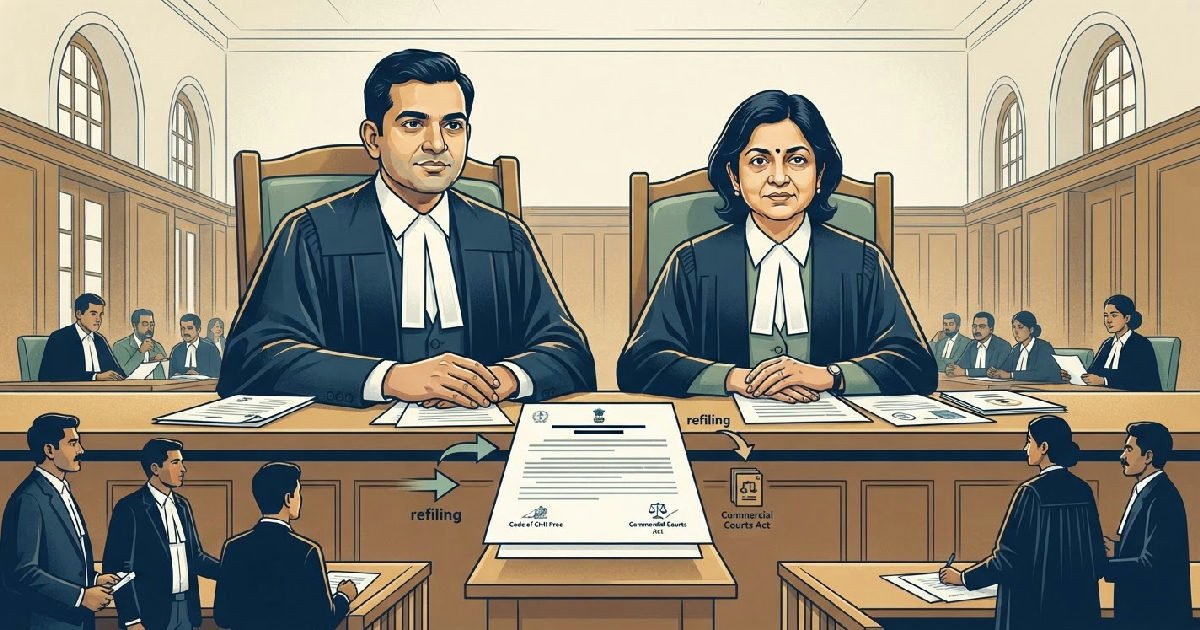
A Commercial Court cannot prevent a litigant from withdrawing a suit with liberty to refile it, the Delhi High Court clarified on January 26, 2023, unless the case is formally rejected under the CPC.
The judgment, passed on April 8, 2026, by a Division Bench comprising Justices Vivek Chaudhary and Renu Bhatnagar, addresses a critical intersection between a plaintiff’s right to correct curable defects and the court’s power to manage its docket.
Background of the pivotal court dispute to refile commercial suit
This decision arose from an appeal filed by Krishan Chawla against a December 15, 2025, order from a Delhi Commercial Court. The ruling reinforces that a court cannot indirectly dismiss a case on its merits at a preliminary stage by denying the chance to refile, thereby protecting litigants from being permanently shut out due to procedural errors.
The case, Krishan Chawla v. Sanjeev Jain and others, began on December 1, 2025, when Chawla filed a commercial suit. He was seeking a declaration and injunction related to disputed cash receipts from an agreement dated February 1, 2022. Chawla also requested urgent interim relief and an exemption from the mandatory pre-institution mediation required by the Commercial Courts Act.
Just two days later, on December 3, 2025, the Commercial Court refused to grant interim relief. It cited several procedural shortcomings, including non-compliance with the pre-institution mediation requirement under Section 12A, a deficiency in court fees, and a lack of supporting materials for the claims.
Faced with these curable defects, Chawla’s counsel sought to withdraw the suit with the liberty to file a fresh one after correcting the issues. However, in its order on December 15, 2025, the Commercial Court took a harsh stance. It permitted the withdrawal but explicitly denied the liberty to refile, a move that would bar Chawla from pursuing the same claim again.
Crucially, the lower court went a step further, making observations on the substance of the case. It stated that the suit appeared to lack bona fides and did not present a genuine cause of action. This premature assessment of the merits became a central issue in the appeal to the High Court.
High court’s sharp rebuke and legal reasoning
The Delhi High Court decisively overturned the Commercial Court’s order, finding its approach to be legally untenable. The Division Bench held that the lower court had effectively non-suited the appellant through an indirect method, which was impermissible. The judgment clarifies the distinct roles of different procedural rules that govern the life cycle of a civil suit.
In its ruling, the High Court stated, “In absence of an actual rejection of the plaint under Order VII Rule 11 CPC, the Commercial Court could not have indirectly non-suited the Appellant by denying liberty under Order XXIII Rule 1(3) CPC.” The court found that the refusal was “unduly harsh” as it foreclosed Chawla’s remedy for defects that were entirely curable.
The Bench also criticised the lower court for overstepping its jurisdiction at such an early stage. It noted the Commercial Court “travelled beyond this limited inquiry by recording observations regarding lack of bona fides and absence of a genuine cause of action, which were not warranted at the pre-summoning stage.”
This distinction is vital for ensuring that cases with technical flaws are not unfairly dismissed before the defendant is even summoned.
Ultimately, the High Court allowed the appeal, setting aside the Commercial Court’s order and its adverse observations. It granted Krishan Chawla permission to withdraw the original suit with the liberty to institute a fresh one in accordance with the law, restoring his right to a proper day in court.
Procedural guardrails: Order VII vs Order XXIII
This judgment highlights the critical difference between two key provisions of the Code of Civil Procedure, which serve as procedural guardrails in litigation. The court’s decision underscores that these rules have distinct purposes and cannot be conflated. Understanding the key differences between courts and their procedures is vital for litigants.
While both provisions address the premature termination of a suit, they operate from fundamentally different premises. Order VII Rule 11 is an involuntary judicial act, forcing a plaintiff out of court due to incurable defects in their pleading.
Conversely, Order XXIII Rule 1 provides a litigant with the agency to rectify technical errors, recognising that justice should not be impeded by minor procedural lapses, provided these are not attempts to abuse the judicial process.
The High Court’s ruling thus clarifies that a court cannot sidestep the strict requirements for rejection under Order VII by indirectly denying a plaintiff the chance to fix a curable defect under the guise of an Order XXIII application.
This distinction ensures that parties are either formally non-suited on specific legal grounds or allowed a fair opportunity to present their case after rectifying procedural missteps, preventing arbitrary dismissals.
| Legal Provision | Action | Typical Grounds | Consequence of Action |
|---|---|---|---|
| Order VII Rule 11, CPC | Rejection of Plaint | No cause of action, suit barred by law, improper valuation. | Court dismisses the suit at the threshold. Plaintiff may refile after curing the defect. |
| Order XXIII Rule 1(3), CPC | Withdrawal with Liberty | Formal defects (e.g., misjoinder of parties) or other sufficient grounds. | Plaintiff withdraws and is explicitly allowed to file a fresh suit on the same cause. |
| Order XXIII Rule 1(4), CPC | Withdrawal without Liberty | Plaintiff withdraws without court permission, or permission to refile is denied. | Plaintiff is permanently barred from filing a new suit on the same subject matter. |
Rejection of a plaint under Order VII Rule 11
Order VII Rule 11 provides a mechanism for a court to reject a plaint at the outset if it suffers from certain fundamental flaws. This is not a discretionary power but a mandatory one. If a plaint fails on one of these grounds, the court must reject it.
The grounds for rejection are specific and include the plaint not disclosing a cause of action, being barred by any law, or being improperly valued or stamped without correction. The court’s examination is strictly limited to the statements made in the plaint itself, not the defendant’s potential arguments.
Withdrawal of a suit under Order XXIII Rule 1
Order XXIII Rule 1 deals with a plaintiff’s choice to withdraw a suit. A plaintiff can abandon their suit at any time. However, if they do so without the court’s permission to refile, they are barred from bringing a fresh suit on the same matter under Order XXIII Rule 1(4).
To avoid this bar, a plaintiff can seek the court’s permission to withdraw with liberty to refile. Under Order XXIII Rule 1(3), the court can grant this permission if the suit is bound to fail due to a “formal defect” or for other “sufficient grounds.” This provision ensures that technical mistakes don’t lead to a miscarriage of justice.
The Commercial Courts Act and speedy justice
This ruling is particularly relevant in the context of the Commercial Courts Act, 2015. The Act was specifically designed to create a streamlined, fast-track system for resolving commercial disputes and improving India’s ease of doing business. It introduced specialised courts and stricter timelines for various stages of litigation.
One of its key features, introduced via a 2018 amendment, is the requirement for mandatory pre-institution mediation before a suit can be filed, unless urgent interim relief is sought. This was one of the procedural hurdles the plaintiff in the present case had failed to clear initially.
The court’s decision reinforces that while these procedures are important, a failure to comply at the first instance should not lead to the complete extinguishment of a party’s rights.
The Act aims for efficiency, but this judgment shows that efficiency cannot come at the cost of fundamental principles of justice. By allowing litigants to correct procedural missteps, the High Court ensures that the focus remains on the substantive merits of a dispute. The Commercial Courts Act applies broadly, and its procedures must be balanced with fairness.
Implications for commercial litigants
For businesses and other commercial litigants, the Delhi High Court’s decision provides a welcome layer of protection. It serves as a reminder that procedural rules are intended to facilitate justice, not to create insurmountable traps for the unwary. A plaintiff who makes a mistake in filing can take comfort in knowing they have an opportunity to correct it.
This precedent discourages lower courts from taking a hyper-technical or punitive approach at the initial filing stage. It directs the focus towards a preliminary check for compliance rather than a premature mini-trial on the merits of the case.
Litigants can now be more confident that if they identify a formal defect in their own plaint, they can seek to withdraw and refile without fear of being arbitrarily blocked by the court.
Legal strategists will see this as an affirmation of the principle that curable defects should be allowed to be cured. It prevents a defendant from gaining an unearned victory due to a plaintiff’s initial procedural error. The ruling promotes a system where cases are decided on substance, not on technical knockouts.
This aligns with broader judicial trends that favour resolving disputes on their merits and avoiding dismissals based on procedural grounds alone, especially when such procedures can be complex, as seen in cases involving additional written statements.
A balance between speed and fairness
The judgment strikes a crucial balance. On one hand, the Commercial Courts Act demands efficiency and strict adherence to timelines. On the other, the principles of natural justice embedded in the Code of Civil Procedure demand that every party gets a fair opportunity to present its case.
The Delhi High Court’s ruling navigates this tension by establishing a clear boundary. Commercial Courts must enforce the Act’s procedures, but they cannot use a litigant’s request to fix a procedural flaw as an opportunity to pass a final judgment on the case’s merits in disguise.
The proper route for a court that believes a suit is fundamentally non-maintainable is to formally reject the plaint under Order VII Rule 11, which itself is an appealable order.
By preventing this procedural shortcut, the High Court ensures the integrity of the litigation process. It confirms that the path to justice, while intended to be swift in commercial matters, must also be fair and equitable, allowing for human error to be corrected along the way.
What is the main difference between a suit’s rejection and its withdrawal?
Rejection of a suit, under Order VII Rule 11 CPC, is an action taken by the court itself when it finds a fundamental defect in the plaint (e.g., it discloses no legal claim). Withdrawal is an action initiated by the plaintiff, who chooses to pull back the suit, often to fix a procedural error they have identified.
What is a ‘formal defect’ that allows a plaintiff to refile a suit?
A ‘formal defect’ is a procedural or technical error that doesn’t go to the root of the case’s merits but could cause the suit to fail. Examples include misjoinder of parties, errors in the court’s jurisdiction, or improper valuation of the suit. It’s a flaw in the form of the suit, not its substance.
Why was the Commercial Court’s original order considered incorrect?
The Commercial Court’s order was deemed incorrect because it conflated two separate procedures. It denied the plaintiff the right to refile (an action related to withdrawal under Order XXIII) while also making comments on the case’s merits (which is relevant to rejection under Order VII). The High Court ruled it cannot deny the liberty to refile without formally rejecting the plaint first.
Need commercial lawyers in Delhi? Call or Whatsapp for Free Consultation.
Related Service: https://arpitmarwah.com/commercial-lawyers-in-delhi/