
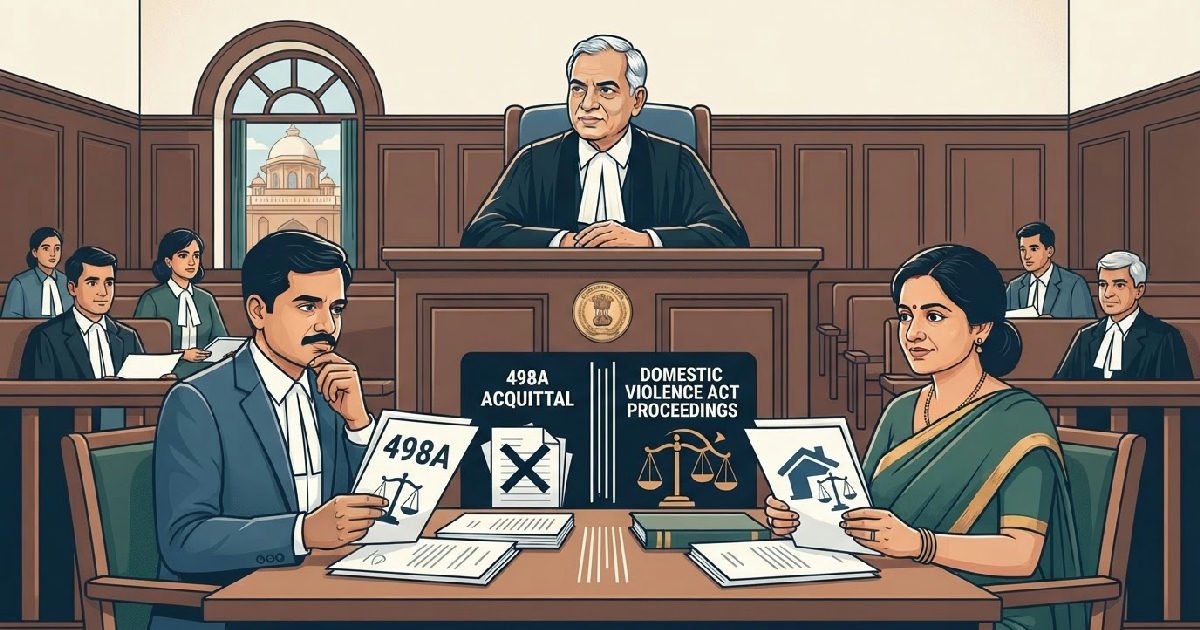
An acquittal in a criminal case for dowry harassment and cruelty does not prevent a person from facing proceedings under civil domestic violence laws, the Chhattisgarh High Court has ruled.
In a significant judgment on August 26, 2026, Justice Narendra Kumar Vyas affirmed that the two legal avenues operate in entirely different spheres, offering distinct forms of justice to victims of familial abuse. This ruling clarifies the implications of a section 498a acquittal domestic violence act.
The court’s decision dismisses a petition filed by Manoj Kurre and his family, who sought to quash a complaint filed against them by his wife, Smt. Sunita Kurre, under the Protection of Women from Domestic Violence Act, 2005 (DV Act).
Understanding the section 498a acquittal domestic violence act
The petitioners had previously been acquitted of charges under Section 498A of the Indian Penal Code (IPC) based on the same allegations of cruelty and dowry demands.
In dismissing the petition, Justice Vyas provided a crucial clarification on the relationship between two of India’s most important statutes concerning matrimonial disputes. The court held that Section 498A of the IPC and Section 12 of the DV Act serve fundamentally different purposes. One is designed to punish, while the other is meant to protect and provide relief.
The petitioners, represented by counsel Mr. Parag Kotecha, argued that since they were acquitted in the criminal case, the subsequent complaint under the DV Act was an abuse of the legal process. They contended the matter had already been decided.
However, the High Court disagreed, finding no illegality in the trial court’s decision to register the new complaint from Smt. Kurre. The court’s stance aligns with a broader judicial trend of recognizing expansive definitions of cruelty.
Justice Vyas emphasized that Parliament’s intent in creating the DV Act was to offer more effective and immediate protection for women facing any kind of violence within the family. He pointed directly to the text of the law itself to support this conclusion, ensuring that civil remedies remain available regardless of the outcome of a criminal trial.
The specific arguments in the Kurre case
The legal dispute stemmed from allegations made by Smt. Sunita Kurre that her husband and his family subjected her to mental torture. She claimed they made persistent demands for a dowry payment of Rs. 1,00,000 and a motorcycle. These allegations first led to an FIR being lodged under Section 498A IPC, a criminal provision dealing with cruelty by a husband or his relatives.
After a trial, Manoj Kurre and the other accused family members were acquitted of the criminal charges. Subsequently, Smt. Kurre initiated a new case, this time seeking remedies under Section 12 of the DV Act.
The petitioners argued that this amounted to being tried twice for the same allegations, a concept often linked to double jeopardy. They also noted that divorce proceedings and a child custody application were already pending before the High Court.
However, the High Court’s ruling establishes that these are not equivalent proceedings. The court’s order explicitly stated, “… both the acts operate in different sphere, therefore the acquittal of the petitioner under Section 498A of the I.P.C. will not prohibit or restrict the complainant to file a complaint under Section 12 of the Act of 2005.”
Criminal punishment vs civil remedies: a critical distinction
The core of the Chhattisgarh High Court’s ruling rests on the fundamental differences between criminal law and civil law. These two systems run on parallel tracks, with different standards of proof, objectives, and outcomes. Understanding this distinction is key to comprehending why an acquittal in one does not automatically negate the other.
Criminal proceedings, exemplified by Section 498A of the IPC, operate with a high bar for conviction, demanding proof ‘beyond a reasonable doubt.’ Their primary aim is to punish the accused for offenses like cruelty or dowry harassment, leading to potential imprisonment and fines. The focus is on establishing guilt and delivering retribution for a proven crime against the state.
Conversely, civil remedies under the DV Act are designed with a protective and rehabilitative lens, requiring a lower standard of ‘preponderance of probabilities.’ This allows courts to swiftly address immediate threats and provide relief such as protection orders or financial support to victims, irrespective of whether criminal culpability can be established.
The intent is not primarily punitive, but rather to prevent ongoing harm and secure the well-being of the aggrieved party.
Section 498A IPC: a punitive measure
Introduced in 1983, Section 498A was a direct response to the escalating crisis of dowry deaths and harassment. It criminalizes cruelty inflicted upon a woman by her husband or his relatives. As a criminal statute, its primary purpose is to punish the offenders with imprisonment and fines. The burden of proof is high, requiring the prosecution to prove the accused’s guilt “beyond a reasonable doubt.”
The DV Act, 2005: a protective shield
The Protection of Women from Domestic Violence Act, enacted in 2006, is primarily a civil law. Its definition of “domestic violence” is far broader than the “cruelty” in Section 498A, covering physical, emotional, verbal, sexual, and economic abuse. The goal isn’t just punishment but providing immediate relief to the victim.
The standard of proof is lower, based on a “preponderance of probabilities,” meaning the court must be convinced that the victim’s claims are more likely to be true than not. The Supreme Court’s directives on dowry have reinforced the need for strong enforcement mechanisms, which the DV Act supports.
This difference in proof is critical. Evidence that might not be sufficient to secure a criminal conviction can often be enough to persuade a magistrate to grant a civil protection order under the DV Act. The law’s focus is on safeguarding the woman’s constitutional rights and preventing future harm.
| Feature | Section 498A IPC | Domestic Violence Act, 2005 |
|---|---|---|
| Nature of Law | Criminal | Primarily Civil (Quasi-Criminal) |
| Primary Objective | To punish the accused for cruelty | To provide protection and remedies to the victim |
| Standard of Proof | Beyond a reasonable doubt | Preponderance of probabilities |
| Scope of Abuse | Focuses on ‘cruelty’, often linked to dowry | Broadly defines physical, emotional, sexual, and economic abuse |
| Available Outcomes | Imprisonment (up to 3 years) and fine | Protection orders, residence orders, monetary relief, custody orders |
| Applicability | Husband and his relatives | Covers a wide range of domestic relationships, including live-in partners |
A consistent view from India’s higher courts
The Chhattisgarh High Court’s judgment is not an outlier. It reinforces a legal principle that has been consistently upheld by various High Courts and the Supreme Court over the years. Courts have repeatedly recognized that the two statutes are intended to coexist and offer cumulative, not alternative, remedies.
For instance, a 2022 ruling by the Punjab and Haryana High Court in *Hardeep Khan vs Rano* reached a similar conclusion. It reiterated that proceedings under the DV Act and Section 498A are separate and different in nature. Therefore, an acquittal in the criminal case does not serve as a bar to seeking remedies under the civil statute.
Similarly, the Allahabad High Court, in a January 2025 judgment, affirmed this principle. Citing a Calcutta High Court decision, it noted that the lower standard of proof in DV Act proceedings means that a criminal acquittal, based on a higher standard, is not automatically grounds to dismiss a civil complaint.
It’s a recurring theme in cases where a pending domestic violence case is cited in other legal matters.
The ‘in addition to’ clause: Section 36 of the DV Act
A key piece of statutory text supporting Justice Vyas’s decision is Section 36 of the Domestic Violence Act itself. This clause explicitly states that the provisions of the Act are “in addition to, and not in derogation of, the provisions of any other law for the time being in force.”
This language makes Parliament’s intention clear. The DV Act was not created to replace or override existing criminal laws like Section 498A. Instead, it was designed to supplement them, creating a civil pathway for remedies that the criminal justice system does not provide.
While the IPC can send an abuser to jail, the DV Act can ensure the victim has a roof over her head, receives financial support, and is protected from further contact.
This framework acknowledges that a victim of domestic abuse may need both punitive action against the perpetrator and immediate protective measures for herself and her children. The two laws work in tandem to provide a more comprehensive system of justice.
Ongoing debates and the potential for misuse
While the legal distinction is clear, the parallel application of these laws is not without controversy. For years, the Supreme Court has acknowledged concerns about the misuse of Section 498A. In the 2005 case of *Sushil Kumar Sharma v.
UOI*, the court famously observed that non-bonafide complaints can lead to a form of “legal terrorism,” where the law is used as a weapon in matrimonial disputes.
More recently, in September 2024, a Supreme Court bench including Justice B.R. Gavai again highlighted instances where such laws were misapplied. This judicial commentary reflects a continuing tension between protecting vulnerable women and preventing the malicious use of protective laws to settle personal scores.
However, the potential for misuse does not invalidate the legal principle that criminal and civil proceedings can run concurrently. The Chhattisgarh High Court’s ruling focuses squarely on the legal structure, affirming that one path does not close the other. The trial court handling the DV Act complaint will still be required to independently assess the evidence presented by Smt. Sunita Kurre before granting any relief.
What this means for victims of domestic abuse
The ruling is a powerful affirmation for individuals navigating the complexities of the justice system. It clarifies that a failure to secure a criminal conviction—a difficult task given the high standard of proof and the private nature of domestic abuse—does not leave a victim without recourse.
They can still pursue crucial civil remedies like protection orders, the right to reside in the marital home, and monetary support.
By dismissing the petition to quash the DV Act proceedings, the High Court has allowed the case to move forward on its own merits in the trial court.
The judgment serves as a reminder to lower courts and litigants that these two legal frameworks are meant to operate independently, each fulfilling a distinct and vital role in addressing the pervasive issue of domestic violence in India.
Can a person be tried for the same crime twice in India?
No, the Constitution of India protects against double jeopardy, meaning a person cannot be prosecuted and punished for the same offense more than once. However, this ruling clarifies that proceedings under Section 498A IPC (criminal) and the DV Act (civil) are considered different matters, not the same offense, so double jeopardy does not apply.
What is the main difference between a Section 498A case and a DV Act case?
A Section 498A case is a criminal proceeding aimed at punishing the accused for cruelty, requiring proof “beyond a reasonable doubt.” A DV Act case is a civil proceeding focused on providing immediate remedies like protection, residence, and monetary relief to the victim, with a lower standard of proof called “preponderance of probabilities.”
What kind of relief can a victim get under the Domestic Violence Act?
The DV Act offers a range of civil remedies. These include protection orders to stop the abuser from committing violence, residence orders allowing the victim to live in the shared household, monetary relief to cover expenses, and temporary custody orders for children. The focus is on the safety and well-being of the victim.