
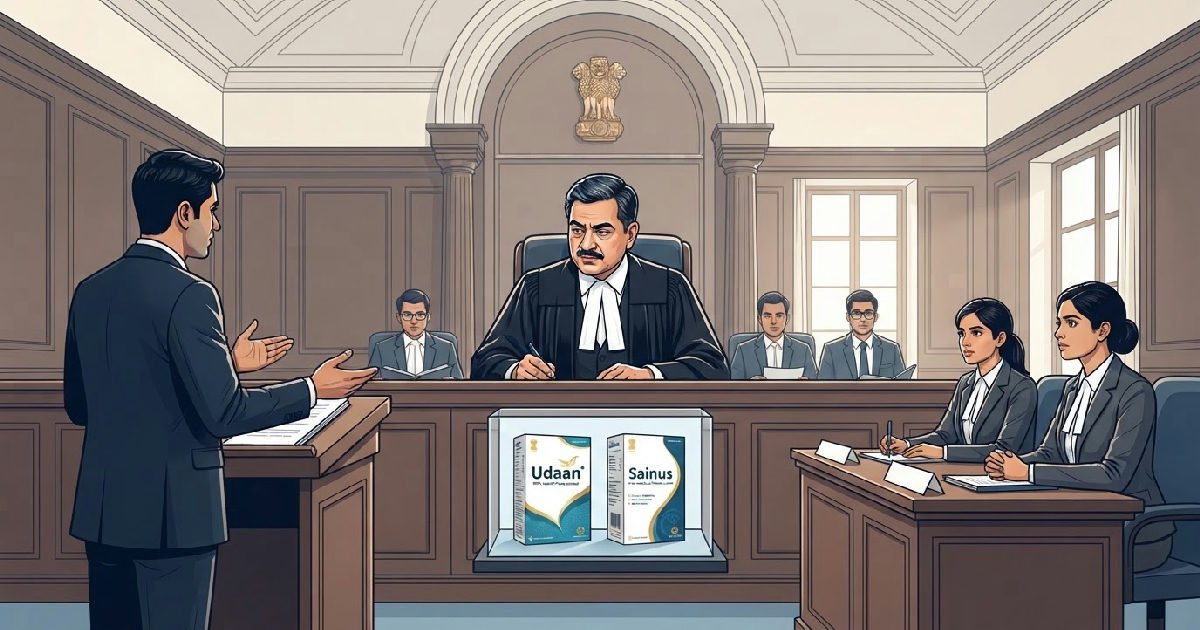
A Delhi court delivered a definitive ruling on August 13, 2026, issuing a permanent injunction against Hyderabad-based Sainus Pharmaceutical Private Limited. The judgment prohibits the company from using the trademark ‘Udaan’ or any mark deceptively similar to it. This concludes a significant Udaan trademark dispute.
District Judge Pankaj Sharma presided over the case, siding with RSPL Health Private Limited, known for its ‘Ghari’ detergent brand. The court found Sainus Pharmaceutical’s use of ‘Udaan’ to be a clear violation of RSPL Health’s proprietary rights, marking a crucial win for intellectual property protection in India.
Udaan trademark dispute: Court finds mark deceptively similar
The core of the court’s decision hinged on the striking similarities between the two trademarks. Judge Sharma explicitly stated that Sainus Pharmaceutical’s ‘Udaan’ mark was both “identical and deceptively similar” to RSPL Health’s previously registered ‘Udan’ trademark.
This finding underscores the principle that even slight phonetic or visual differences aren’t enough to avoid infringement if the overall impression is likely to confuse consumers. The judiciary often scrutinizes such nuances in trademark cases.
The origins of the ‘Udan’ mark
RSPL Health first adopted its ‘Udan’ trademark and label in 2007. The company used this mark specifically for its sanitary napkin products, establishing a significant market presence over nearly two decades.
This long-standing use and registration provided a strong foundation for RSPL Health’s claim of proprietary rights against Sainus Pharmaceutical. Their prior claim was a key factor in the court’s judgment. Such cases often underscore the application of the commercial courts act.
Ex parte judgment underscores defendant’s absence
The judgment was delivered ex parte, meaning the court proceeded without the defendant, Sainus Pharmaceutical Private Limited, being present or presenting its case. This procedural detail is vital to understanding the ruling’s context.
District Judge Pankaj Sharma noted that Sainus Pharmaceutical failed to appear before the court. This absence left RSPL Health’s contentions “unrebutted, unchallenged, and uncontroverted,” allowing the court to accept the plaintiff’s evidence and arguments without opposition.
RSPL Health had specifically alleged that Sainus Pharmaceutical was not only making direct retail sales but also distributing its infringing products. They claimed these goods, bearing the ‘Udaan’ trademark, were supplied to various dealers and shopkeepers in prominent New Delhi markets.
These markets included busy commercial areas like Parliament Street, Connaught Place, Barakhamba, Chanakyapuri, Gole Market, and Bengali Market. Such widespread alleged distribution highlighted the potential for consumer confusion. It’s a common scenario that courts handling business disputes in Delhi often see.
Enforcement and asset destruction ordered
Beyond simply halting the use of the trademark, the court issued further significant directives for enforcement. The judgment mandates the permanent injunction against any use of ‘Udaan’ or similar marks by Sainus Pharmaceutical.
Crucially, the court also ordered the complete destruction of all infringing materials. This includes any counterfeit products, packaging, dies, and blocks that bear the falsified ‘Udaan’ mark. These items must be surrendered to RSPL Health for proper disposal.
What this means for consumers in New Delhi
For consumers, this ruling helps prevent potential confusion when purchasing products. Clear differentiation between brands is essential in competitive markets, especially when names are so phonetically similar. The court’s action ensures greater clarity.
The prevalence of similar-sounding brands can often mislead buyers, making them believe they are purchasing from a trusted source. This judgment safeguards consumers from such deceptive practices, particularly in high-volume areas like those specified in New Delhi. The court’s action helps ensure clarity in the marketplace.
Broader implications for brand protection in India
This verdict serves as a powerful reminder of the robust legal framework protecting intellectual property in India. It also highlights the jurisdiction of designated commercial courts in handling such matters.
For businesses, it underscores the critical importance of conducting thorough trademark searches before adopting new brand names. Neglecting this step can lead to costly legal battles and the ultimate loss of a brand identity.
The case also highlights the proactive role companies must play in monitoring the market for potential infringements. Timely legal action, as taken by RSPL Health, is often necessary to protect established trademarks and market share.
Other entities named ‘Udaan’: Distinguishing unrelated businesses
It’s important to note that while this ruling focuses on Sainus Pharmaceutical Private Limited, several other legitimate and distinct entities also use variations of the name “Udaan.” These businesses are entirely separate and are not implicated in this specific trademark dispute.
- Udaan Healthcare Private Limited: Incorporated in July 2023, this company, with directors Ashima Suneja and Shubham Aneja, focuses on the retail sale of pharmaceuticals and medical goods.
- Udaan Pharma: Operating out of Farrukhabad, Uttar Pradesh, this entity functions as a wholesaler and distributor for pharmaceutical injections, veterinary drugs, and human albumin.
- Udaan (B2B e-commerce platform): Founded in 2016 by Amod Malviya, Sujeet Kumar, and Vaibhav Gupta, this Bengaluru-headquartered platform is a major player in India’s eB2B sector, covering FMCG, staples, and healthcare. It has raised nearly $2 billion in funding.
- Udaan Foundation: Established in 2007 by Dr. (Prof.) Amit Varma, this registered organization is dedicated to healthcare, particularly diabetes care, through welfare programs and awareness initiatives across India.
- UDAAN (BioMatrix Healthcare Pvt. Ltd. initiative): Launched in 2007, this program represents an employee empowerment initiative by BioMatrix Healthcare Private Limited.
These examples illustrate that while “Udaan” is a popular name, each business operates within its distinct legal and commercial sphere.
The Delhi court’s decision reinforces the sanctity of registered trademarks and the legal repercussions for those who infringe upon them. It’s a clear message to all businesses: protect your brand, or risk having the courts do it for you, with potentially severe consequences.