
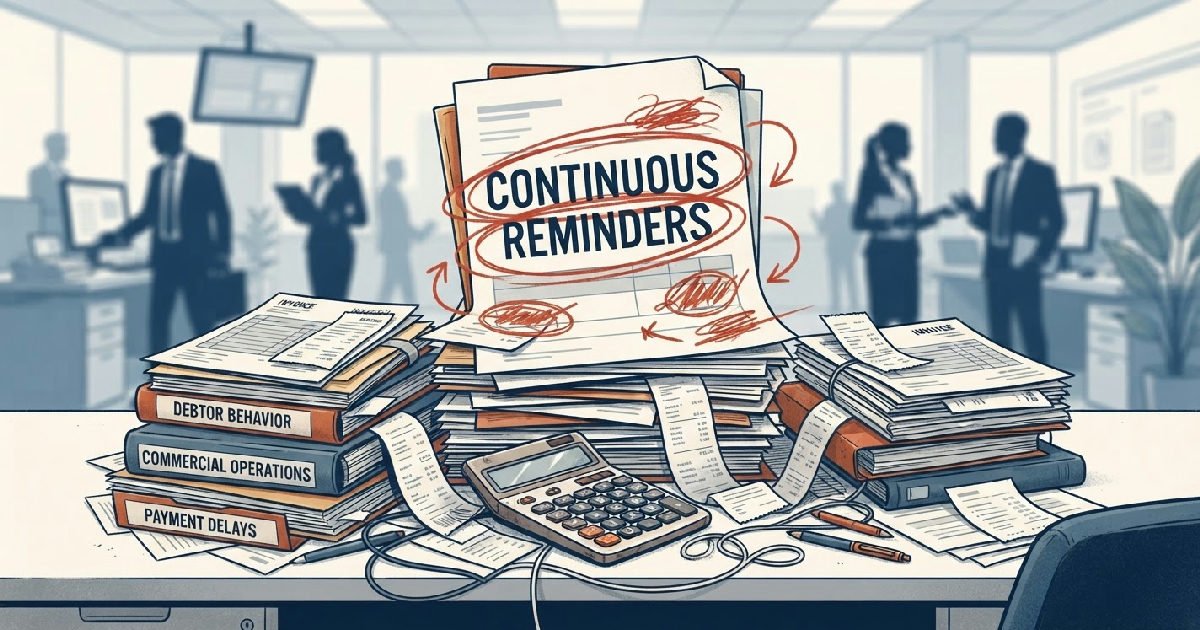
For many businesses, the traditional approach to managing unpaid dues often involves a repetitive cycle of continuous reminders, a method proving both ineffective and costly. This habit implicitly signals to defaulting clients and vendors that payment delays carry no real consequences, undermining effective unpaid dues recovery.
Shifting away from mere reminders towards implementing structured consequences can significantly alter debtor behavior and boost overall recovery rates, according to recent analysis.
Businesses find continuous costly cycles
This pervasive issue highlights a critical misunderstanding in commercial operations. Companies frequently expend valuable resources on polite follow-ups, mistakenly believing this process will eventually yield results. However, without a clear escalation path, these efforts often perpetuate the problem rather than resolve it.
Many businesses find themselves trapped in a repetitive cycle of sending reminders for unpaid dues. They dispatch initial emails, followed by repeated requests, with the file remaining active and communications flowing. Critically, the money often stays uncollected, despite these ongoing efforts.
This approach, while appearing diligent, is financially draining. The resources committed to continuous communication – staff time, system usage, and management oversight – accumulate without achieving the desired financial outcome. It creates an operational overhead that directly impacts a company’s profitability.
What silent messages reminders send
Every time an unpaid invoice receives only another reminder, an implicit message is conveyed to the defaulting party. This communication often undermines the very goal of collection, inadvertently teaching the debtor about the lack of immediate repercussions for non-payment.
Defaulting clients and vendors come to understand that there is no genuine urgency associated with the payment request. They perceive no real escalation in the situation, suggesting that the business prioritizes maintaining the relationship over securing its financial entitlements. This leads them to conclude the company isn’t truly prepared to take decisive action.
From follow-up to structured pressure
There is a critical distinction between simple follow-up and effective pressure in debt collection. Follow-up primarily involves communication, ensuring the debtor remains aware of the outstanding amount. Pressure, however, introduces a structural change that alters the cost-benefit analysis for the defaulting party.
A mere reminder politely asks for payment. Conversely, a consequence fundamentally changes the economic or legal cost associated with not paying. This strategic shift is often the catalyst that moves stagnant accounts towards resolution, improving commercial claims action.
Implementing structured consequences
Effective consequences are not vague threats; they are structured, defined actions. These actions clearly signal that the period of polite requests has ended and a new phase has begun. They compel the debtor to re-evaluate their inaction, moving beyond mere reminders.
Shifting to structured consequences means taking concrete steps to enforce payment terms. These approaches aim to demonstrate a clear intent to secure financial entitlements. Until such structured consequences enter the equation, many commercial disputes can remain stuck in a cycle of polite but costly delay.
Recognizing the costs of inaction
While the shift to structured consequences is often necessary, businesses commonly defer such actions. They may persist with reminders, hoping for voluntary compliance without escalation. This prolonged patience, however, carries its own significant financial and operational costs over time.
The cycle of sending repeated reminders is specifically highlighted as a costly habit. Companies invest considerable time and resources in this activity, yet it often fails to yield timely payments. This perpetuates a state where capital remains tied up in receivables, impacting liquidity and growth.
The hidden costs of prolonged patience
As weeks and months pass with unpaid dues, the direct financial impact of the outstanding amount grows. The problem isn’t just the missing revenue; it’s the resources continually spent on chasing it. This contributes to an ongoing operational burden that is ultimately inefficient.
The traditional approach signals a lack of urgency and escalation to debtors, who then believe delay has no real cost. This perception allows non-payment to persist, hindering effective unpaid dues recovery. Businesses must evaluate if the cost of continued patience outweighs potential benefits.
Shifting debtor behavior with clear action
The moment a company transitions from a strategy of mere reminders to one of structured action, debtor behavior frequently undergoes a dramatic shift. This change isn’t always about immediate payment, but it invariably introduces a new dynamic into the situation. The debtor is compelled to engage more seriously.
Structured consequences are designed to alter the debtor’s belief that delay has no real cost. This can lead to increased engagement from the defaulting party, as they are prompted to address the outstanding amounts more proactively than before. The aim is to create a tangible reason for action.
The clarity advantage over uncertainty
One of the most valuable outcomes of implementing structured consequences is the clarity it provides. By moving beyond continuous reminders, businesses receive a clearer picture of their financial standing and the debtor’s intentions. This clarity, even if it confirms non-payment, is highly useful.
When a debtor is faced with a concrete shift in approach, their response clarifies their position. This allows the creditor to move forward with definitive planning, rather than remaining in a state of prolonged, uncertain delays. Such decisive action is crucial for efficient commercial operations.
A disciplined approach to commercial recovery
Companies that consistently achieve higher rates of money recovery typically adopt a disciplined, structured approach. This means moving beyond the ad-hoc nature of continuous reminders and embedding specific protocols into their collections process. It transforms collections from a reactive chore into a proactive strategy.
This discipline involves a planned transition from initial communications to more serious steps. The goal is to avoid the ‘costly habit’ of endless reminders that fail to produce results. Such an approach aims to improve overall recovery rates significantly.
Establishing clear steps for resolution
A key component of effective recovery involves clearly defined stages for addressing unpaid dues. Instead of indefinite follow-ups, businesses establish a pathway for escalation. This structured progression ensures that outstanding amounts do not languish indefinitely in a state of polite deferral.
This shift means businesses must consciously stop confusing endless patience with sound commercial practice. While building relationships is important, allowing persistent non-payment to undermine financial stability is not sustainable. It’s about implementing a strategy that actively pursues mid-project recovery.
The bottom line for effective unpaid dues recovery
The fundamental reality of debt collection is stark: reminders are excellent for maintaining the status quo but insufficient for driving resolution. They keep the file active and acknowledged but do little to compel actual payment. True progress comes only when the narrative shifts.
Consequences are the mechanism that moves the file forward. They introduce a tangible reason for the defaulting party to act, whether that is making a payment, negotiating a settlement, or finally communicating their position. Without consequences, files often remain in a state of perpetual follow-up, which is a costly habit.
If your company has been circulating the same outstanding amounts for weeks or months, relying solely on reminders, the strategy isn’t working. Continuing this approach is unlikely to yield a different result. At a certain juncture, every business must decide whether its priority is polite activity or actual financial recovery.
| Aspect | Continuous Reminders Strategy | Structured Consequences Strategy |
|---|---|---|
| Implied Urgency | Low to non-existent | High and immediate |
| Cost to Business | High (ongoing administrative, resource drain) | Aims to reduce overall recovery costs |
| Debtor Perception | Delay is acceptable; no immediate repercussions | Delay has potential financial or operational implications |
| Recovery Rate Impact | Often ineffective, can lead to prolonged delay | Can significantly improve recovery rates |
| Underlying Message | Payment is requested, not enforced | Financial obligations will be pursued actively |
Why are continuous reminders ineffective for unpaid dues?
Continuous reminders often communicate a lack of urgency, escalation, and readiness to act. This teaches defaulting clients that delaying payment has no real cost or immediate repercussions, making them less likely to pay promptly.
What types of consequences can a business implement?
The research indicates that shifting to structured consequences can alter debtor behavior and improve recovery rates. While specific types are not detailed, the focus is on actions that signal urgency and a readiness to act, communicating that delay carries a real cost.
When should a business shift from reminders to consequences?
A business should shift from continuous reminders to structured consequences when the traditional approach proves ineffective and costly. The core principle is to move towards actions that communicate urgency and enforce that delay has a real cost, rather than perpetuate the costly habit of endless follow-ups.