
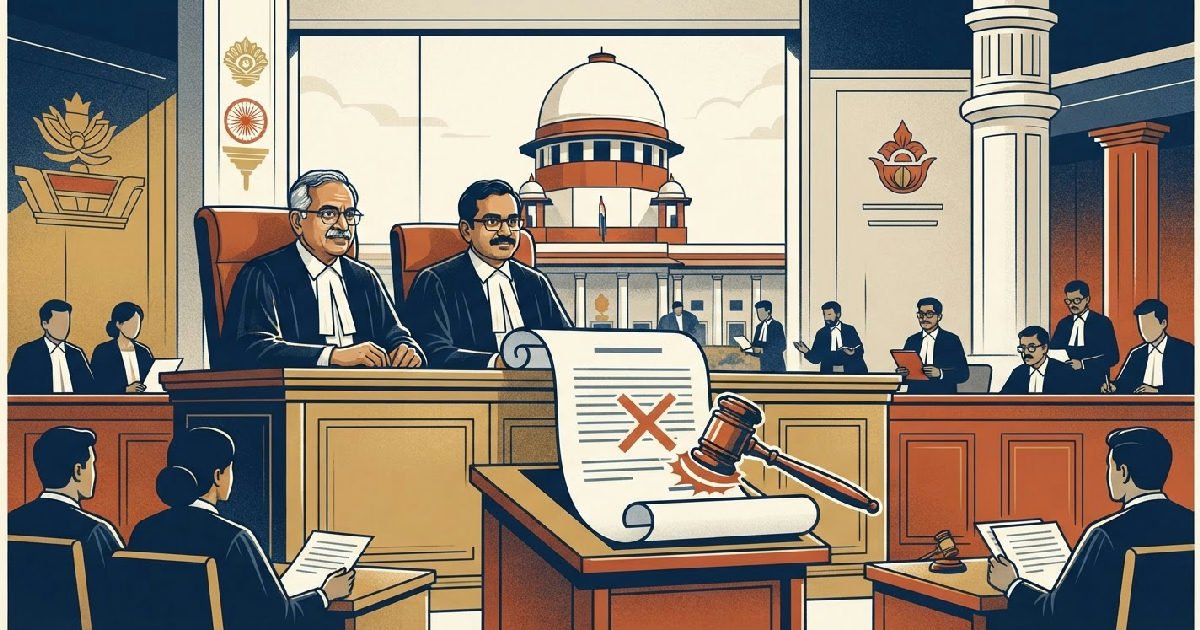
The implications of the Supreme Court’s ruling extend beyond individual cases and reflect a broader commitment to efficient judicial proceedings concerning plaint rejection.
This ruling sets a crucial benchmark for how plaint rejection should be perceived and enforced.
In conclusion, the clarity provided regarding plaint rejection is invaluable for future cases.
The recent judgment is a landmark in establishing clear guidelines for plaint rejection.
Judges are thus encouraged to apply the concept of plaint rejection judiciously.
This ruling significantly reinforces the critical nature of the plaint rejection process in civil litigation.
Ultimately, the case emphasizes that the principle of plaint rejection is not merely procedural but essential for maintaining judicial integrity.
The insistence on timely action underscores the court’s resolve in addressing the issue of plaint rejection decisively.
Legal practitioners should be aware of these developments regarding plaint rejection, as they are pivotal in advising clients effectively.
This strong approach to plaint rejection by the Supreme Court may encourage litigants to be more mindful of deadlines.
The Supreme Court of India ruled on August 23, 2026, that civil courts can reject a plaint at the outset if pleadings show the suit is barred by limitation. This decision, handed down by a bench comprising Justice J.B. The ruling clarifies the legal position on plaint rejection limitation.
Pardiwala and Justice K. Vinod Chandran, stems from a specific case involving a Joint Venture Agreement dispute between N Asha Devi and R Aravind Kumar & Anr. It underscores the judiciary’s commitment to curbing frivolous litigation and preserving valuable court resources.
Supreme Court Reaffirms Immediate Plaint Rejection Limitation for Time-Barred Suits
The apex court emphasized that while the question of limitation often involves a mix of factual and legal considerations requiring a full trial, there are instances where the time-bar is so glaringly obvious from the plaint’s averments that immediate rejection becomes imperative. This strong stance aims to prevent unnecessary protraction of legal proceedings.
It sets a clear precedent for how lower courts should approach cases with apparent procedural defects.
The Supreme Court made it unequivocally clear that judges should not hesitate to dismiss a plaint when the limitation period has evidently expired, based solely on the documents presented. The bench, led by Justice J.B. Pardiwala and Justice K.
Vinod Chandran, stated that courts must exercise their authority under Order VII Rule 11 of the Code of Civil Procedure, 1908 (CPC) in such circumstances. This means stopping a trial before it even begins if the legal foundation is clearly missing.
This ruling reinforces the principle that procedural laws, like those governing limitation, are crucial for the efficient administration of justice. The Court stressed that allowing suits that are patently time-barred to proceed would amount to an abuse of the legal process. It would needlessly consume judicial time and financial resources, ultimately delaying justice for meritorious cases.
The specific observation by the bench highlighted this point: “…the Court cannot be hesitant in granting relief of rejection of a plaint when it is so obvious from the pleadings itself.” This directly instructs lower courts to act decisively.
Such clarity from the highest court is expected to streamline the early stages of civil civil proceedings across the country. It provides a robust framework for managing case loads more effectively.
The specific dispute: Joint Venture Agreement gone awry
This critical Supreme Court pronouncement originated from a detailed dispute concerning a Joint Venture Agreement (JVA) dated August 18, 2014. The agreement was forged between an appellant landowner, N Asha Devi, and a respondent developer, R Aravind Kumar & Anr. Its purpose was for the developer to construct eight flats on two plots owned by N Asha Devi.
Under the terms of the JVA, the construction was expected to be completed within 15 months. Upon completion, N Asha Devi was to receive 56% of the super built-up area. The developer, R Aravind Kumar & Anr., would retain the remaining 44%. This division outlined the core business arrangement and the expected benefits for both parties once the project was finished.
However, the project encountered issues. N Asha Devi cancelled the JVA on April 20, 2016, alleging that the construction had not been finished within the stipulated 15-month timeframe. This cancellation sparked a series of communications, including a lawyer’s notice from N Asha Devi on July 22, 2016. R Aravind Kumar & Anr.
responded to this notice the very next day, on July 23, 2016, challenging the validity of the cancellation. In June 2017, N Asha Devi ultimately took possession of the properties, signaling a clear break in the agreement.
The respondent, R Aravind Kumar & Anr., eventually filed a suit for specific relief in October 2022. They sought division and allotment of their 44% share of the super built-up area. This filing came more than six years after N Asha Devi’s initial communication cancelling the agreement.
The significant delay would become the central point of contention in the higher courts, ultimately leading to the Supreme Court’s intervention.
Unpacking Order VII Rule 11 of the CPC
Order VII Rule 11 of the Code of Civil Procedure, 1908, stands as a pivotal procedural tool within the Indian legal system. It grants civil courts the authority to reject a plaint at an early stage.
The primary goal of this rule is to prevent the judicial machinery from being bogged down by unmeritorious, frivolous, or vexatious litigation. It acts as a gatekeeper, ensuring that only cases with a valid legal basis proceed to trial.
The rule enumerates six specific grounds upon which a plaint may be rejected. These include scenarios where the plaint fails to disclose a cause of action, is undervalued and the plaintiff neglects to correct it, or is insufficiently stamped and the plaintiff does not provide the required stamp paper.
Critically, it also covers instances where the suit appears, from the statements in the plaint, to be barred by any law, such as the law of limitation. Other grounds involve non-compliance with rules regarding defendant details or failure to file the plaint in duplicate.
Courts are obligated to reject a plaint if any of these grounds are established. When considering an application under Order VII Rule 11, the examination is generally confined strictly to the averments (statements) made within the plaint itself and any documents attached to it.
Courts are explicitly restrained from delving into other external materials or disputed factual matters at this preliminary stage. This narrow scope ensures a quick assessment of the plaint’s legal viability without getting entangled in the merits of the case prematurely.
| Ground for Plaint Rejection (Order VII Rule 11 CPC) | Brief Description | Typical Outcome |
|---|---|---|
| No Cause of Action | Plaint does not reveal any legal basis for the relief sought. | Immediate rejection. |
| Barred by Law (e.g., Limitation) | Statements in the plaint clearly show the suit is prohibited by law. | Immediate rejection. |
| Under-valuation | Suit is undervalued, and plaintiff fails to correct it after court order. | Rejection after failure to amend. |
| Insufficient Stamping | Plaint not properly stamped, and plaintiff fails to supply required stamp paper. | Rejection after failure to rectify. |
Distinguishing limitation: Fact, law, and obviousness
The Supreme Court
What is the significance of the Supreme Court’s latest ruling on plaint rejection?
The ruling clarifies that civil courts can reject a plaint at the initial stage if it’s glaringly obvious from the pleadings that the suit is barred by limitation. This aims to prevent frivolous litigation and save valuable court resources by stopping unmeritorious cases early.
Under which legal provision can courts reject a plaint for being time-barred?
Courts primarily exercise this power under Order VII Rule 11(d) of the Code of Civil Procedure, 1908 (CPC). This specific clause allows for the rejection of a plaint if it appears from the statement in the plaint itself that the suit is barred by any law, such as the law of limitation.
Does this ruling mean all limitation issues will be decided at the initial stage?
No, the ruling specifically applies to cases where the time-bar is “glaringly obvious” and apparent from the plaint’s averments alone. If the question of limitation involves complex factual disputes or intricate legal interpretations, it may still require a full trial for a comprehensive determination.
In light of this, the Supreme Court’s stance on plaint rejection serves as a critical deterrent against procrastination.
Furthermore, this ruling on plaint rejection emphasizes the importance of timely legal action and the consequences of delay.
Trying to recover money and unsure where to file the case? WhatsApp or call for a free consultation.
Related Service: Civil Law