
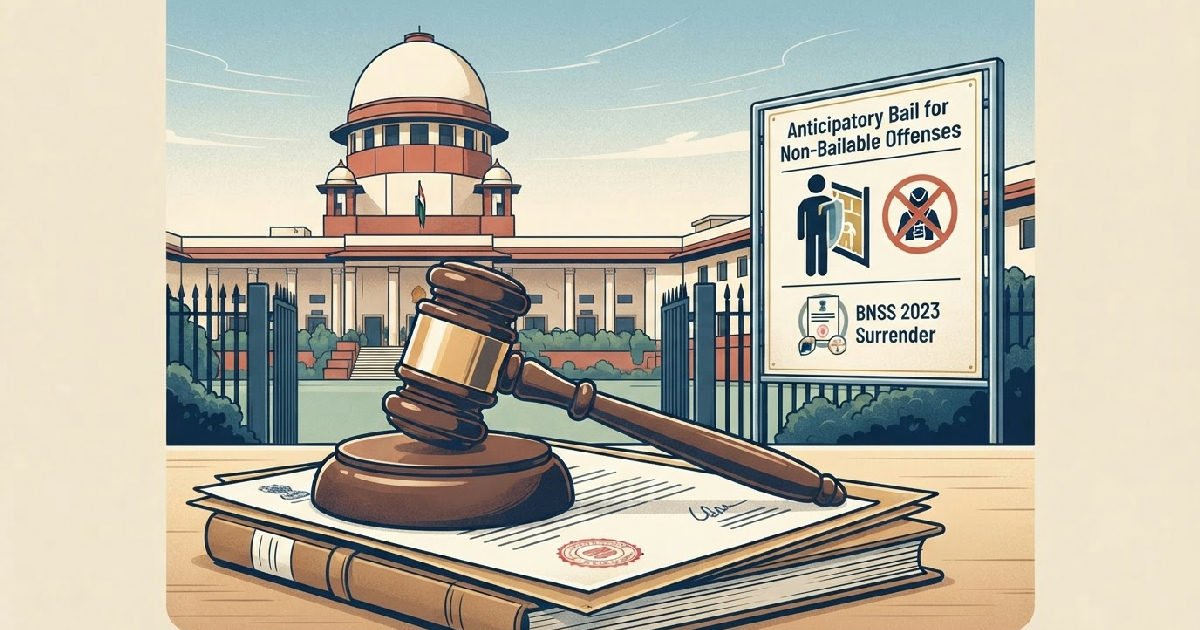
India’s Supreme Court has decisively reinforced that individuals seeking anticipatory bail for non-bailable offenses cannot be compelled to surrender. This landmark clarification, centring on the “No Forced Surrender” doctrine, strengthens pre-arrest protection under the Bharatiya Nagarik Suraksha Sanhita (BNSS), 2023. The ruling ensures personal liberty remains paramount, even amidst serious accusations.
This legal provision allows someone to secure bail before an arrest for a non-bailable offense. It now falls under Section 482 of the BNSS, 2023, having replaced Section 438 of the older Code of Criminal Procedure, 1973. This move underscores a preventive approach to justice, shielding citizens from arbitrary detention.
Understanding Anticipatory Bail for Non-Bailable Offenses
Anticipatory bail functions as a proactive legal tool, protecting individuals from potential arrest in non-bailable cases. The intent is to safeguard personal liberty against arbitrary action and baseless charges. This provision helps prevent unnecessary incarceration before guilt is established.
The Law Commission of India advocated for this provision in its 41st report, recognising its importance. It ensures that the justice system balances law enforcement needs with individual rights. This recommendation paved the way for its formal inclusion in procedural law.
Defining bailable and non-bailable offenses
Non-bailable offenses are serious crimes like murder, rape, or kidnapping, where bail is a court’s discretion, not a right. Bailable offenses, conversely, grant an accused an automatic right to bail upon arrest. This distinction is crucial for understanding the scope of important legal guide and its application.
Solidifying the ‘No Forced Surrender’ doctrine
The Supreme Court has made it clear that courts cannot force an individual to surrender while rejecting an anticipatory bail application. This ruling ensures the application’s nature as a protective measure isn’t undermined. It prevents courts from overstepping their jurisdiction.
If a court decides against granting anticipatory bail, it lacks the power to order the accused’s surrender to a trial court. Such a directive would be “wholly without jurisdiction,” according to crucial Supreme Court decisions. The doctrine reinforces anticipatory bail as a shield, not a post-detention remedy. This principle protects individuals from unnecessary custody.
This stance underlines the preventative purpose of anticipatory bail. It’s meant to offer protection from arrest, not to act as a mechanism for post-detention release. The court ensures that the spirit of the law is upheld, safeguarding individual freedom.
Apprehension after chargesheet
The threat of arrest can persist even after police file a chargesheet. Therefore, individuals can still seek anticipatory bail at this stage, provided they haven’t been arrested yet. This extends the protective window for accused persons, ensuring ongoing legal recourse.
The new procedural framework: BNSS, 2023
The Bharatiya Nagarik Suraksha Sanhita (BNSS), 2023, now governs anticipatory bail in India, marking a significant legal evolution. Its Section 482 has replaced the previous Section 438 of the Code of Criminal Procedure (CrPC), 1973. This legislative update maintains the essence of pre-arrest bail.
This shift from the CrPC to the BNSS signifies a modernised approach to criminal procedure. It aims to refine legal processes while preserving fundamental rights. The new code reflects years of legal discourse and recommendations.
Applications for anticipatory bail can be filed with either the High Court or the Court of Session. Both courts hold concurrent jurisdiction, offering applicants flexibility in their legal recourse. This dual pathway ensures wider accessibility for individuals seeking protection from arrest.
Navigating the anticipatory bail application process
To apply for anticipatory bail, an individual must genuinely believe they may be arrested for a non-bailable offense. This apprehension must be based on reasonable grounds, not vague fears. It can be evidenced by summons, police visits, or credible threats.
A detailed petition outlining the circumstances gets filed before the Sessions Court or High Court. This petition must highlight the lack of prima facie evidence or a genuine fear of arbitrary arrest. For specific details on required petition documents, consulting legal guidance is recommended.
The court then uses its discretion to evaluate the petition. It considers several key factors, including the nature and gravity of the accusation, and the antecedents of the applicant, which covers any previous convictions.
Judges also assess the possibility of the applicant fleeing from justice. They examine whether the accusation is made with the object of injuring or humiliating the applicant. The necessity of custodial interrogation is another critical consideration.
Courts often issue an interim order for anticipatory bail. They typically notify the prosecution, the Public Prosecutor, to contest the application. If bail is granted, specific conditions are imposed.
These conditions ensure investigative integrity and prevent abuse of liberty. They may include making oneself available for interrogation by the police as and when required.
| Factor for consideration | Description |
|---|---|
| Nature of accusation | The gravity and seriousness of the alleged non-bailable offense. |
| Applicant’s antecedents | Previous convictions, past criminal record, or history of non-compliance. |
| Flight risk | The likelihood of the applicant absconding from justice. |
| Motive of accusation | Whether the accusation aims to injure or humiliate the applicant. |
| Custodial interrogation | The perceived necessity for police to interrogate the applicant in custody. |
Impact and outlook for legal protections
The Supreme Court’s consistent upholding of the “No Forced Surrender” doctrine significantly strengthens civil liberties in India. It prevents the misuse of arrest powers, offering a vital safeguard for citizens. This judicial stance promotes fairness within the criminal justice system and reinforces the rule of law.
The BNSS, 2023, codifies and refines these protections, reflecting evolving legal thought and societal needs. It aims to streamline the process while preserving fundamental rights, ensuring that legal mechanisms remain robust. This legislative update ensures that anticipatory bail remains an effective mechanism for pre-arrest protection.
This clarity provides legal practitioners and individuals with a stronger framework for seeking pre-arrest bail. It reduces ambiguity and enhances predictability in judicial decisions regarding anticipatory bail. The focus on preventive justice continues to be a cornerstone of Indian law, adapting to modern challenges.
What is anticipatory bail in India?
Anticipatory bail is a legal provision in India allowing an individual to seek protection from arrest for a non-bailable offense even before being taken into custody. It serves as a pre-arrest directive from a court for release on bail if an arrest occurs, safeguarding personal liberty.
What does the “No Forced Surrender” doctrine mean?
The “No Forced Surrender” doctrine, established by the Supreme Court of India, means that courts cannot compel an individual to surrender while rejecting an anticipatory bail application. A court may reject the plea, but it has no jurisdiction to direct surrender, preserving the preventive nature of anticipatory bail.
Which legal provision governs anticipatory bail now?
As of 2023, anticipatory bail in India is primarily governed by Section 482 of the Bharatiya Nagarik Suraksha Sanhita (BNSS). This new provision has replaced Section 438 of the erstwhile Code of Criminal Procedure (CrPC), 1973, reflecting an updated legal framework for criminal procedure.