
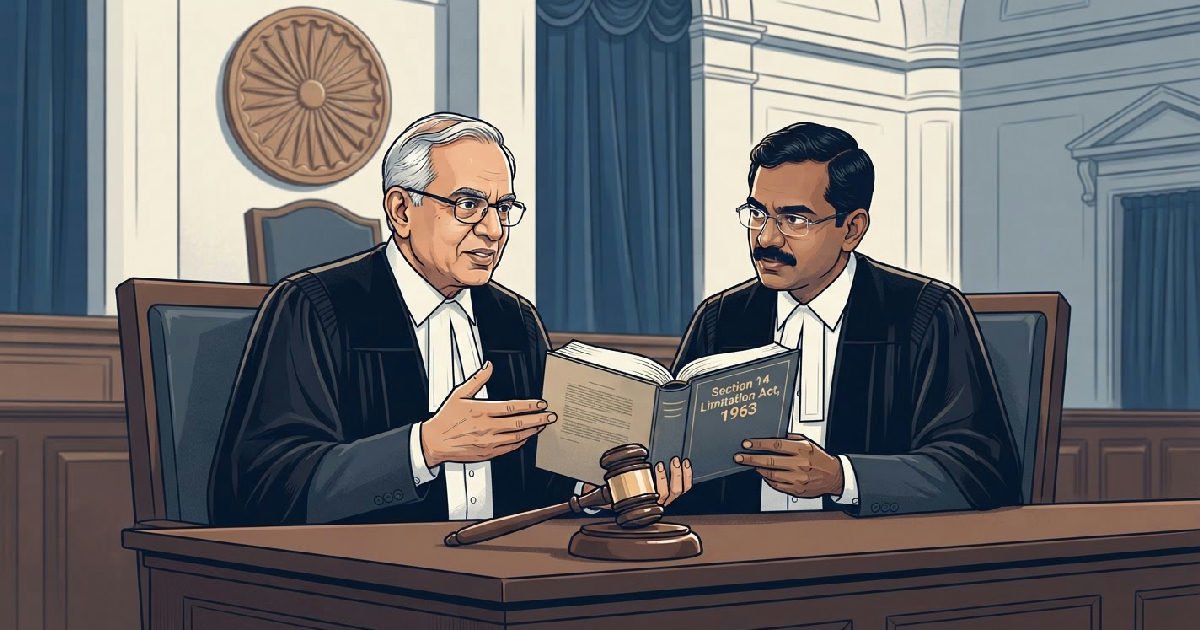
The Supreme Court of India ruled on August 12, 2026, that Section 14 of the Limitation Act, 1963, does not allow exclusion of time spent on winding-up proceedings for recovery suits. Justices J.B. Pardiwala and K.
Vinod Chandran, who authored the judgment, emphasized that the relief sought in these two types of proceedings is “fundamentally different.” This decision definitively sets aside a Calcutta High Court ruling and impacts how companies, like Mageba Bridge Products Private Limited and M/s. Trade Centre, must approach debt recovery [cite: 2, 4].
Supreme Court’s ruling on Section 14 Limitation Act exclusion
The core of the judgment hinges on the strict interpretation of Section 14, which requires the “same matter in issue” and “same relief” for time exclusion [cite: 2, 4]. This clarification is crucial for creditors and legal practitioners navigating the complexities of corporate insolvency and debt collection.
It underscores the importance of adhering to precise legal timelines, ensuring timely recourse to appropriate legal channels. The judgment has far-reaching implications for legal uncertainty in commercial disputes across India.
The Mageba Bridge Products Private Limited case facts
The case at hand involved M/s. Trade Centre, the respondent, which initiated a suit seeking recovery of ₹24,36,105/- [cite: 2, 3]. This substantial claim stemmed from unpaid invoices for supplies made to Mageba Bridge Products Private Limited, the appellant. These invoices dated back to January 2006 and March 2007, marking the origin of the financial contention [cite: 2, 4].
M/s. Trade Centre filed its recovery suit in June 2010. Crucially, this filing occurred well beyond the standard three-year limitation period applicable to such claims, which begins when the debt is due [cite: 2, 6]. This delayed action became the central point of contention in the higher courts.
Before pursuing the recovery suit, M/s. Trade Centre had attempted a different legal route. In February 2009, they initiated winding-up proceedings against Mageba Bridge Products Private Limited in the Company Court [cite: 2, 6]. This action aimed to dissolve the company and recover debts through that process.
However, the Company Court identified a clear dispute raised by the appellant company [cite: 2]. Consequently, it directed M/s. Trade Centre to pursue a civil remedy instead. This earlier directive proved to be a critical juncture, setting the stage for the subsequent litigation.
Mageba Bridge Products Private Limited had admitted three invoices, which were subsequently paid [cite: 2]. The company also agreed to provide security for two invoices dated January 2006, highlighting a partial acknowledgment of its obligations [cite: 2]. However, the broader recovery suit remained contentious.
Calcutta High Court’s overturned decision
The Calcutta High Court had previously allowed the recovery suit, effectively accepting M/s. Trade Centre’s argument for time exclusion [cite: 2]. This decision paved the way for the matter to be appealed to the highest court in India.
But the Supreme Court ultimately rejected this interpretation, setting aside the Calcutta High Court’s judgment. The apex court’s decision underscores a stricter reading of the Limitation Act, preventing the extension of deadlines through alternative proceedings [cite: 2, 4].
Core principles of the Limitation Act
The Limitation Act, 1963, serves as a cornerstone of India’s legal system, establishing statutory deadlines for initiating legal proceedings [cite: B1, B2]. Its primary goal is to ensure that legal remedies are pursued diligently, preventing the proliferation of stale claims and fostering judicial efficiency [cite: B1]. It aims to provide certainty and discourage endless litigation.
For a typical civil suit seeking money recovery, the standard limitation period is three years [cite: B3, B4]. This crucial period usually commences from the date when the cause of action arises, such as when a default occurs or money becomes due [cite: B4]. Missing this deadline legally bars the right to recover the debt through judicial intervention.
Conditions for time exclusion under Section 14
Section 14 of the Limitation Act allows for the exclusion of time spent prosecuting a civil proceeding under specific conditions [cite: B5, B6]. These conditions are stringent, requiring that both the prior and subsequent proceedings involve the “same matter in issue” and seek the “same relief” [cite: 2, 4, B5].
The section mandates that the prior proceeding must have been prosecuted with both due diligence and in good faith [cite: B6, B7]. This ensures that litigants genuinely attempted to pursue their claims, rather than using the previous action as a delaying tactic.
Additionally, the failure of the prior proceeding must have been due to a defect of jurisdiction or a similar cause [cite: B5, B7]. This provision aims to protect litigants who genuinely made a mistake about the proper forum, not those who deliberately chose an inappropriate legal avenue.
Ultimately, Section 14 is designed to shield diligent litigants from penalization due to procedural errors or jurisdictional issues [cite: B7]. It encourages the pursuit of legitimate claims without fear of time-barring, provided all conditions are met, particularly the crucial “same relief” and “same matter” criteria.
Fundamentally different legal remedies
The Supreme Court emphasized that winding-up proceedings and a civil suit for money recovery are “separate and independent remedies with divergent procedures” [cite: 2, 6]. This distinction formed the bedrock of its ruling against the application of Section 14.
Winding-up proceedings primarily aim to dissolve a company and distribute its assets among creditors [cite: B8]. Conversely, a recovery suit is a direct legal action to compel payment of a specific debt [cite: B9]. The Court noted that ultimate recovery in a winding-up scenario is a “mere consequence or result,” not the primary relief sought [cite: 2, 6].
So, while a creditor might hope to recover money during a winding-up, the legal purpose and mechanism are distinct from filing a targeted recovery suit. This nuanced difference proved decisive in the Supreme Court’s interpretation.
| Proceeding Type | Primary Goal | Limitation Period (Typical) | Section 14 Exclusion (Post-Ruling) |
|---|---|---|---|
| Civil Suit for Money Recovery | Direct collection of specific debt | 3 years from cause of action | Not for winding-up proceedings |
| Winding-up Petition (Company Law) | Dissolution of company and asset distribution | Varies, often 3 years for debt basis | No, as relief differs from recovery suit |
| Insolvency Proceedings | Declaration of insolvency, asset realization | Varies by specific law | No, as relief differs from recovery suit |
Precedents reinforcing the distinction
The Court reinforced its position by referring to several key precedents. One such case was Yeswant Deorao Deshmukh v. Walchand Ramchand Kothari (1950 SCC 766) [cite: 2, 3]. In this earlier judgment, the Supreme Court held that insolvency proceedings could not be excluded under Section 14, as they do not seek the same relief as a subsequent recovery action [cite: 2, 4].
Another crucial precedent cited was Jignesh Shah v. Union of India (2019) [cite: 3, 4]. This case further clarified the distinction between a civil suit for recovery and winding-up proceedings, affirming that the filing of one does not impact the limitation period for the other [cite: 3, 6]. These earlier rulings provided a solid jurisprudential foundation for the latest decision.
Heightened due diligence for debt recovery
This ruling signals a critical need for creditors to exercise heightened due diligence in pursuing debt recovery [cite: B10]. The window for filing a recovery suit is strictly three years from the date the debt becomes due, and businesses can no longer assume that ongoing winding-up proceedings will extend this period [cite: B10]. Failing to meet this timeline means forfeiting the legal avenue for recovery.
The judgment effectively closes a potential loophole or a common misunderstanding among some litigants regarding the interplay between different corporate legal actions. It clarifies that a company’s financial distress, leading to winding-up, does not automatically pause the clock for creditors seeking direct monetary judgments. This impacts legal strategy for foreign decree execution and domestic debt collection alike.
Impact on corporate insolvency proceedings
While winding-up proceedings remain a vital tool for corporate insolvency, their distinct purpose is now more sharply defined [cite: B8]. They are not a substitute for timely recovery suits, nor do they offer a shield against the strictures of the Limitation Act for such suits.
Businesses must now critically re-evaluate their internal protocols for managing overdue accounts and initiating legal action. Early and accurate assessment of legal options, coupled with prompt filing, will be paramount to successful debt recovery in India’s challenging commercial environment [cite: B11].
Ensuring legal certainty in commercial dealings
The Supreme Court’s decision provides much-needed clarity in an area of law that often leads to complex litigation. It removes ambiguity regarding the application of Section 14 to corporate insolvency matters, making the legal landscape more predictable for all parties involved [cite: B12].
This ruling reinforces a fundamental principle of law: different legal actions serve different aims and are not interchangeable for the purpose of statutory limitation. It underscores the importance of choosing the correct legal remedy and pursuing it within the stipulated timeframe [cite: B13].
The decision reflects the Supreme Court’s ongoing commitment to a clear and predictable legal framework that supports efficient commercial dealings. It will significantly shape how legal professionals advise on corporate debt matters moving forward.
Can time spent in winding-up proceedings extend the deadline for a recovery suit?
No, the Supreme Court of India ruled on August 12, 2026, that the period spent pursuing winding-up proceedings cannot be excluded under Section 14 of the Limitation Act, 1963, for filing a separate recovery suit.
Why did the Supreme Court make this distinction?
The Court reasoned that winding-up proceedings and recovery suits seek “fundamentally different” reliefs. Section 14 requires the “same matter in issue” and “same relief” for exclusion, which is not met when comparing these two types of actions.
What are the practical consequences of this judgment for businesses?
Businesses and creditors must now be more vigilant about filing recovery suits within the standard three-year limitation period. They cannot rely on concurrent winding-up proceedings to extend this crucial deadline.
Call or Whatsapp for free consultation.
Related Services: https://arpitmarwah.com/civil-law/