
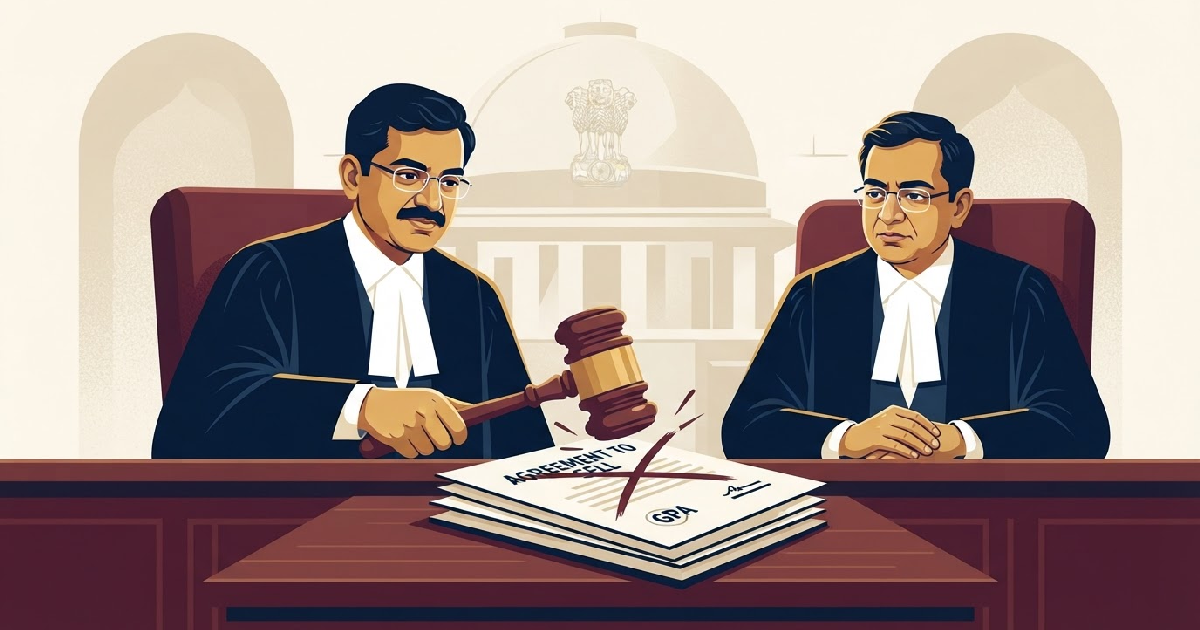
A registered sale deed is the sole legal instrument for property title transfer in India, as reiterated by the Supreme Court on September 1, 2025.
This decision, handed down by a bench comprising Justices Aravind Kumar and Sandeep Mehta in the case of Ramesh Chand (D) through LRs. v. Suresh Chand & Anr., explicitly states that documents like an Agreement to Sell, a General Power of Attorney (GPA), or an unproved Will do not, by themselves, confer ownership rights.
Preventing property fraud: The court’s clear message
The verdict sets aside a Delhi High Court judgment that had affirmed a trial court’s order to grant possession, mandatory injunction, and declaration of ownership without the presence of a registered sale deed. It underscores the apex court’s consistent stance on the necessity of formal registration for property transactions, aiming to safeguard genuine owners and prevent fraudulent claims.
This latest pronouncement from the Supreme Court sends an unequivocal message to the public and legal fraternity alike: shortcuts in property transactions carry significant risks. The Court’s insistence on registered sale deeds is fundamentally about securing property rights and maintaining transparency in the real estate sector.
It directly tackles long-standing issues of informal property transfers that often lead to complex legal disputes and expose buyers to considerable vulnerability.
For years, many property dealings in various parts of India, particularly in urban centres, relied on instruments other than a registered sale deed. This practice, often termed “GPA sales,” was prevalent largely due to attempts to evade stamp duty, registration fees, and capital gains tax. However, such methods created a murky property title declarations landscape ripe for fraud and litigation.
Historical context: The Suraj Lamp & Industries precedent
The Supreme Court’s current ruling isn’t a new interpretation but a firm reiteration of a principle established over a decade ago. The landmark 2011 judgment in Suraj Lamp & Industries Pvt. Ltd. v. State of Haryana first decisively clarified that transactions using Agreements to Sell, GPAs, and Wills do not transfer ownership.
That ruling, finalized in 2012, was a watershed moment for property law in India.
The rise of GPA sales and their pitfalls
Historically, property transactions often bypassed formal registered sale deeds in favor of these “GPA sales.” This involved sellers executing an agreement to sell, granting buyers a General Power of Attorney to manage the property, and sometimes even a Will.
While these methods offered apparent cost savings by avoiding stamp duty and registration fees, they came with substantial hidden risks and legal ambiguities. These informal arrangements often facilitated the circulation of unaccounted money within the real estate market.
The practice created a parallel system of property transfer that lacked legal sanctity. It left buyers with no legitimate claim to ownership, only a contractual right to compel a future sale. Such systems invited disputes and made it difficult to establish clear, undisputed title, leading to protracted legal battles.
Key definitions and their limitations
The Suraj Lamp judgment, and now the Ramesh Chand ruling, precisely define the limited scope of these documents. An Agreement to Sell is merely a promise to sell in the future; it doesn’t transfer present ownership.
A General Power of Attorney grants an agent the authority to act on behalf of the principal, but it doesn’t convey title. Critically, a GPA often becomes invalid upon the death of the principal, leaving the “buyer” with no legal recourse.
Similarly, a Will only takes effect after the death of the testator and can be challenged. It doesn’t create ownership during the testator’s lifetime. The consistent legal view is that none of these instruments, individually or combined, can substitute a duly registered sale deed for conferring legal title to immovable property.
The Ramesh Chand case: A dispute over family property
The recent case of Ramesh Chand (D) through LRs. v. Suresh Chand & Anr. provides a clear illustration of the problems arising from informal property transfers. The dispute centered around property inherited from a deceased father, pitting brother against brother in a contest over ownership claims that lacked formal documentation.
Disputed inheritance claims
Suresh Chand, the plaintiff, claimed to have purchased the property from his father back in 1996. His evidence included an Agreement to Sell, a General Power of Attorney, an affidavit, a receipt, and a registered Will. He argued these documents collectively demonstrated his ownership and entitlement to the property. The Delhi High Court had previously sided with Suresh Chand, validating his claim.
However, Ramesh Chand, the defendant, countered this by asserting that the property had been orally gifted to him in 1973. He maintained that he had been in possession of the property ever since. This stark contrast in claims, both lacking a registered sale deed, highlights the very type of ambiguity the Supreme Court seeks to eliminate.
Judicial reasoning on specific documents
Justice Aravind Kumar, who authored the judgment, emphasized the legal limitations of the documents presented by Suresh Chand. He stated, “In this case, the plaintiff undisputedly asserts that there is only an agreement to sell and that no sale deed has been executed in his favor by his father.
According to established legal principles, this document does not confer valid title on the plaintiff, as it is not a deed of conveyance under Section 54 of the Transfer of Property Act.”
The judge further clarified that “At best, it allows the plaintiff to seek specific performance for the execution of a sale deed, but it does not create an interest or charge on the suit property.” Regarding the Power of Attorney, the Court explained that “A power of attorney does not constitute a sale.”
The bench also questioned the validity of the Will, noting that it was “highly unlikely that a father would grant his entire property to one of his children, at the cost of three others, without there being any evidence of estrangement.” This observation highlights the court’s scrutiny of suspicious circumstances surrounding such documents.
The bedrock of property law: Registration requirements
The Supreme Court’s continued emphasis on registered sale deeds is deeply rooted in India’s property statutes. These laws are designed to provide clarity, prevent disputes, and ensure the state records all property transfers for legal certainty and revenue collection. Without such a framework, the stability of property ownership would be severely compromised.
The role of registration in authenticating ownership
Section 54 of the Transfer of Property Act, 1882, is explicit. It defines a “sale” as a transfer of ownership for a price. For tangible immovable property valued at ₹100 or more, this transfer must be made by a registered instrument.
This requirement ensures that property transactions are recorded publicly, creating a clear chain of title and preventing multiple claims over the same property. The registration process involves verification of documents and payment of stamp duties, adding a layer of authenticity and legal validity that informal agreements lack.
The Registration Act, 1908, further reinforces this by mandating compulsory registration for documents that create, declare, assign, limit, or extinguish any right, title, or interest in immovable property. Section 49 of this Act makes it clear that any compulsorily registrable document, if unregistered, cannot be used as evidence of title in court. This legal framework is paramount for property security.
Impact on legal disputes and
| Property Transaction Type | Legal Validity for Title Transfer | Typical Associated Costs (Excluding Property Price) | Risk of Disputes |
|---|---|---|---|
| Registered Sale Deed | Full and Final | Stamp Duty, Registration Fees | Low |
| Agreement to Sell + GPA | None (Contractual Only) | Nominal (Agreement Stamp Duty) | Very High |
| Unregistered Will | None (Takes effect post-death, challengeable) | Will drafting fees, potential probate costs | High |
What is the primary difference between an Agreement to Sell and a Sale Deed?
An Agreement to Sell is a contract outlining the terms for a future sale, while a Sale Deed is the final legal document that actually transfers ownership rights of the property. The Sale Deed must be registered to be legally valid for title transfer.
Can a General Power of Attorney (GPA) be used to transfer property ownership?
No, a GPA only grants authority to an agent to act on behalf of the principal. It does not, by itself, transfer ownership title of a property. Relying solely on a GPA for property transfer is legally invalid and poses significant risks.
What are the implications of using unregistered documents for property transactions?
Unregistered documents that are required by law to be registered (like sale deeds) cannot be used as evidence to prove title in a court of law. This renders the transaction legally unsound, leaving the buyer without legitimate ownership rights and vulnerable to disputes.