
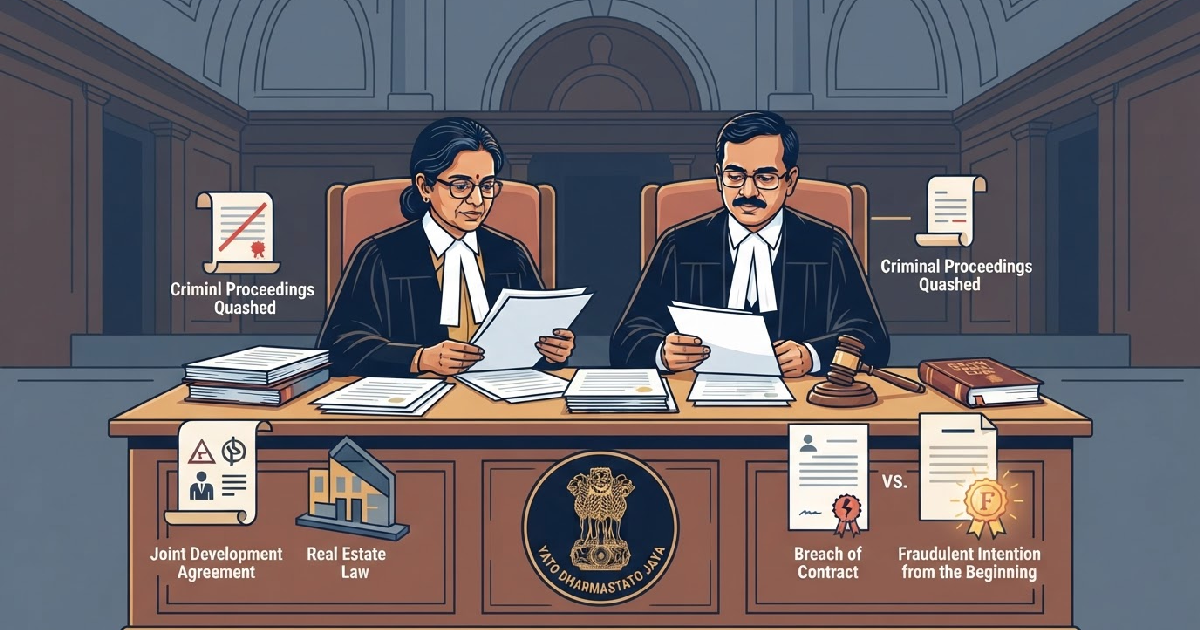
The Supreme Court of India, on August 4, 2026, delivered a pivotal judgment, quashing criminal proceedings against two landowners embroiled in a failed real estate joint development project. This ruling, handed down by a Bench comprising Justice B.V.
Nagarathna and Justice Ujjal Bhuyan, unequivocally clarified that a mere breach of contract cheating standards demand fraudulent or dishonest intention existed from the very inception of the transaction.
Supreme Court quashes criminal proceedings in real estate dispute
The Court further reiterated a crucial legal distinction: the offenses of ‘cheating’ and ‘criminal breach of trust’ cannot ordinarily coexist on the same set of facts. This decision underscores the judiciary’s commitment to preventing the criminalization of what are fundamentally civil disputes, a stance with significant ramifications for business and legal practices across India.
The core of this ruling stems from a dispute involving a 2012 Joint Development Agreement (JDA) for a residential project in Chennai. A real estate developer had paid a refundable security deposit of ₹3 crore to landowners, intending to proceed with construction.
However, the project encountered a significant roadblock when the Chennai Metropolitan Development Authority (CMDA) rejected planning permission. The property, it turned out, was part of an unapproved layout, making development impossible under the initial terms.
The Chennai joint development agreement at the center
Following the CMDA’s refusal, the landowners canceled the General Power of Attorney they had granted to the developer. They subsequently sold the property to a third party, prompting the developer to initiate criminal proceedings.
The developer lodged complaints alleging both cheating under Section 420 of the Indian Penal Code (IPC) and criminal breach of trust under Section 406 IPC. These sections were read with Sections 109 and 34 of the IPC, encompassing abetment and acts done by several persons in furtherance of a common intention.
Initial developer claims and court’s assessment
The Supreme Court, in its assessment, found no evidence to suggest that the landowners had fraudulent intent when they initially entered into the agreement. Both parties, the Court observed, acted with the intention of fulfilling their contractual obligations.
The project’s failure was attributed to the refusal of planning permission, a development that occurred well after the agreement’s inception. The Court highlighted that the developer should have conducted thorough due diligence regarding the property’s status before committing to the venture.
Distinguishing civil disputes from criminal offenses
This judgment reinforces a long-held principle in Indian jurisprudence: not every failed business transaction can be automatically escalated to a criminal matter. The Court explicitly stated that allowing criminal proceedings to continue would be an abuse of the legal process, turning a civil dispute into a criminal one.
The Bench, composed of Justice B.V. Nagarathna and Justice Ujjal Bhuyan, meticulously examined the elements required for a charge of cheating. They emphasized that the dishonest intention must be present at the very beginning of the transaction, not arise from subsequent events.
The critical role of proving fraudulent intent
For an act to be considered cheating under Section 420 IPC, deception must induce a person to deliver property or alter property, with the fraudulent or dishonest intent existing at the time of inducement. The Court found no such initial intent from the landowners.
As the Court observed, “It cannot be said that the accused at the time of entering into the agreement had a fraudulent and dishonest intention to induce the complainant to part with the refundable security deposit inasmuch as both parties, pursuant to the execution of the development agreement, acted with the intention of performing their respective contractual obligations.”
This quote from the judgment underscores the absence of foundational fraud.
Why cheating and criminal breach of trust can’t coexist
The Supreme Court also dismissed the allegation of criminal breach of trust. It clarified that the refundable security deposit did not constitute ‘entrustment’ of property in the sense required for Section 406 IPC.
Criminal breach of trust requires an initial lawful entrustment followed by dishonest misappropriation. Cheating, conversely, demands dishonest intent from the outset. These two offenses often cannot stand together on the same set of facts due to their differing foundational requirements regarding intent and property transfer.
Below is a table illustrating the key distinctions between cheating and criminal breach of trust under the Indian Penal Code, as highlighted by the Supreme Court.
| Feature | Cheating (Section 420 IPC) | Criminal Breach of Trust (Section 406 IPC) |
|---|---|---|
| Core Element | Deception and dishonest inducement to deliver property | Entrustment of property followed by dishonest misappropriation |
| Intent Timing | Must exist at the inception of the transaction | Arises after initial lawful entrustment of property |
| Property Handling | Induces delivery of property from victim to accused | Accused already has lawful dominion/possession of property |
| Co-existence | Cannot ordinarily coexist with criminal breach of trust on same facts | Cannot ordinarily coexist with cheating on same facts |
| Punishment (Max) | Imprisonment up to 7 years and fine | Imprisonment up to 3 years, or fine, or both |
Judicial precedents reinforce legal standards
The Court did not arrive at this conclusion in isolation; it drew upon established legal precedents. These earlier rulings have consistently sought to define the delicate boundary between civil and criminal matters, particularly in commercial disagreements.
The reliance on previous judgments provides a strong foundation for this decision, ensuring consistency and predictability in the interpretation of criminal law related to contracts. Such judicial clarity is vital for businesses and individuals engaged in complex transactions.
Consistent stance on dishonest intention at inception
A key reference point for the Court was its earlier decision in Hridaya Ranjan Prasad Verma v. State of Bihar. That case laid down the foundational principle that “mere breach of contract cannot give rise to criminal prosecution for cheating unless fraudulent or dishonest intention is shown right at the beginning of the transaction.”
This enduring principle serves as a bulwark against the misuse of criminal law to settle civil disputes. It ensures that the high bar for criminal culpability, particularly concerning intent, is maintained, preventing undue pressure on parties in contractual disagreements.
Preventing the abuse of legal process
Further solidifying its position, the Court also referenced its recent decision in Delhi Race Club (1940) Ltd. v. State of U.P. This judgment reiterated that offenses like cheating and criminal breach of trust typically cannot coexist on identical factual allegations.
The distinctions are clear: cheating demands dishonest intention from the very start, while criminal breach of trust necessitates a lawful entrustment followed by subsequent dishonest misappropriation. Recognizing these differences is crucial for a fair application of the law.
Implications for real estate and legal practice
The Supreme Court’s judgment offers a significant safeguard for landowners and developers alike, establishing clear boundaries for legal action when projects falter. It mandates a rigorous examination of intent at the outset of any contractual agreement.
This ruling strongly suggests that business failures, while financially painful, are primarily civil matters unless criminal intent is proven from the start. It shifts the burden away from criminal prosecution for mere commercial disappointments.
Emphasizing due diligence in agreements
The Court specifically noted that the developer ought to have conducted comprehensive due diligence before entering the venture. This highlights the critical importance of thoroughly researching property statuses and obtaining necessary approvals prior to signing agreements.
Such scrutiny can prevent significant future disputes and legal challenges. Parties entering into joint development agreements must ensure all regulatory hurdles are identified and addressed proactively, protecting against future claims of negligence or fraud. Securing financial transactions in complex dealings requires thorough preparation. Understanding financial security is key.
Encouraging civil remedies over criminal charges
The decision reaffirms the principle that subsequent legal defects or failure to obtain statutory approvals cannot, by themselves, be used to criminally prosecute parties. This distinction helps foster a more predictable business environment, reducing the risk of commercial disputes being weaponized as criminal charges.
It encourages parties to resolve disagreements through established civil remedies, such as arbitration or contractual litigation, rather than resorting to the more severe and often inappropriate recourse of criminal law.
The landowners in this case had offered to refund the ₹3 crore security deposit through a legal notice, subject to the return of original title documents. This action further illustrated the civil nature of the dispute, showcasing a willingness to fulfill financial obligations rather than an intent to defraud.
The evolving legal landscape in India
The Supreme Court’s consistent position on this matter, echoed in several judgments over recent years, reflects a broader judicial effort to streamline justice. It aims to ensure that the criminal justice system is reserved for genuine criminal acts, not for enforcing contractual breaches.
This clarity is particularly important as the Indian legal framework undergoes significant changes. The distinction between civil and criminal matters remains a cornerstone of legal practice, safeguarding individuals and businesses from unwarranted criminalization. The arbitral award passed under the development agreement, determining contractual liabilities, reinforces the civil nature of the redressal mechanism.
Transition to the Bharatiya Nyaya Sanhita
As India prepares for the implementation of the Bharatiya Nyaya Sanhita (BNS), which replaces the Indian Penal Code of 1860, these principles will continue to hold sway. Section 420 IPC, dealing with cheating, will find its equivalent in Section 318 of the BNS.
Similarly, criminal breach of trust, currently under Section 406 IPC, will be covered by BNS Section 3. The underlying legal philosophy regarding intent and the distinction between civil and criminal wrongs is expected to persist in the new legal code, ensuring continuity in legal interpretation.
Maintaining judicial integrity
The Court explicitly observed that the complainant had attempted to give a criminal color to what was purely a civil dispute. This practice is considered an abuse of the process of law, a concern the Supreme Court has consistently addressed.
The case fell within categories warranting the High Court’s quashing jurisdiction as per State of Haryana v. Bhajan Lal, highlighting the judiciary’s role in preserving the integrity of legal proceedings. Sound judicial interpretation of law remains paramount.
Ultimately, this judgment serves as a robust reminder for legal practitioners and the public. Understanding the nuances between a contractual breach and criminal fraud is fundamental to preventing the misuse of the criminal justice system. The emphasis on initial intent provides a critical filter, ensuring that commercial risks and failures are appropriately managed under civil law.
What is the key takeaway from the Supreme Court’s ruling?
The primary message is that a simple breach of contract isn’t automatically considered criminal cheating. To be deemed cheating, fraudulent or dishonest intent must be proven to have existed right at the very beginning of the agreement or transaction.
Can cheating and criminal breach of trust charges be filed simultaneously for the same incident?
No, the Supreme Court reiterated that these two offenses, cheating and criminal breach of trust, cannot ordinarily coexist based on the same set of facts. Cheating requires fraudulent intent from the start, while criminal breach of trust involves dishonest misappropriation after an initial lawful entrustment of property.
What is the importance of due diligence in real estate agreements after this judgment?
The judgment highlights the critical need for all parties, especially developers, to conduct thorough due diligence before entering into joint development agreements. This includes verifying property statuses and obtaining all necessary planning permissions to avoid issues that could lead to project failures and subsequent legal disputes.