
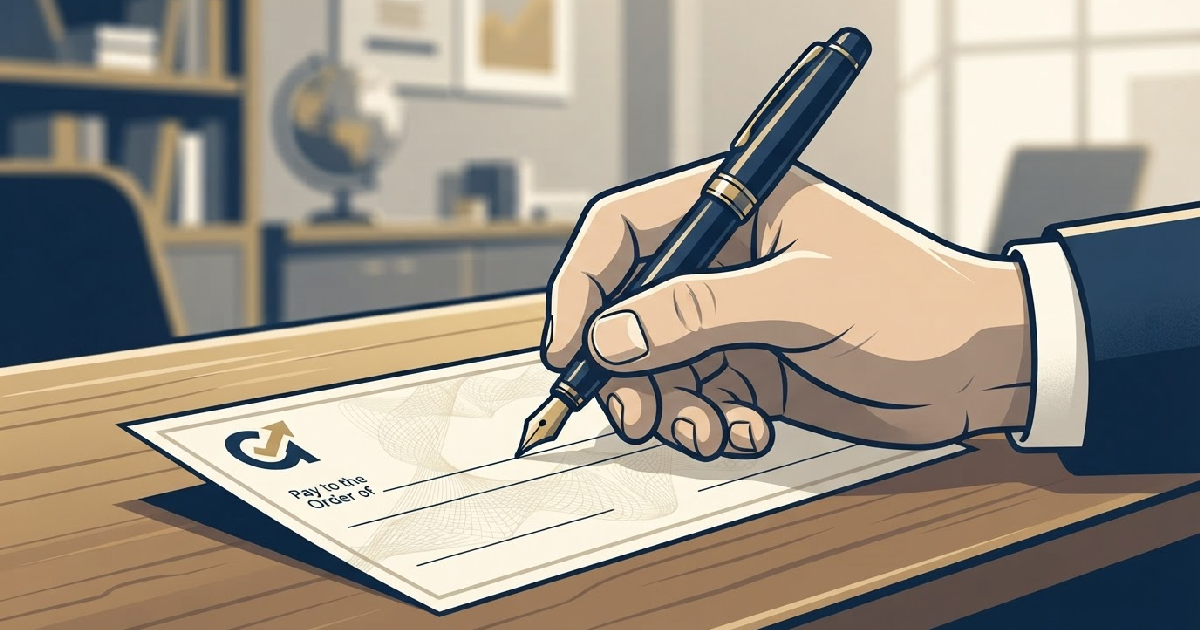
Writing a check to yourself remains a fundamental, legal, and common financial transaction, allowing individuals to efficiently move funds between their own accounts or withdraw cash. This practice essentially serves as a direct instruction to your bank, authorizing a specific sum from your account to be paid to yourself as the designated recipient.
While straightforward, knowing the precise mechanics and potential legal pitfalls, especially regarding insufficient funds, is critical for anyone engaging in this common banking activity.
Understanding the Check and Its Purpose for Self-Payment
A check is a formal written document that instructs a bank or another financial institution to transfer a specific amount of money from the payer’s account to the payee. The individual who writes the check is referred to as the “drawer” or “payor,” while the recipient of the funds is the “payee.”
Banks typically expect to pay the amount “on demand,” provided there are sufficient funds in the drawer’s account.
People often find themselves writing a check to yourself for several practical reasons. This includes transferring money between different bank accounts, even if those accounts are at separate financial institutions. Business owners, such as sole proprietors, LLCs, and S-corps, also use this method to draw salaries or distribute funds from their business accounts, helping to keep personal and business finances distinct.
Step-by-step guidance for writing a self-addressed check
The process for writing a check to yourself largely mirrors that of writing one to any other recipient, with a crucial difference: you list your own name as the payee. Start by accurately dating the check in the upper right-hand corner with the current calendar date.
On the “Pay to the order of” line, write your full legal name precisely as it appears on your bank account and government-issued identification. It’s generally ill-advised to write “Cash” on this line due to the inherent security risks involved. Next, accurately enter the numerical dollar amount in the designated box next to the dollar sign.
Below the payee line, spell out the dollar amount in words, such as “One Hundred Fifty and 00/100.” The memo line is optional but useful for noting the check’s purpose, creating a clear record for personal bookkeeping. Finally, sign the check on the signature line in the bottom right corner as the account holder.
Endorsing and depositing your self-written check
Before depositing or cashing the check, you must properly endorse it by signing the back. For enhanced security, particularly when depositing, consider adding a restrictive endorsement. This involves writing “For deposit only to account #[your account number]” directly above your signature.
For mobile deposits, some banks require specific wording like “For mobile deposit only” to be written on the reverse side of the check. If you need immediate cash, visit the issuing bank in person, where a teller can verify funds and provide cash without a hold period. Remember to present a government-issued photo ID.
Depositing a check at a different bank can be done through a teller, ATM, or mobile app. Such checks typically clear through the Federal Reserve system within one to three business days. Under Regulation CC, the initial $275 of a deposited check usually becomes available the next business day, with the remainder accessible by the second business day for most local checks.
Legal Risks and Financial Thresholds to Note
While convenient, writing a check to yourself demands careful attention to financial and legal considerations. It is absolutely essential to ensure sufficient funds are available in the account the check is drawn on. Writing a check to yourself with insufficient funds, even to temporarily move money between accounts, is defined as check kiting.
Check kiting constitutes a federal crime under 18 U.S.C. § 1344, which is categorized as bank fraud. An insufficient funds (NSF) check will also incur fees from your bank and could lead to your account being closed. Maintaining adequate balances is crucial to avoid these severe consequences.
Although some might consider writing a check payable to “Cash,” this practice carries significant security risks. Should such a check be lost or stolen, anyone who finds it can cash it, leaving your funds vulnerable. Also, post-dating a check by writing a future date does not legally prevent it from being cashed immediately, as banks are not obligated to observe the written date.
For cash transactions of $10,000 or more, your bank is legally required by the Bank Secrecy Act to file a Currency Transaction Report (CTR) with the Financial Crimes Enforcement Network (FinCEN). This is a standard regulatory reporting requirement and not an accusation of wrongdoing. However, intentionally breaking up transactions to avoid this reporting threshold, known as structuring, is a federal crime.
Alternatives and Bank Policy Considerations
It’s always wise to understand your bank’s specific policies regarding checks made out to yourself. Some financial institutions may charge fees for these transactions, or frequent instances could trigger their fraud prevention systems. Proactive communication with your bank can help mitigate unexpected issues.
While a valid method, writing a check to yourself isn’t always the most efficient option in today’s digital banking environment. Electronic transfers, mobile banking applications, and ATM withdrawals often provide faster and more streamlined ways to manage funds or obtain cash. These alternatives can offer improved speed and convenience for personal finance management.
| Financial Action / Regulatory Trigger | Threshold / Typical Timing | Associated Legal / Financial Impact |
|---|---|---|
| Check Clearing Time for Deposits | 1-3 business days | Funds typically available after this period, per Federal Reserve system. |
| Regulation CC Initial Availability | First $275 (as of July 2025) | Generally available the next business day for deposited checks. |
| Regulation CC Large Deposit Hold Trigger | Over $6,725 | May result in extended hold periods on funds. |
| Currency Transaction Report (CTR) Filing | $10,000 or more (cash transaction) | Routine regulatory report to FinCEN; structuring to avoid it is a federal crime. |
| Insufficient Funds (NSF) Check | Any amount without sufficient balance | Bank fees, potential account closure, constitutes check kiting (federal crime if intentional). |
Is writing a check to yourself illegal?
No, writing a check to yourself is a legal and routine financial transaction used to transfer money between your own accounts or to withdraw cash. It becomes illegal only if you do so with insufficient funds and intent to defraud, which is known as check kiting.
What are the dangers of insufficient funds when writing a check to yourself?
Writing a check to yourself without sufficient funds in your account carries serious repercussions. It will result in fees from your bank and can lead to your account being closed. More critically, it constitutes check kiting, which is classified as a federal crime under bank fraud statutes.
What are some faster alternatives to using a check for personal funds?
For quicker access to funds or transfers, electronic methods are generally more efficient than writing a check. These alternatives include direct electronic transfers, using mobile banking applications for transfers, or making immediate cash withdrawals from an ATM.