
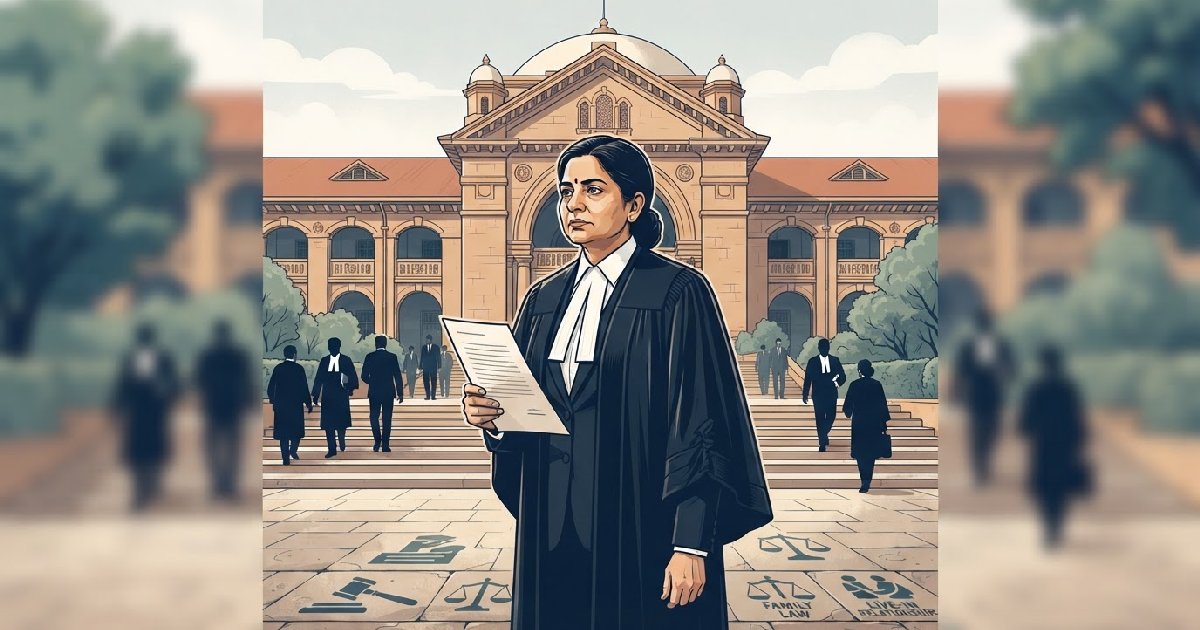
On July 30, 2026, the Allahabad High Court ruled a woman cannot claim maintenance as a live-in partner under Section 125 CrPC without proving the relationship. Justice Lakshmi Kant Shukla delivered this crucial judgment, dismissing a criminal revision petition from Manju Sonkar.
This decision underscores the necessity for explicit evidence in asserting financial rights within non-marital cohabitation.
The court’s specific findings against Manju Sonkar
The court’s ruling reaffirms that while live-in relationships are recognized, they do not automatically confer the same legal benefits as a formal marriage without proper substantiation. It highlights a recurring theme in family law, where evolving social norms intersect with established legal frameworks. Claimants must now present a robust case to secure maintenance.
Justice Lakshmi Kant Shukla’s judgment meticulously examined Manju Sonkar’s criminal revision petition, which challenged an earlier order from the Principal Judge, Family Court, Kaushambi. The Family Court, in its July 15, 2022 order, had granted maintenance solely to the couple’s biological minor child, rejecting Sonkar’s individual claim for financial support.
The High Court found no fault in the Family Court’s decision. It had already determined Manju Sonkar wasn’t legally married to the respondent. Moreover, Justice Shukla specifically noted there was “neither any pleading nor any evidence suggesting that the parties had lived in a live-in relationship.”
Absence of pleading and proof
Manju Sonkar’s case faltered on two critical fronts: she couldn’t establish a valid marriage and she failed to substantiate a live-in relationship. She had contended that she married the respondent unknowingly of his pre-existing marital status. However, this argument lacked the necessary legal foundation.
The respondent, in his defense, had “categorically denied having any relationship with her.” This direct denial, combined with Manju Sonkar’s lack of supporting evidence, proved decisive for the court. Justice Shukla concluded that precedents she cited, such as Anupama Pradhan v. Sultan Pradhan and Chanmuniya v. Virendra Kumar Singh Kushwaha, were not applicable given the facts.
Legal landscape for maintenance and live-in relationships
India’s legal system has gradually recognized live-in relationships, even without a dedicated statute. However, securing financial support from these arrangements remains a complex area. Section 125 of the Code of Criminal Procedure, 1973 (CrPC), serves as a secular safety net.
This provision aims to prevent destitution, compelling individuals with sufficient means to support dependents like wives, minor children, and parents. For live-in partners, accessing this protection often hinges on proving the relationship was “in the nature of marriage.” This legal nuance often creates significant hurdles for claimants.
The role of Section 125 CrPC
Section 125 CrPC is a fundamental legal tool for ensuring basic financial security, extending beyond religious personal laws. It applies to those unable to maintain themselves, irrespective of their social standing. However, its application to live-in relationships has been refined through judicial interpretation, requiring specific conditions to be met.
The statute acts as a crucial social welfare measure. But, the burden is on the claimant to demonstrate eligibility under the law. This usually involves proving legal marital status or, in modern contexts, a relationship that legally approximates a marriage. The Allahabad High Court bars woman’s maintenance claim without first divorce if she cannot prove a valid marriage.
Protection under PWDVA 2005
The Protection of Women from Domestic Violence Act (PWDVA) of 2005 provides another significant avenue for women in live-in relationships. Its Section 2(f) broadly defines a “domestic relationship” to include a “relationship in the nature of marriage.” This legal phrasing has been pivotal in extending protections.
Under the PWDVA, women in such relationships can seek various forms of relief. These include protection orders, residence rights, and monetary compensation, which often encompasses maintenance. The Act thus offers a vital statutory instrument for those not formally married but living in marriage-like arrangements.
Supreme Court precedents on ‘relationship in the nature of marriage’
Indian courts, particularly the Supreme Court, have been instrumental in shaping the legal understanding of live-in relationships. They’ve affirmed that living together without marriage isn’t illegal, protecting the right to choose a partner under Article 21 of the Constitution. These landmark judgments have significantly broadened the scope of protection for women in such unions.
A seminal ruling was Chanmuniya v. Virendra Kumar Singh Kushwaha (2011). The Supreme Court held that a woman in a live-in relationship could claim maintenance under Section 125 CrPC if the relationship was “in the nature of marriage.” This judgment advocated for a broad interpretation of “wife” to include de facto marriage-like relationships.
Defining de facto marriages
The Supreme Court further clarified these parameters in D. Velusamy v. D. Patchaiammal (2010), outlining conditions for a live-in relationship to qualify as “in the nature of marriage” under the PWDVA. These included a couple presenting themselves as spouses to society and being of legal age and eligibility to marry.
They also needed to have voluntarily cohabited for a substantial period within a shared household. The Indra Sarma v. V.K.V. Sarma (2013) judgment expanded on these criteria. It stipulated that only long-standing, stable, and demonstrably domestic relationships, with mutual consent to cohabitation, would typically receive legal protection.
Allahabad High Court’s evolving stance
The Allahabad High Court continues to contribute to the complex discourse surrounding live-in relationships and maintenance rights. Its judgments strive for a balance, safeguarding vulnerable individuals while upholding the sanctity of traditional marital laws. The court consistently demands clear evidentiary backing for maintenance claims.
In a December 2025 ruling, Justice Madan Pal Singh of the Allahabad High Court stated that a woman couldn’t claim maintenance under Section 125 CrPC from a live-in partner if her first marriage remained legally unresolved. The court clarified that such cohabitation, even if publicly acknowledged, wouldn’t confer the legal status of a wife for maintenance purposes.
The prior marriage impediment
The court’s consistent position emphasizes that a subsisting prior marriage significantly impacts maintenance claims from subsequent relationships. If a previous marital tie remains, any purported second marriage, even if ceremonial, is often deemed void ab initio. This legal principle aims to protect the integrity of marital institutions.
This stance creates a clear legal barrier for individuals attempting to secure maintenance benefits when previous marital obligations haven’t been legally dissolved. It highlights the importance of legal due diligence regarding marital status before entering new relationships that might involve shared financial responsibilities.
On July 13, 2026, the Allahabad High Court, through Justice Achal Sachdev, set aside a Family Court order granting Rs 2,000 monthly maintenance to a woman named Ranno for failing to prove a valid marriage.
Deception and void marriages
Conversely, the Allahabad High Court demonstrated a different nuance on July 28, 2026. Justice Garima Prashad ruled that a woman induced into a marriage through the concealment of her husband’s existing marriage is still entitled to maintenance under Section 125 CrPC, even if the marriage is technically void. This judgment protects victims of deception.
It underscores the legal principle that a husband cannot exploit his own wrongdoing to evade financial responsibility. The Mathura Family Court had originally awarded Monika alias Satyawati ₹6,000 per month. Her husband, Manoj Kumar alias Bablu, challenged this, but the High Court affirmed the maintenance, denying his plea. The Allahabad High Court affirms maintenance for woman when deception is involved.
Implications for individuals seeking maintenance as live-in partners
The recent decision from the Allahabad High Court sends a clear message to women in live-in relationships seeking maintenance: proactive pleading and concrete proof are essential. Merely asserting a live-in status won’t suffice; claimants must present compelling evidence to the court. This ruling reinforces existing legal principles.
It clarifies that while live-in relationships are protected under Article 21 of the Constitution, they do not automatically grant all the legal rights and obligations of a formal marriage. Financial provisions like maintenance require a demonstrated effort to prove the nature and legitimacy of the relationship. The burden of proof remains squarely with the individual seeking relief.
The burden of proof
To successfully claim maintenance, a woman in a live-in relationship must gather substantial evidence. This might include shared household expenses, joint bank accounts, property ownership documents, or public acknowledgment of their relationship. Without such verifiable documentation or credible witness testimonies, claims are likely to be dismissed.
Legal experts often observe that India lacks a comprehensive law specifically for live-in couples, which leads to a fragmented approach in court. Rights are often “pieced together from diverse laws and court rulings.” This complexity makes meticulous preparation and strong legal counsel crucial for claimants.
Call for legislative clarity
Many legal scholars and judges have highlighted the urgent need for dedicated legislation addressing live-in relationships. Such a law could provide much-needed clarity on issues like property rights, inheritance, and maintenance, reducing ambiguity and streamlining judicial processes. Until then, courts must rely on interpreting existing laws like the CrPC and PWDVA.
This ongoing judicial interpretation means each case contributes to shaping the legal contours of live-in partner rights. The rulings emphasize that legal recognition of these relationships for maintenance is conditional. It demands adherence to specific legal procedures and evidentiary standards, distinguishing genuine relationships from casual cohabitation.
Here’s a summary of recent Allahabad High Court rulings concerning maintenance claims:
| Ruling Date | Court/Judge | Claimant Status | Maintenance Outcome | Key Reason for Decision |
|---|---|---|---|---|
| July 30, 2026 | Allahabad HC, Justice Lakshmi Kant Shukla | Live-in Partner (claimed) | Denied (for woman) | No pleading/proof of live-in relationship or valid marriage |
| July 15, 2022 | Family Court, Kaushambi | Wife/Partner | Granted (for child) | Woman not legally wedded, child’s right upheld |
| July 13, 2026 | Allahabad HC, Justice Achal Sachdev | Wife (claimed) | Denied (for woman) | Failed to prove valid marriage, subsisting first marriage |
| December 16, 2025 | Allahabad HC, Justice Madan Pal Singh | Live-in Partner | Denied (for woman) | First marriage unresolved, cohabitation doesn’t confer wife status |
| July 28, 2026 | Allahabad HC, Justice Garima Prashad | Second Wife | Granted (for woman) | Induced into marriage by concealment of husband’s first marriage |
What is Section 125 CrPC?
Section 125 of the Code of Criminal Procedure is an Indian legal provision allowing wives, minor children, and parents to claim maintenance from those legally obligated to support them. Its primary objective is to prevent destitution and ensure financial stability for dependents.
Can a woman in a live-in relationship claim maintenance in India?
Yes, a woman in a live-in relationship can claim maintenance in India. However, she must provide sufficient evidence to formally plead and prove that her relationship qualifies as being “in the nature of marriage,” as defined by various court rulings.
What evidence is needed to prove a live-in relationship for maintenance?
Proving a live-in relationship for maintenance typically requires showing evidence of long-term cohabitation, shared household responsibilities, joint financial records, and public acknowledgment as a couple. This can include documents, photographs, and witness testimonies demonstrating a marriage-like commitment and mutual support.