
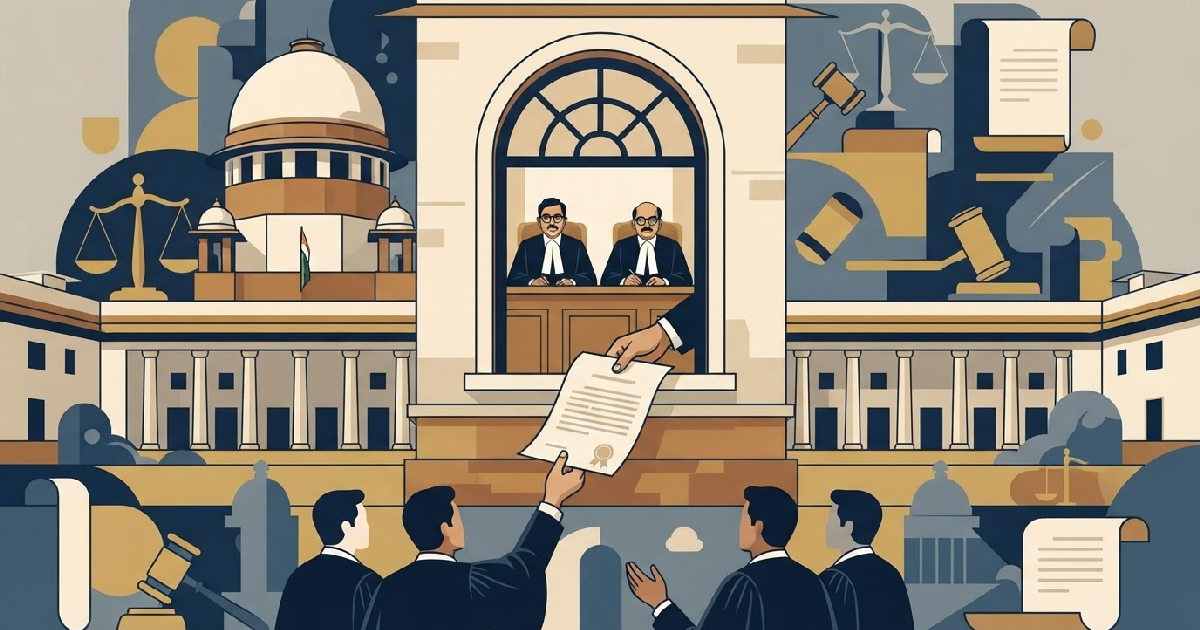
On September 25, 2025, the Supreme Court mandated that defendants in summary suits under Order XXXVII of the CPC require court leave to file a reply or defence. A bench comprising Hon’ble Justices Ahsanuddin Amanullah and S.V.N. Bhatti made this decision.
It directly impacts commercial litigation by setting aside a Bombay High Court order and reinforcing strict procedural adherence for any summary suit defense.
Supreme Court Clarifies Summary Suit Defence Requirements
This judgment is critical for businesses and legal practitioners across India. It reinforces the objective of summary suits: to achieve swift resolutions in cases of undisputed debts. The ruling aims to prevent deliberate delays often used by defendants who lack a genuine defense.
The Supreme Court’s recent directive underscores the critical importance of procedural safeguards in commercial disputes. This move aims to prevent strategic delays frequently employed by defendants who may lack a genuine claim. It effectively streamlines the process for legitimate debt recovery.
Justices Ahsanuddin Amanullah and S.V.N. Bhatti unequivocally stated that sub-Rule (5) of Rule 3 of Order XXXVII of the CPC is not merely advisory. It is a mandatory requirement. This means a defendant must actively seek and be granted permission before any form of defense can be officially recorded by the court.
Reaffirming the Mandatory ‘Leave to Defend’ Rule
The core of the Supreme Court’s pronouncement lies in its insistence on the “leave to defend” mechanism. This procedural step acts as a crucial filter. It ensures that only defendants with a triable issue or a plausible defense are allowed to proceed to a full trial, preventing frivolous objections.
Without this mandatory pre-approval, the very purpose of Order XXXVII would be significantly undermined. This order was created to provide a swift path to judgment in clear-cut monetary claims. Bypassing it would dilute the distinction between summary and ordinary civil suits.
Overturning the Bombay High Court’s Deviation
This significant Supreme Court ruling arose from an appeal against an order issued by the Bombay High Court on December 5, 2023. That particular order had permitted the defendant to file a reply to a Summons for Judgment. Crucially, it did so without requiring the defendant to first obtain the necessary leave.
The Supreme Court found this approach procedurally flawed, stating that such a deviation would effectively nullify the legislative intent behind summary suits. The case that prompted this clarification was EXECUTIVE TRADING COMPANY PRIVATE LIMITED. VERSUS GROW WELL MERCANTILE PRIVATE LIMITED. It stemmed from Commercial Summary Suit No. 19 of 2020.
The Precedent: Executive Trading Company v. Grow Well Mercantile
This particular case offers a clear precedent for how commercial summary suits should be handled across India. The plaintiff, Executive Trading Company Private Limited (Plaintiff-Appellant), initiated the suit before the High Court of Judicature at Bombay.
They aimed to recover an alleged admitted and confirmed total liability of ₹2,15,54,383.50/-, together with interest, from Grow Well Mercantile Private Limited (Defendant-Respondent). This substantial financial claim exemplifies the types of cases for which summary suits were specifically designed.
Origins of the Commercial Dispute
The dispute itself centered on a significant financial obligation. Executive Trading Company Private Limited sought to quickly recover funds it considered indisputably owed, utilizing the expedited legal action afforded by Order XXXVII CPC. This highlights the directness inherent in summary suit procedures.
Grow Well Mercantile Private Limited, the defendant, faced this rapid legal challenge. The burden in such proceedings often rests on the defendant to prove a genuine defense, or risk an immediate judgment against them.
Mediation Attempts and Procedural Hurdles
Initially, Grow Well Mercantile Private Limited attempted to dismiss the suit. They argued for non-compliance with the pre-institution mediation requirement under Section 12A of the Commercial Courts Act. However, mediation efforts ultimately failed to resolve the commercial disagreement.
Following this, the plaintiff was permitted to amend the plaint, and a Summons for Judgment was issued. The Bombay High Court’s subsequent direction, allowing the defendant to file a reply without prior leave, became the central point of contention in the Supreme Court appeal. The Supreme Court’s decision thus corrected this procedural oversight.
Understanding Summary Suit Procedures (Order XXXVII CPC)
Order XXXVII of the Code of Civil Procedure (CPC), 1908, represents a specialized procedural framework within India’s legal system. Its purpose is distinct from ordinary civil litigation, focusing heavily on efficiency. It seeks to prevent frivolous delays, particularly in financial matters.
This order provides a streamlined mechanism for specific types of claims, especially those involving clear-cut financial obligations. It contrasts sharply with the often lengthy and complex processes associated with other civil suits. This ensures commercial cases progress much faster.
Purpose of Expedited Justice in Commercial Disputes
The primary objective of a summary suit is to facilitate the speedy disposal of cases involving liquidated debts. This includes claims based on financial instruments like bills of exchange, hundies, and promissory notes. It also extends to liquidated money demands arising from written contracts, statutory enactments, or guarantees.
The procedure is available in High Courts, City Civil Courts, and Courts of Small Causes. Other courts specifically notified by the High Court can also institute these suits. This legal mechanism is crucial for businesses seeking quick resolution of financial disagreements, such as those involving account confirmations.
Key Procedural Steps for Defendants
The “leave to defend” mechanism is the cornerstone of summary suits, dictating the defendant’s initial steps. After a defendant is served with the summons, they must enter an appearance within 10 days of receiving it. This initial appearance acknowledges their participation in the legal process.
Crucially, after this appearance, the defendant has another 10 days from the service of the summons for judgment to apply for leave to defend the suit. This application must be supported by an affidavit that genuinely discloses a substantial defense. Mere assertions are insufficient for the court’s consideration.
| Procedural Step | Defendant Action Required | Timeline (Post-Summons Service) |
|---|---|---|
| Entry of Appearance | File appearance | Within 10 days |
| Application for Leave to Defend | File application with affidavit | Within 10 days (of Summons for Judgment) |
| Filing Reply/Defence (if permitted) | Submit detailed defence | Only AFTER court grants leave |
| Consequence of No Leave/Refusal | Judgment entered for plaintiff | Immediate judgment |
Criteria for Granting and Refusing Leave to Defend
The discretion to grant or refuse leave to defend is a critical aspect that judges weigh carefully. It balances the plaintiff’s right to swift justice with the defendant’s right to present a legitimate challenge. Courts do not grant leave automatically.
Judges assess the nature and strength of the proposed defense meticulously. This ensures the summary procedure is utilized for its intended purpose and not abused by either party seeking unfair advantage in the legal process.
When Leave to Defend is Granted
Leave to defend is generally granted when a defendant can raise a triable issue. This signifies a genuine question of fact or law needing resolution through evidence and argument. It implies the plaintiff’s claim isn’t entirely straightforward or indisputable.
A fair, bona fide, or even plausible defense (though not necessarily ironclad) will often secure conditional or unconditional leave. If a defendant admits to owing part of the amount, they must deposit that sum in court to obtain conditional leave to defend. Judges can also condone delays in applying for leave if sufficient cause is shown.
The Supreme Court has previously clarified that granting leave to defend should be the general rule, with denial being an exception. For instance, in B.L. Kashyap And Sons Limited v. JMS Steels And Power Corporation And Another (2022 INSC 60), Justices Vineet Saran and Dinesh Maheshwari highlighted this principle.
Leave should only be refused if the defendant presents virtually no defense or fails to raise any triable issues.
Similarly, IDBI Trusteeship Services Ltd. v. Hubtown Ltd. (2017) 1 SCC 568 affirmed that leave to defend must be granted if the defendant raises triable issues. Summary disposal is reserved for cases where no real defense genuinely exists, reinforcing the courts’ careful approach.
Refusal and Consequences for Defendants
Leave will not be granted if the defense presented is deemed frivolous, vexatious, sham, or “moonshine.” These terms describe defenses that are clearly baseless, intended solely to annoy or delay proceedings, or have no real prospect of success in court. Such defenses waste judicial time.
If the defendant has practically no genuine defense or fails to raise any triable issues, the court will refuse leave. In these instances, or if the defendant simply does not apply for leave, the plaintiff becomes entitled to an immediate judgment. This accelerates justice for clear debts.
Should leave be granted subject to certain conditions, and the defendant subsequently fails to meet those conditions, the plaintiff is similarly entitled to immediate judgment. However, an ex parte decree, a judgment passed in the defendant’s absence, can still be set aside under Rule 4 of Order XXXVII.
This is possible if the defendant demonstrates special circumstances prevented their appearance or failure to apply for leave within the stipulated timeframe.
Broader Implications for India’s Commercial Landscape
This Supreme Court ruling carries substantial weight for the landscape of commercial litigation in India. It signals a clear judicial intent to ensure the efficiency and integrity of the summary suit process, which is vital for businesses and trade across the nation.
The decision reinforces predictability for creditors seeking to recover clear debts. It curtails avenues for debtors to prolong legal battles without a substantial defense. This will likely lead to a more streamlined resolution of many commercial disputes.
Boosting Efficiency and Reducing Case Backlogs
By mandating strict adherence to the “leave to defend” procedure, the Supreme Court is actively contributing to the streamlining of dispute resolution. This move is expected to help reduce the backlog of cases. It will especially impact overburdened commercial courts and aligns with broader efforts to improve efficiency in commercial suits.
Businesses rely on quick and effective legal mechanisms to resolve financial disagreements. This clarity means fewer cases will proceed to full trial where defendants have no genuine claim. This frees up judicial resources for more complex matters. It’s a strategic step towards a more efficient justice system.
This ruling essentially closes a potential loophole where defendants could delay proceedings without substantiating their claims. It makes the summary suit truly ‘summary’ by enforcing its intended procedural rigor. Such judicial clarity helps to foster a more transparent and accountable commercial environment.
Enhancing Predictability for Creditors and Businesses
For legal practitioners, this judgment offers unequivocal clarity on a critical procedural point. Lawyers will now have a precise understanding of a defendant’s obligations in summary suits. This will undoubtedly impact litigation strategies for both plaintiffs and defendants, enabling more informed legal advice.
The ruling should also boost confidence among creditors and businesses. Knowing that the courts will rigorously enforce procedural requirements for debt recovery makes commercial transactions more secure and disputes more manageable. Such clarity is essential for the steady development of commercial law.
This increased predictability minimizes the financial and operational risks associated with commercial agreements. When the legal recourse for recovering debts is swift and clear, it incentivizes investment and commercial activity. Companies can plan with greater certainty regarding their receivables.
The Economic Value of Judicial Clarity
The expeditious resolution of commercial disputes has a direct positive impact on the economy. Prolonged litigation ties up capital, creates uncertainty, and can deter both domestic and foreign investment. This judgment acts as a catalyst for economic stability.
This judicial emphasis on speed and clear process in debt recovery, therefore, isn’t just about legal procedure. It’s about fostering a more robust and predictable business environment. It underscores the judiciary’s vital role in supporting economic growth through efficient legal frameworks and predictable outcomes.
What is Order XXXVII CPC?
Order XXXVII of the Code of Civil Procedure (CPC) outlines a summary procedure for specific types of suits, primarily those involving liquidated money demands. Its goal is to allow for quicker judgments when a defendant lacks a genuine defense, speeding up commercial dispute resolution.
Why did the Supreme Court issue this ruling?
The Supreme Court issued this ruling to uphold the foundational distinction between summary suits and ordinary civil suits. It ensures that the mandatory “leave to defend” requirement is not bypassed, preventing undue delays and preserving the efficiency intended for these expedited cases.
How does this decision affect defendants in summary suits?
This decision means defendants in summary suits must formally apply for and obtain the court’s permission (leave) before they can file any reply or defense. Failing to do so can result in immediate judgment against them, making proper adherence to procedure crucial for a summary suit defense.