
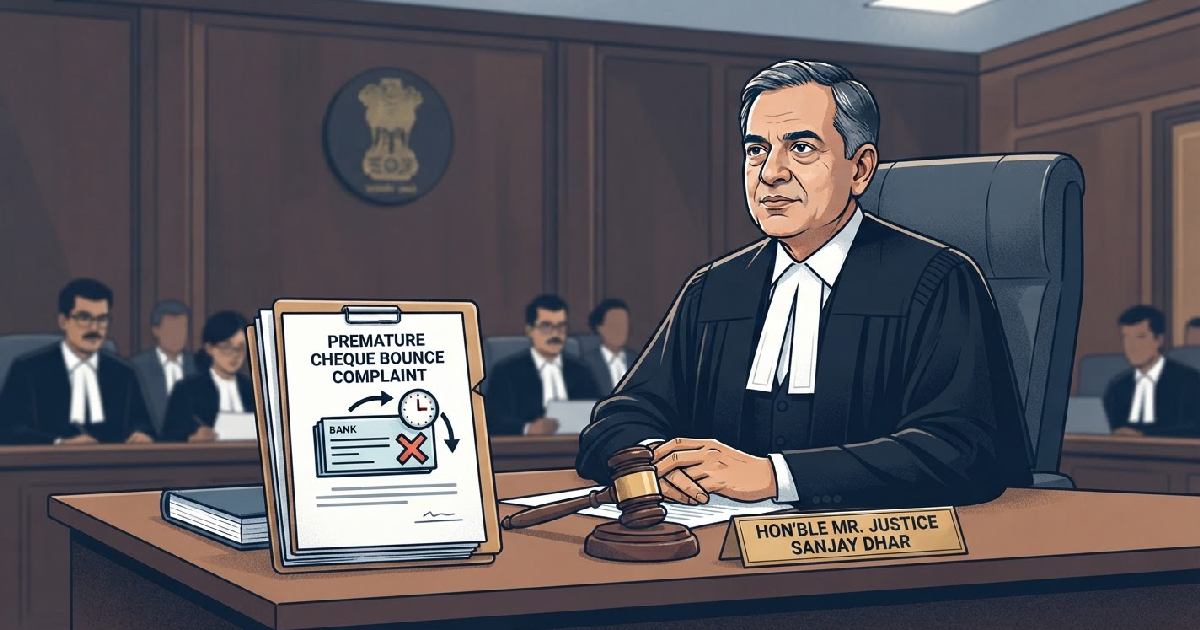
In a significant decision released on July 24, 2026, the High Court of Jammu & Kashmir and Ladakh has clarified the legal landscape surrounding cheque dishonour cases. Justice Sanjay Dhar ruled that the time spent in bona fide prosecuting a premature cheque bounce complaint must be excluded when calculating the limitation period for filing a fresh complaint.
This ruling provides crucial relief to diligent litigants like Sheikh Abdul Rehman, the petitioner in the criminal revision case, ensuring they aren’t penalised by procedural technicalities. It underscores the court’s commitment to protecting genuine causes from being defeated by strict interpretations of statutory timelines, especially when initial complaints are deemed defective.
A lifeline for diligent litigants in cheque dishonour cases
The High Court’s verdict represents a critical safeguard for individuals who pursue legal remedies in good faith. Justice Sanjay Dhar firmly stated that a complainant who genuinely prosecutes a cheque dishonour complaint, only to find it later declared premature, shouldn’t forfeit their statutory cause of action.
This protection remains even if the litigation process extends over several years. The court emphasised that the period actively spent on such a defective complaint must be factored out when determining the limitation for filing a subsequent, correct complaint. This prevents undue hardship and loss of legal recourse for those acting with due diligence.
The Sheikh Abdul Rehman case explained
The recent judgment arose from a criminal revision petition filed by Sheikh Abdul Rehman. His initial complaint under Section 138 of the Negotiable Instruments Act was deemed premature, leading to protracted legal proceedings.
The Chief Judicial Magistrate, Srinagar, had previously refused to condone the delay in filing a fresh complaint, a decision Justice Dhar described as a “wrong appreciation of facts and the law.” This initial refusal by the lower court effectively ignored the material circumstances that caused the delay.
Following an appeal decided on August 8, 2025, the petitioner promptly obtained a certified copy of the judgment. He then retrieved the original dishonoured cheques from the trial court, subsequently filing a fresh complaint on September 11, 2025. The High Court found these actions to be sufficient in explaining the delay.
Understanding India’s cheque dishonour laws
Cheque bounce cases in India operate under the stringent framework of the Negotiable Instruments Act, 1881, specifically Sections 138 and 142. These provisions were initially introduced to foster financial discipline and bolster confidence in cheque-based transactions.
A crucial aspect of this framework is the concept of a “premature complaint.” A complaint filed before the mandatory 15-day notice period expires (after a demand notice is served to the drawer) is considered premature. Such a complaint is not legally maintainable, but typically allows for a new complaint to be filed once the correct timeframe arrives.
Key conditions and penalties under NI Act
For a complaint under Section 138 of the NI Act to be valid, several conditions must be met. The cheque must represent a legally enforceable debt, and it must be presented within its validity period, usually three months. After dishonour, a legal notice demanding payment must be sent within 30 days, and the drawer then has 15 days to pay.
Only after these steps, and if payment isn’t made, can a complaint be filed within 30 days. Penalties for conviction can include imprisonment for up to two years, a fine up to twice the cheque amount, or both. For more details on the potential cheque bounce punishment, specific provisions outline the severity.
Precedent setting: Supreme Court’s guiding hand
Justice Sanjay Dhar’s recent ruling didn’t emerge in a vacuum; it drew heavily on established Supreme Court precedent. The High Court specifically relied on the landmark ruling in Yogendra Pratap Singh v. Savitri Pandey. This reliance highlights the judicial commitment to consistency and fairness.
The Supreme Court’s position in such matters has long guided lower courts. Their clarifications ensure that procedural fairness is upheld. This prevents genuine claimants from being disadvantaged by technical errors, especially when they act with diligence.
The `Yogendra Pratap Singh` ruling detailed
The Supreme Court, in Yogendra Pratap Singh v. Savitri Pandey, articulated a clear principle.
They stated, “The payee or the holder in due course of the cheque may file a fresh complaint within one month from the date of decision in the criminal case and, in that event, delay in filing the complaint will be treated as having been condoned under the proviso to clause (b) of Section 142 of the NI Act.”
This crucial dictum provides a safety net for complainants. It explicitly acknowledges that procedural missteps, if diligently corrected, shouldn’t automatically bar the pursuit of justice. It essentially grants a window for rectify a previously premature complaint.
Broader implications for India’s legal system
This ruling from the High Court of Jammu & Kashmir and Ladakh holds significant implications for India’s broader legal system. It reinforces the principle that procedural flaws, particularly those related to the timing of premature cheque bounce complaints, should not override the substance of justice. This judicial stance helps reduce the burden on honest litigants.
The decision is particularly pertinent given the substantial backlog of cheque bounce cases across the country. Such clarifications can streamline the process for refiling complaints. They help courts avoid dismissing cases purely on technical grounds, which often necessitates new, equally time-consuming litigation.
Tackling the case backlog in cheque cases
Cheque bounce cases contribute significantly to the colossal backlog within Indian courts. As of December 2024, approximately 4.3 million cheque bounce cases were pending nationwide. States like Rajasthan, Maharashtra, and Delhi bear the brunt of this caseload.
The average pendency for Section 138 cases in subordinate courts stood at over three years and seven months. This new ruling offers a nuanced approach to an age-old problem. It means courts can focus on the merits rather than perpetually revisiting procedural errors.
Impact on litigation strategies
Lawyers and their clients will now have clearer guidance when a cheque dishonour complaint is initially filed prematurely. The ruling encourages prompt and diligent action to refile after a procedural dismissal. This approach ensures that the legal journey continues without the complete loss of the cause of action.
Furthermore, it reduces the risk of years of litigation being rendered fruitless. This provides a more predictable path for complainants. The ruling also aligns with the broader judicial trend of promoting substantive justice over mere technicalities in the face of complex legal procedures.
Judicial scrutiny and lower court accountability
Justice Dhar’s observations regarding the Chief Judicial Magistrate, Srinagar, are particularly telling. He noted that the impugned order displayed a “wrong appreciation of facts and the law.” This pointed critique highlights the importance of correct legal interpretation at all judicial levels.
It acts as a reminder to lower courts to carefully consider the circumstances surrounding delays. Simply dismissing a case based on perceived untimeliness, without examining the bona fide efforts of the litigant, can lead to further appeals and prolonged justice delivery. This emphasis on appreciation of facts safeguards against arbitrary decisions.
Navigating the nuances of limitation law
Limitation periods in law are designed to ensure disputes are resolved within a reasonable timeframe, preventing stale claims. However, legal systems also recognize situations where strict adherence to these periods might lead to injustice. This is where provisions like Section 14 of the Limitation Act, 1963, come into play, although this specific ruling applies a similar principle in a criminal context under the NI Act.
Section 14 of the Limitation Act allows for the exclusion of time spent prosecuting a civil proceeding in good faith, in a court lacking jurisdiction. While cheque bounce cases are criminal in nature, the underlying principle of protecting diligent litigants from technical procedural hurdles remains consistent.
This High Court ruling extends that protective spirit to the NI Act framework, acknowledging that errors made in good faith shouldn’t destroy a legitimate claim.
This legal clarity provides an important pathway for complainants. It ensures their right to seek redress is preserved, even if their initial filings were flawed. The emphasis is on the bona fide intent and diligence of the complainant, rather than an unyielding adherence to procedural strictures that might otherwise lead to unjust outcomes.
The road ahead: ensuring fair process
The Jammu & Kashmir and Ladakh High Court’s ruling marks a progressive step in the interpretation of cheque dishonour laws. It ensures that individuals who genuinely seek justice for bounced cheques are not unfairly disadvantaged by technical errors or premature filings. By allowing the exclusion of time spent on such complaints, the court upholds the spirit of the law over its letter.
This decision is expected to influence how similar cases are handled across India, potentially leading to more consistent judicial approaches. It underscores the judiciary’s role in evolving legal interpretations to meet the practical realities faced by litigants, ultimately strengthening public trust in the justice system.
Future cases will likely cite this ruling as a precedent for maintaining the cause of action in complex procedural scenarios, promoting fairness in litigation.
Comparison of case processing status
| Case Status | Initial Complaint (Premature) | Fresh Complaint (Post-Ruling) |
|---|---|---|
| Filing Date | Undetermined (Premature) | September 11, 2025 |
| Lower Court Ruling | Dismissed / Delay not condoned | Remanded for merits consideration |
| Appeal Outcome | Appeal decided August 8, 2025 | N/A (fresh filing) |
| Limitation Status | Expired (originally) | Time excluded, delay condoned |
What does “premature cheque bounce complaint” mean?
A premature cheque bounce complaint is one filed before all statutory conditions under the Negotiable Instruments Act are fully met, specifically before the mandatory 15-day notice period given to the cheque drawer has expired. Such complaints are typically not maintainable at that stage.
How does this ruling protect litigants?
This ruling protects litigants by allowing the time they spent prosecuting a genuine but technically premature complaint to be excluded from the limitation period. This means they can file a fresh, valid complaint without being time-barred, as long as their initial actions were taken in good faith and with diligence.
Which Supreme Court case was referenced in this judgment?
The High Court of Jammu & Kashmir and Ladakh referenced the Supreme Court’s landmark ruling in Yogendra Pratap Singh v. Savitri Pandey. This precedent established the principle that delays in refiling due to initial premature complaints can be condoned under specific conditions.