
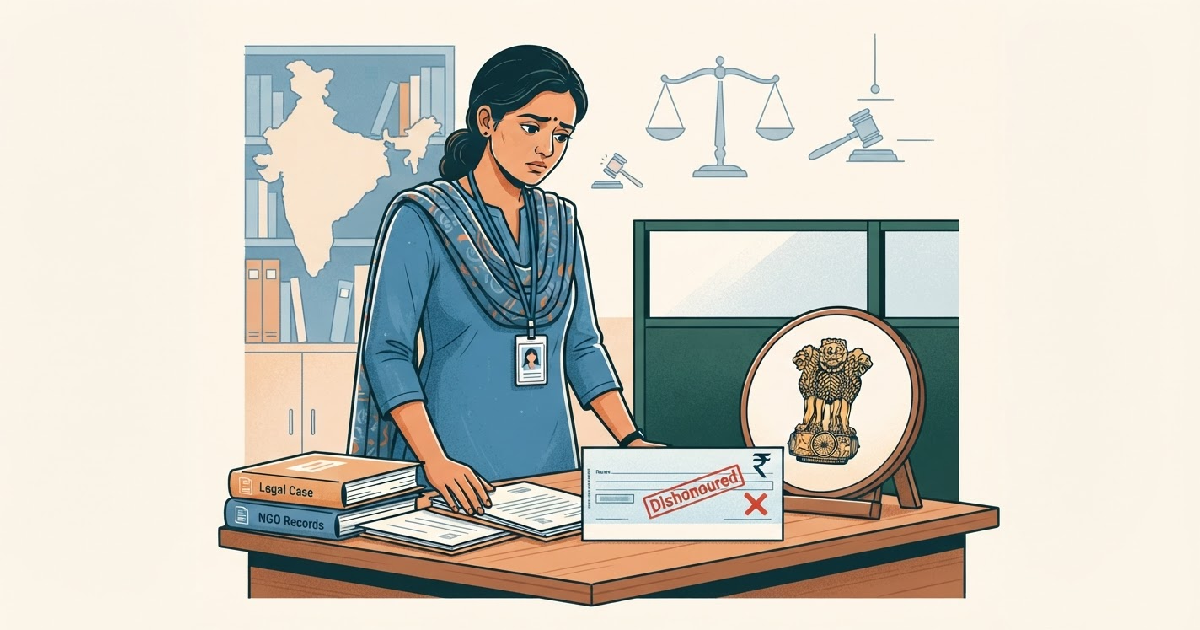
In India, cheque bounce cases against NGO employees are primarily governed by the Negotiable Instruments Act, 1881 (NI Act). This law criminalizes the dishonour of cheques under specific conditions. While the Non-Governmental Organization itself typically faces liability as a legal entity, individual employees or office bearers can also face criminal prosecution.
This individual accountability applies particularly if they were directly involved in the financial transaction or exercised “plenary control” over the NGO’s finances. The Supreme Court of India has provided key clarifications on this matter, making it vital for both NGOs and their personnel to understand these legal nuances.
India’s Legal Framework for Cheque Dishonour
India’s legal system provides a robust framework to uphold the integrity of financial instruments like cheques. The Negotiable Instruments Act, 1881, stands as the foundational statute for managing commercial paper. It addresses the significant implications when a cheque is dishonoured.
This legislation aims to build trust in financial transactions, making it a criminal offense to issue cheques without sufficient backing. It sets clear guidelines for accountability and legal redressal, fostering a reliable financial environment.
The Negotiable Instruments Act: Core Provisions
The Negotiable Instruments Act, 1881, serves as India’s primary law governing promissory notes, bills of exchange, and cheques. This foundational statute establishes the legal validity and enforceability of these critical commercial tools.
Sections 138 to 142 of the NI Act specifically address the dishonour of cheques. They outline the precise conditions under which a bounced cheque escalates into a criminal matter, thereby ensuring payment reliability and deterring fraud.
Defining Liability Under Sections 138 and 141
Section 138 of the NI Act criminalizes the act of issuing a cheque for a legally enforceable debt or liability that is subsequently returned unpaid. This situation commonly arises due to insufficient funds or if the amount exceeds the agreed bank arrangement.
Section 141 extends this criminal liability beyond the organization itself to individuals within it. It stipulates that any person “in charge of and responsible for the conduct of the business” at the time the offense was committed can also be deemed guilty, alongside the organization.
Individual Accountability for NGO Cheque Bounces
Determining who bears ultimate responsibility when a Non-Governmental Organization’s cheque bounces can be complex. While the NGO, as a legal entity, is generally held primarily liable, Indian law allows for the prosecution of individuals under specific conditions.
This system of dual responsibility ensures that those genuinely at fault, especially individuals holding significant decision-making power, face the appropriate consequences. It prevents individuals from using an organizational shield to evade their criminal culpability.
Who is Responsible When an NGO’s Cheque Bounces?
For NGOs structured as corporate entities, such as Section 8 Companies, the organization itself is primarily liable under Section 138 of the NI Act. However, individuals within these organizations often face significant scrutiny.
Section 141 clarifies that office bearers, directors, or authorized officials who were “in charge of and responsible for the conduct of the organization’s business” at the time of the offense can also be held accountable. The individual who actually signed the cheque on behalf of the NGO is always liable alongside the organization.
The “Plenary Control” Doctrine and Personal Liability
The Supreme Court of India has provided crucial clarity on individual liability through the concept of “plenary control.” An authorized signatory who exercises significant and comprehensive authority over an NGO’s financial transactions can be held criminally liable as the “drawer” of the bounced cheque.
This ruling means individuals cannot simply hide behind their administrative titles; their actual involvement and comprehensive control over financial matters dictate their potential liability. For directors or other officers to be held liable, the complaint must contain specific allegations about their direct involvement in the financial operations or the events leading to the cheque bounce.
An individual can avoid liability if they can prove that the offense occurred without their knowledge, or that they exercised due diligence to prevent it. Resignation from the NGO before the cheque was issued or dishonoured can also serve as a valid defense. It is crucial that the NGO itself is arraigned as an accused party before its authorized signatory can be prosecuted.
| Liability Factor | NGO Entity | Authorized Signatory | Director/Officer (Section 141) |
|---|---|---|---|
| Primary Liability | Yes (as Drawer) | Yes (as Signatory/Drawer) | Conditional |
| Requires “Plenary Control” | N/A | Yes (Supreme Court Ruling) | No (Direct Responsibility) |
| Specific Allegations Needed | No | No | Yes |
| Defense Available | N/A | Due Diligence / No Knowledge / Resignation | Due Diligence / No Knowledge / Resignation |
The Mandated Procedural Steps for Prosecution
Navigating a cheque bounce case under Section 138 of the NI Act involves a series of strict, mandatory steps and specific timelines. Failing to adhere to any of these steps can jeopardize the entire complaint, potentially leading to its dismissal.
This structured process aims to ensure fairness to both the payee and the drawer, offering an opportunity for payment before legal action escalates. Strict adherence to these established rules is paramount for all parties involved in the dispute.
Key Stages and Timelines in Cheque Dishonour Cases
The process initiates when a cheque, presented within its validity period of three months from the issue date, is returned unpaid by the bank. Subsequently, the bank issues a memo detailing the precise reason for the dishonour, such as insufficient funds.
Following this, the payee must issue a legal demand notice process to the drawer within 30 days of receiving the cheque return memo. The drawer then has a mandatory 15-day window from the date of receiving this notice to make the outstanding payment.
If payment is not received within that 15-day period, the payee gains the right to file a criminal complaint in a magistrate’s court. This complaint must be filed within 30 days from the expiry of the initial 15-day payment window. Courts will then examine the complaint and issue a summons if a prima facie case is established.
Severe Penalties and Widespread Consequences
Being found guilty in a cheque bounce case carries significant consequences that extend far beyond mere financial penalties. These repercussions can include potential imprisonment and enduring damage to an individual’s financial standing and professional reputation.
Such severe outcomes underscore the seriousness with which India’s legal system treats the dishonour of cheques. It serves as a strong deterrent against irresponsible or fraudulent financial conduct, protecting the credibility of financial instruments.
Criminal Sanctions and Financial Repercussions
If convicted under Section 138 of the NI Act, an individual can face imprisonment for up to two years. They may also be liable to pay a substantial fine, which can be as high as twice the amount of the original cheque, or face both imprisonment and a fine.
Beyond these criminal sanctions, the payee also retains the right to pursue a civil suit for the recovery of the cheque amount, along with any accrued interest and damages. This dual legal approach provides comprehensive avenues for seeking redressal and financial restitution.
In certain instances, a bounced cheque might even lead to additional charges under the Indian Penal Code, such as Section 420 for cheating or Section 406 for criminal breach of trust.
The financial impact can also be severe, including bank penalties, a damaged credit score, and significant difficulties in securing future loans or opening new bank accounts. These stringent cheque bounce penalties highlight the critical need for careful financial management and adherence to legal obligations.
What is a cheque bounce?
A cheque bounce, also known as cheque dishonour, occurs when a bank refuses to process a cheque for payment. This can happen for various reasons, including insufficient funds, a signature mismatch, an expired cheque, a stop payment request, or a closed account in the drawer’s bank.
Can an NGO employee be solely liable for a bounced cheque?
Yes, an NGO employee can be held personally liable for a bounced cheque, especially if they were the authorized signatory who signed it and exercised “plenary control” over the NGO’s finances. While the NGO is often the primary liable entity, Section 141 of the NI Act extends accountability to other responsible individuals.
What defenses are available in a cheque bounce case?
An individual can avoid liability if they can prove that the offense occurred without their knowledge, or that they exercised due diligence to prevent it. Resignation before the cheque was issued or dishonoured can also serve as a defense in such cases.