
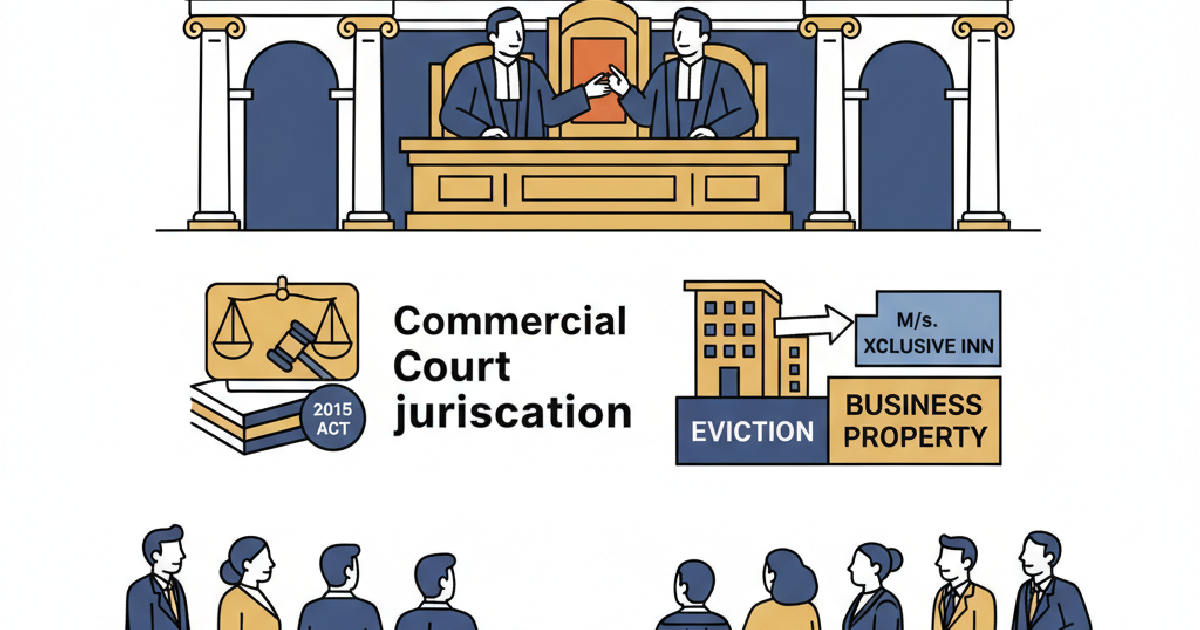
On July 9, 2026, the Calcutta High Court delivered a pivotal judgment, affirming that eviction suits involving properties used for trade and commerce fall under the specialized commercial court jurisdiction. A Division Bench, comprising Hon’ble Justice Debangsu Basak and Hon’ble Justice Md. Shabbar Rashidi, dismissed an appeal by M/s. Xclusive Inn Private Limited & Ors., upholding a summary judgment for eviction, arrears, and mesne profits.
The ruling clarifies a crucial aspect of the Commercial Courts Act, 2015, particularly concerning the definition of a “commercial dispute” in property matters. This decision provides significant guidance for businesses and landlords navigating eviction proceedings in India’s specialized commercial tribunals.
The core issue: commercial nature of eviction suits
The central question before the Calcutta High Court was whether a suit for eviction, particularly when it involves property used for commercial purposes, should be classified as a “commercial dispute” under the Commercial Courts Act, 2015. Appellants M/s. Xclusive Inn Private Limited had vigorously argued it should not.
They contended that an eviction suit, in its essence, doesn’t align with the Act’s definition, specifically challenging the interpretation of Section 2(1)(c)(vii). The firm’s senior advocates stressed that a plain eviction suit ought not to be drawn into the commercial court framework.
Factual matrix of the Xclusive Inn dispute
The dispute originated from Title Suit No. 5 of 2021 filed by Anjana Guha & Ors. before the learned Commercial Court at Rajarhat. The respondents, as heirs of the deceased Tarun Kumar Guha, sought eviction, along with arrears of license fees and mesne profits, from M/s. Xclusive Inn Private Limited & Ors.
Tarun Kumar Guha had leased part of a property (Schedule B) to the appellants on April 17, 2008. This lease was for the purpose of operating a hotel, restaurant, and night club, at a monthly license fee of Rs. 28,000/-. Simultaneously, an agreement for maintenance of Rs. 60,000/- per month was also executed.
These agreements stipulated that the appellants would vacate the premises by March 16, 2018. However, after Tarun Kumar Guha’s passing on December 28, 2013, the respondents claimed the appellants remained in breach of contract. They said the tenancy had ended, despite assurances from the appellants to vacate by the end of December 2020.
The respondents had also permitted the appellants to use another portion (Schedule C) as a hotel kitchen and dance bar. They also allowed construction of security guard rooms (Schedule D).
They revoked the appellants’ license to occupy and called for vacant possession multiple times in late 2020 and early 2021. However, M/s. Xclusive Inn Private Limited failed to comply.
In their written statement, M/s. Xclusive Inn Private Limited acknowledged using the property for a “commercial purpose of hotel cum restaurant bar.” This admission became a crucial point of contention.
The appellants also claimed to be tenants by holding over, citing their payment and the respondents’ acceptance of enhanced rent from January 2021 onwards. They also highlighted the absence of a formal notice under Section 106 of the Transfer of Property Act, 1882.
Navigating jurisdiction under the Commercial Courts Act
The Commercial Courts Act, 2015, aims to expedite commercial dispute resolution and improve India’s business environment. It establishes specialized courts and divisions to handle complex commercial matters.
For a Commercial Court or Division to exercise jurisdiction, two “twin ingredients” must be met simultaneously. First, the suit’s subject matter must have a “Specified Value.” Second, the dispute itself must qualify as a “commercial dispute” as defined by the Act.
The monetary threshold and territorial scope
The pecuniary jurisdiction, or “Specified Value,” is a critical factor for commercial court jurisdiction. In West Bengal, a notification dated March 20, 2020, set this threshold at Rs. 30,00,000/- (Rupees Thirty Lakhs) and above. The respondents had valued their suit in excess of this amount.
The parties in the M/s. Xclusive Inn case did not dispute the Commercial Court’s territorial jurisdiction. With the monetary value satisfied and no territorial challenge, the remaining jurisdictional hurdle was the commercial nature of the dispute itself.
Defining “commercial dispute” in property matters
Section 2(1)(c)(vii) of the Commercial Courts Act, 2015, defines “commercial dispute” to include “agreements relating to immovable property used exclusively in trade or commerce.” The High Court emphasized that the word “used” here implies “actually used,” rather than “ready for use” or “likely to be used.”
This distinction is vital; it ensures that only properties with a clear, current commercial function fall under the Act. The Court cited Ambalal Sarabhai Enterprises Limited Vs. K.S. Infraspace LLP and Another, which held that a dispute relating to immovable property becomes commercial if it specifically relates to property actually used in trade or commerce.
The Calcutta High Court relied heavily on a previous Division Bench decision in T.E. Thomson & Company Limited Vs. Swanalatha Chopra Nee Kapur and Another. This case had answered a reference regarding whether a suit based on Section 106 of the Transfer of Property Act, 1882, could still be considered a commercial suit if an underlying lease agreement for commercial use existed.
The T.E. Thomson decision affirmed that the lease agreement must be considered to determine the jural relationship and character of the dispute. It further highlighted that the Explanation clause to Section 2(1)(c) of the Act is integral. This clause clarifies that a commercial dispute does not cease to be so merely because it involves recovery of immovable property.
Crucially, the appellants themselves admitted in their written statement that the property was used for a “commercial purpose of hotel cum restaurant bar.” This admission, coupled with the nature of the agreements, firmly established the dispute as commercial. This detailed analysis helps clarify commercial suit property standards across the region.
Summary judgment and the role of admissions
The Commercial Court at Rajarhat had issued a summary judgment and decree for eviction, arrears, and mesne profits against M/s. Xclusive Inn Private Limited. This was done under Order XIII-A read with Order XII Rule 6 of the Code of Civil Procedure, 1908.
M/s. Xclusive Inn Private Limited argued that the Trial Court erred in invoking these provisions, claiming they made no admissions warranting such a judgment. However, the respondents contended that the appellants’ written statements and objections contained clear admissions of the landlord-tenant relationship and the commercial use of the property.
Key procedural provisions: Order XII Rule 6 and Order XIII-A CPC
Order XII Rule 6 of the CPC empowers courts to pass judgment on admissions at any stage, provided the admissions are clear, categorical, and unequivocal. This provision aims to prevent unnecessary delays in cases where essential facts are undisputed.
Order XIII-A, introduced by the Commercial Courts Act, 2015, allows for summary judgment if a party has “no real prospect of successfully defending the claim” or succeeding on it. It also requires that there be “no other compelling reason” for the case to go to trial.
The Supreme Court, in Reliance Eminent Trading and Commercial Private Limited Vs. Delhi Development Authority (2026 SCC OnLine SC 744), outlined guidelines for summary judgments under Order XIII-A. These include strict compliance with procedural mandates and a clear assessment of whether a party has any real prospect of success or defense, considering all facts presented.
Noteworthy precedents on summary judgments
The Calcutta High Court referenced Payal Vision Limited Vs. Radhika Choudhary (2012 (11) SCC 405) in its reasoning. This Supreme Court ruling stipulated that in eviction suits for tenants not protected by rent control legislation, a plaintiff must establish a jural landlord-tenant relationship and the termination of tenancy.
Termination can occur either by efflux of time or through a notice under Section 106 of the Transfer of Property Act, 1882. Once these conditions are met, a decree under Order XII Rule 6 CPC can be granted.
In the Xclusive Inn case, the appellants had admitted the landlord-tenant relationship and that their agreements had expired by efflux of time on March 16, 2018. Their tenancy wasn’t protected under the West Bengal Premises Tenancy Act, 1997, due to the rent quantum.
Notice to quit: a procedural nuance
The appellants argued that the suit should fail because no formal notice under Section 106 of the Transfer of Property Act, 1882, was issued before the suit was filed. They contended that this omission was fatal to the eviction claim.
However, the respondents countered this by citing established legal precedent. They argued that the filing of an eviction suit itself serves as sufficient notice to quit, rendering a separate formal notice unnecessary in such circumstances.
The Nopany Investments ruling
The High Court relied on the Supreme Court’s decision in Nopany Investments (P) Ltd. Vs. Santokii Singh (HUF) (2008 (2) SCC 728). This landmark judgment unequivocally stated that “filing of an eviction suit under the general law itself is a notice to quit on the tenant.”
Therefore, the Calcutta High Court concluded that the respondents’ suit couldn’t be faulted on the grounds of lacking a prior Section 106 notice. This principle is particularly relevant where the tenancy is not subject to rent control laws due to high rent. The court found that the requirements for an eviction decree were met.
Implications for commercial landlords and tenants
This judgment reinforces the intent behind the Commercial Courts Act, 2015, to fast-track commercial disputes, even those involving immovable property. It clarifies that if a property is demonstrably and actually used for trade or commerce, an eviction dispute falls within commercial court jurisdiction. This applies even if other reliefs, like recovery of possession, are sought.
For commercial landlords, the ruling provides clarity on pursuing eviction and monetary claims through specialized courts, potentially leading to quicker resolutions. It highlights the importance of precise contractual agreements and documenting the commercial use of leased premises. Business owners should also be aware of the implications of appeals for plaint rejection under these acts.
For tenants like M/s. Xclusive Inn Private Limited, the decision underscores the weight of admissions made in pleadings. Any acknowledgment of commercial use or landlord-tenant relationships can significantly impact the course of legal proceedings, potentially paving the way for summary judgments. Therefore, legal teams must advise clients carefully on written statements.
Looking ahead: the evolving commercial legal landscape
The consistent judicial interpretation of the Commercial Courts Act, 2015, reflects a broader commitment to enhancing the efficiency of India’s legal system for businesses. With ongoing efforts to streamline processes, understanding the nuances of commercial court jurisdiction becomes increasingly important for all stakeholders. This case adds another layer of certainty.
The emphasis on “actual use” of property for commercial purposes provides a clear benchmark. It prevents ambiguity and ensures that disputes that genuinely impact economic activity receive specialized judicial attention. This trend suggests a more predictable legal environment for commercial dealings, which helps the ease of doing business.
The detailed breakdown of jurisdictional requirements, coupled with the validation of summary judgment provisions, streamlines litigation pathways. This focus on clear, unambiguous legal principles helps reduce protracted legal battles. It aims to deliver swifter justice in high-value commercial property disputes, ensuring quick resolutions and upholding commercial contracts.
| Aspect of Dispute | Appellants’ Contention | Respondents’ Contention / Court Finding | Legal Basis / Precedent |
|---|---|---|---|
| Commercial Dispute Classification | Eviction suit not commercial under Act of 2015. | Property used commercially (hotel/restaurant/bar). Yes, it’s commercial. | Section 2(1)(c)(vii) Commercial Courts Act, 2015; Ambalal Sarabhai; T.E. Thomson |
| Jurisdiction of Commercial Court | Trial Court lacked jurisdiction. | Suit valued over Rs. 30,00,000/-; property for commercial use. Jurisdiction established. | Specified Value (West Bengal notification); Section 6 Commercial Courts Act, 2015 |
| Summary Judgment (Eviction) | No admissions made to justify summary eviction. | Admitted landlord-tenant relationship, expiry of tenancy, commercial use. Summary judgment valid. | Order XII Rule 6 & Order XIII-A CPC; Payal Vision Limited; Reliance Eminent Trading |
| Notice to Quit (Section 106 TPA) | No formal notice issued, suit should fail. | Filing of eviction suit itself constitutes notice. | Section 106 Transfer of Property Act, 1882; Nopany Investments (P) Ltd. |
| Tenancy Protection | Claimed tenancy by holding over. | Rent quantum took it out of West Bengal Premises Tenancy Act, 1997 purview. Governed by TPA. | West Bengal Premises Tenancy Act, 1997; Transfer of Property Act, 1882 |
Frequently Asked Questions
What is the significance of the “actual use” clause in commercial property disputes?
The “actual use” clause under Section 2(1)(c)(vii) of the Commercial Courts Act, 2015, is critical because it specifies that a property must currently be used for trade or commerce for a dispute related to it to be considered commercial. It prevents disputes over properties merely intended for future commercial use or ready for it from being heard in specialized commercial courts, ensuring focused jurisdiction.
How does this judgment affect the timeline for commercial eviction cases?
This judgment, by clarifying commercial court jurisdiction and validating the use of summary judgments (Order XII Rule 6 and Order XIII-A CPC), is likely to shorten the timeline for many commercial eviction cases. When there are clear admissions or no real prospect of defense, courts can bypass lengthy trials, leading to quicker resolutions for both landlords and tenants.
Can a tenant claim protection under rent control laws if the property is used commercially?
Generally, if the rent or license fee for a commercially used property exceeds a certain threshold, the tenancy falls outside the protection of specific state-level rent control acts, such as the West Bengal Premises Tenancy Act, 1997. In such cases, the tenancy is governed by the broader provisions of the Transfer of Property Act, 1882, allowing for more streamlined eviction processes.