
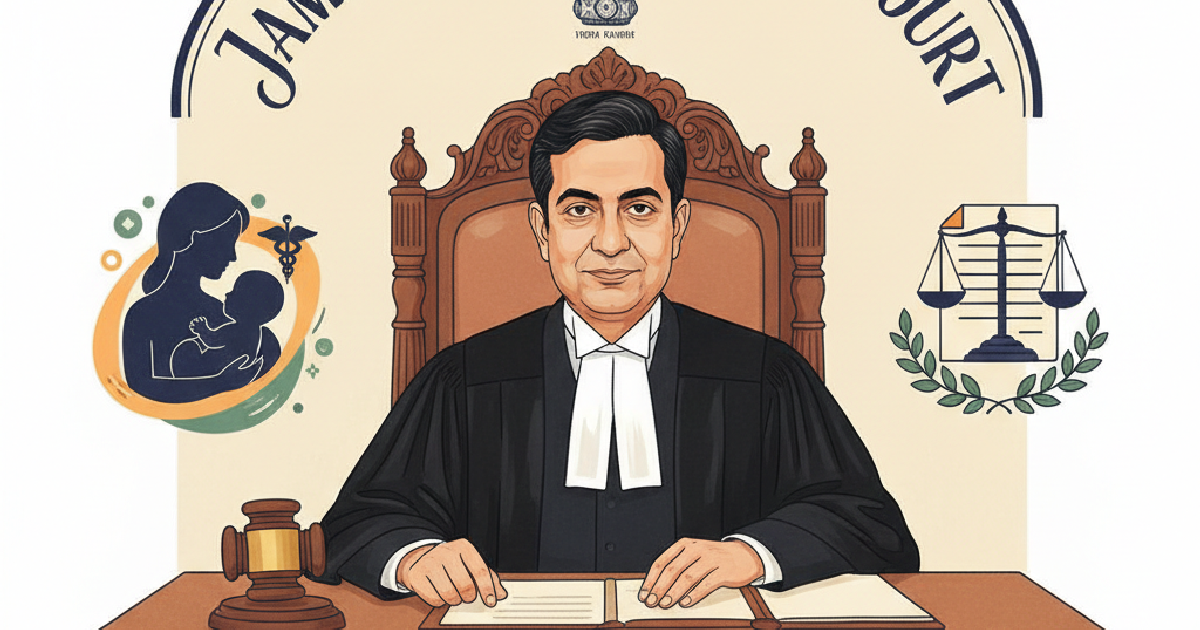
In a landmark judgment issued on July 10, 2026, the High Court of Jammu & Kashmir and Ladakh declared that paid Jammu Kashmir maternity leave is an unassailable constitutional right, not a discretionary benefit.
This pivotal ruling by Justice Rajnesh Oswal quashed an administrative order that had denied salaries and allowances to Senior Resident Doctors and Tutors during their maternity leave, marking a significant victory for working women in India.
Jammu Kashmir High Court Affirms Fundamental Right to Maternity Leave
The High Court of Jammu & Kashmir and Ladakh at Jammu emphatically stated that maternity leave cannot be relegated to a matter of governmental benevolence. Instead, it is an enforceable constitutional right deeply rooted in the dignity, equality, and welfare guarantees provided by the Constitution.
Justice Rajnesh Oswal, who delivered the judgment on July 10, 2026, underscored the fundamental nature of this entitlement. He highlighted that denying paid leave to new mothers constituted a “profound constitutional injury.”
Quashing the administrative denial
The court specifically overturned a communication dated October 14, 2025, issued by the Health and Medical Education Department. This directive, formulated on the advice of the Finance Department, had previously blocked pay and allowances for doctors during their maternity period.
The administrative body had reasoned that these tenure-based appointees were not entitled to such benefits. This justification was directly challenged and rejected by the court.
The constitutional mandate for dignity and equality
Justice Oswal stressed that maternity leave is inextricably linked to a woman’s right to live with dignity. He stated, “Maternity leave is an unassailable constitutional right anchored in the dignity of women,” thereby elevating its status beyond mere policy.
The court found that penalizing women for “the foundational human experience of motherhood” represented “a glaring departure from its character as a compassionate welfare State.” This principle ensures that biological realities are protected, not punished, within the workplace.
The Petitioners’ Plight: Senior Resident Doctors Denied Pay
The case, officially titled WP(C) No. 3509/2025, involved several Senior Resident Doctors and Tutors. These medical professionals were engaged in Government Medical Colleges under the Jammu and Kashmir Medical and Dental Education (Appointment on Academic Arrangement Basis) Rules, 2020.
They found themselves in a difficult position when the administration withheld their salaries during a period of crucial personal and professional transition.
The challenged communication of October 2025
The core of the dispute lay in the October 14, 2025, communication. This departmental order effectively denied the petitioners their rightful pay and allowances while they were on maternity leave.
It was this specific administrative act that the doctors challenged, seeking judicial intervention to secure their entitlements.
Context of their academic arrangements
The administration argued that the petitioners’ tenure-based appointments, rather than regular government employment, precluded them from receiving paid maternity leave. They viewed the doctors as “out of assignment” during their leave.
However, the court recognised that their roles, despite being academic arrangements, still warranted the full protection of maternity benefits.
Government’s Stance and Judicial Rejection
The Union Territory of Jammu and Kashmir administration, including its Health and Medical Education Department and Finance Department, maintained that the doctors were not eligible. They contended that any extension of residency after maternity leave was solely for academic training completion.
This, they argued, did not automatically entitle them to salary for the leave period. Such a narrow interpretation was vigorously opposed by the petitioners.
Arguing against tenure-based employees’ entitlement
The administration’s primary defense hinged on the contractual nature of the doctors’ employment. They suggested that because these doctors were not regular, permanent government employees, the full benefits of maternity leave, particularly paid leave, did not apply to them.
This position essentially created a two-tiered system for maternity benefits, one for regular staff and a lesser one for contractual workers.
Why the court called it “blatant administrative overreach”
Justice Oswal sharply criticised the administration’s stance, labeling the denial of salary a “blatant administrative overreach.” He asserted that withholding wages during a recognised maternity leave period undermines the very essence of the benefit.
The court found that “To penalise a mother based on the technical nature of her employment contract… is an egregious infraction of equality that cannot withstand judicial scrutiny.” This statement highlights the court’s commitment to substantive equality over mere technicalities.
Upholding Legal Frameworks and Precedent
The court’s decision wasn’t merely based on abstract constitutional principles; it was firmly rooted in existing legal frameworks and prior judicial pronouncements. The petitioners had a clear basis for their claims.
Their counsel effectively demonstrated that the administration’s denial contradicted established rules and earlier rulings from the High Court itself.
The J&K Civil Services (Leave) Rules, 1979
A key piece of legislation in the petitioners’ favour was Rule 41(1) of the J&K Civil Services (Leave) Rules, 1979. This rule explicitly grants 180 days of paid maternity leave to eligible female employees, including apprentices, with leave salary equivalent to their last drawn pay.
The court noted that the administration had previously extended these rules to Senior Residents and Tutors via Government Order No. 451-JK(HME) of 2024, issued on July 8, 2024, creating an inconsistency in their current denial.
Previous judgments reinforcing maternity rights
The petitioners’ counsel also drew upon earlier rulings to strengthen their case. They cited the High Court’s judgment in Jammu and Kashmir Bank Ltd. v. Tanu Gupta, a precedent affirming maternity benefits.
Additionally, a ruling from December 17, 2023, by Justice Sanjeev Kumar, held that approved leave, including maternity leave, should not be considered a break in service. This earlier decision reinforced the idea that employees on sanctioned leave are still in active service, entitled to full benefits.
Impact on Contractual Employees Across India
This judgment carries significant implications far beyond the specific case of the Senior Resident Doctors in Jammu & Kashmir. It establishes a powerful precedent that protects the rights of contractual and tenure-based employees.
The ruling clarifies that the nature of an employment contract cannot be used to circumvent a woman’s fundamental right to paid maternity leave, a principle that resonates nationally.
Setting a national benchmark for maternity benefits
By categorizing paid maternity leave as an “inseparable component of the leave itself,” the High Court has set a benchmark for employers nationwide. It sends a clear message that administrative directives cannot arbitrarily curtail benefits flowing from constitutional rights.
This will likely prompt a review of maternity leave policies for contractual workers across various sectors and states.
The importance of paid leave for working mothers
The ruling directly addresses the economic realities faced by women who choose to have children. Denying paid maternity leave places an undue financial burden on new mothers and can force them out of the workforce, negatively impacting their careers and financial independence.
This decision helps ensure that motherhood isn’t penalized professionally, affirming economic security during a critical life stage. It aligns with broader efforts to support women’s participation in the workforce.
Charting the Future: A Call for Compassionate Governance
This judgment by the High Court of Jammu & Kashmir and Ladakh serves as a powerful reminder of the judiciary’s role in safeguarding fundamental rights. It also acts as a directive for government bodies to align their administrative practices with constitutional mandates and welfare state principles.
The decision reinforces the idea that true progress lies in fostering an environment where women can thrive both personally and professionally.
Ensuring consistent application of the ruling
Following this ruling, it is now incumbent upon the Jammu and Kashmir administration, and indeed other state administrations, to ensure consistent application of maternity benefit policies. This means aligning all departmental communications and practices with the constitutional recognition of maternity leave.
The court explicitly directed the administration to release the petitioners’ full salaries and allowances, including for any extended residency period, setting a clear operational standard.
The ongoing evolution of women’s employment rights
The judgment reflects an ongoing evolution in the legal understanding of women’s employment rights. Courts across India are increasingly interpreting laws in a manner that supports gender equality and welfare.
This ruling is a significant step towards dismantling discriminatory practices that historically penalised women for their biological roles. It encourages a more inclusive and equitable workplace environment for all.
Frequently Asked Questions
What was the key outcome of the J&K&L High Court’s ruling on maternity leave?
The High Court ruled that paid maternity leave is an unassailable constitutional right, not a state charity. It quashed an administrative order denying salaries to Senior Resident Doctors during their maternity leave, directing the administration to release full pay and allowances.
Who were the petitioners in the case, and what was their employment status?
The petitioners were Senior Resident Doctors and Tutors employed in Government Medical Colleges under academic arrangement rules. The administration had argued their tenure-based, contractual status made them ineligible for paid maternity leave.
How does this judgment impact other contractual or tenure-based employees in India?
This ruling sets a significant precedent, clarifying that the nature of an employment contract cannot override a woman’s fundamental right to paid maternity leave. It reinforces that paid maternity benefits are an inseparable component of the leave itself, potentially influencing policies for contractual workers nationwide.