
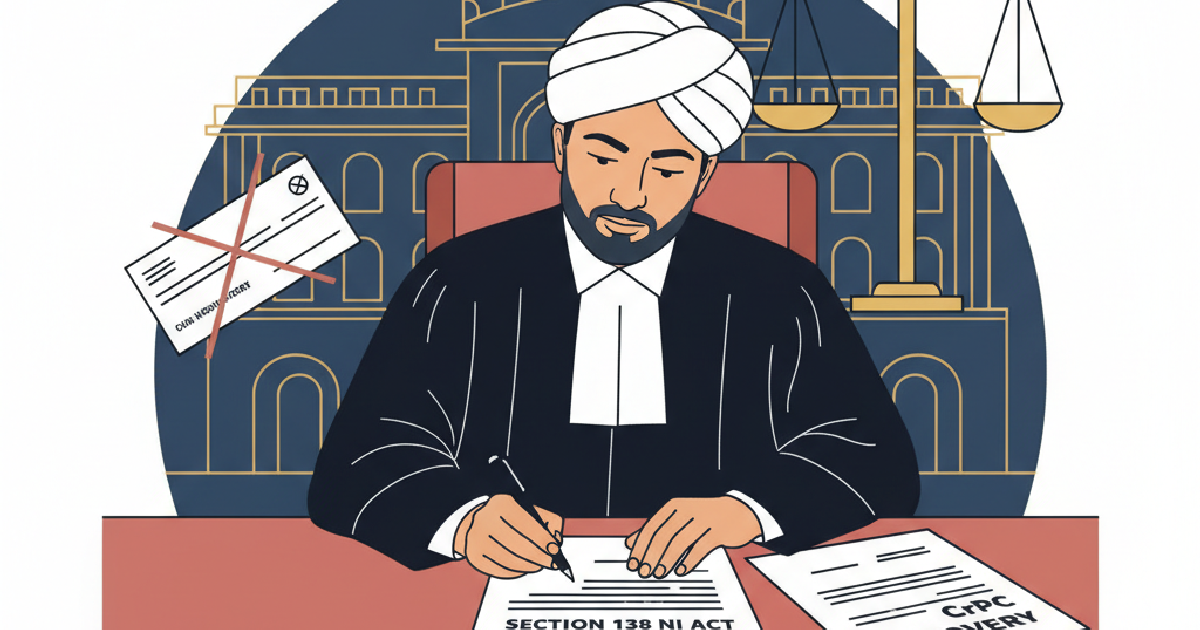
A Section 138 NI Act settlement cannot be enforced via CrPC recovery mechanisms unless explicitly included in a court’s final order, ruled the High Court of Jammu & Kashmir and Ladakh.
This decision, reported by LiveLaw on July 14, 2026, clarifies a crucial procedural requirement for financial agreements stemming from cheque dishonour cases. It means parties settling these matters must now ensure judicial endorsement if they intend to use criminal recovery provisions.
Understanding the Jammu & Kashmir and Ladakh High Court Ruling
The recent pronouncement from the High Court of Jammu & Kashmir and Ladakh underscores a critical distinction in the enforceability of settlements. It specifies that an agreement reached in a Section 138 Negotiable Instruments Act (NI Act) case won’t automatically trigger coercive recovery under the Code of Criminal Procedure (CrPC).
Specifically, Sections 421 and 431 of the CrPC, which detail mechanisms for enforcing court orders, are only applicable if the terms of the settlement have been formally incorporated into a final judicial order. Without this formal incorporation, the settlement remains a private arrangement, lacking the direct coercive power of the state’s criminal recovery apparatus.
This ruling brings much-needed clarity for both complainants and accused individuals involved in cheque dishonour cases. It emphasizes that while out-of-court settlements are encouraged, their legal teeth for criminal enforcement depend entirely on judicial sanction.
The Core of Section 138 of the Negotiable Instruments Act
Section 138 of the Negotiable Instruments Act, 1881, serves as a cornerstone for financial discipline in India. It criminalizes the dishonour of cheques, commonly referred to as “cheque bounce” cases. This provision aims to build trust in cheque-based transactions and provide a swift remedy for creditors.
The offense under Section 138 is not purely criminal; it’s often described as “quasi-criminal” or primarily compensatory in nature. Its main goal is to ensure the payment of dues, thereby upholding the reliability of financial instruments. Penalties can include imprisonment up to two years, a fine up to twice the cheque amount, or both.
For a complaint under Section 138 to be valid, several conditions must be met. The cheque must have been issued for a legally enforceable debt, presented within its validity period, and returned unpaid due to insufficient funds. Additionally, the payee must issue a demand notice within 30 days of the cheque’s return, and the drawer must fail to make payment within 15 days of receiving that notice. Courts cannot hear premature cheque bounce complaints if these conditions aren’t strictly followed.
Cases under Section 138 of the NI Act are also compoundable, as outlined in Section 147 of the NI Act. This means parties can reach a compromise and withdraw the complaint. Courts frequently keep the original complaint pending until the full settlement amount is paid by the accused, highlighting the law’s compensatory focus.
Supreme Court Guidelines on Compounding
The Supreme Court of India has provided clear guidelines regarding the compounding of offenses under the NI Act. If the cheque amount is paid before defense evidence is presented, the offense can be compounded without any additional cost.
However, if the payment occurs after the presentation of defense evidence but before judgment, an additional 5% of the cheque amount must be paid. These guidelines incentivize early resolution and payment, reducing the burden on the judicial system.
Other judicial observations reinforce various aspects of Section 138 cases. For instance, the interim moratorium under Section 96 of the Insolvency and Bankruptcy Code (IBC), 2016, does not prevent criminal proceedings under Section 138 of the NI Act from continuing. Also, a violation of Section 269SS of the Income-Tax Act, regarding cash loans above ₹20,000, leads only to a penalty under Section 271D of the IT Act, and doesn’t invalidate the transaction under Section 138.
Even if a signed blank cheque is given, the Supreme Court has confirmed it implies debt under the Negotiable Instruments Act, placing the onus on the drawer to prove otherwise. This further strengthens the position of complainants in these matters. Furthermore, recent changes have seen India tighten cheque dishonour laws for NRIs, including potential 2-year prison terms.
Mechanisms for Recovery: CrPC Sections 421 and 431
The Code of Criminal Procedure (CrPC) provides specific provisions for the recovery of fines and other amounts imposed by criminal courts. Sections 421 and 431 are central to these coercive recovery mechanisms. They allow courts to enforce their monetary orders through state power, including the attachment and sale of property.
Section 421 CrPC, titled “Warrant for levy of fine,” details the procedure a court can employ to recover a fine. It permits the issuance of a warrant for the attachment and subsequent sale of the offender’s movable property. This is a direct and forceful method to ensure compliance with a court-ordered financial penalty.
Section 431 CrPC extends this principle to other sums recoverable as fines. If any money, other than a fine, is ordered by a court to be paid and is recoverable as a fine, Section 431 enables its recovery using the same methods outlined in Section 421. This includes compensation to victims, costs, or other monetary directions.
The key takeaway from the J&K&L High Court’s ruling is that a mere private settlement, even within the context of a Section 138 NI Act case, does not automatically gain access to these powerful CrPC recovery tools. It must first transform into a court order, thereby receiving judicial imprimatur for its enforcement.
Practical Implications for Litigants and Legal Practice
This ruling has significant practical implications for individuals and businesses dealing with cheque dishonour cases. For complainants, it means that securing a private settlement isn’t the final step; they must ensure that the settlement terms are explicitly recorded and adopted by the court as part of its final order.
Otherwise, if the accused defaults on a privately agreed settlement, the complainant would be forced to pursue separate civil remedies for recovery. This could involve fresh litigation, adding considerable time and expense to an already prolonged process. The direct, coercive recovery under CrPC would be unavailable.
For the accused, this judgment offers a clear procedural safeguard. It prevents settlements from being informally used as a basis for criminal recovery without proper judicial oversight. Any settlement not integrated into a court order would require different enforcement avenues, typically civil in nature, offering a degree of protection against summary criminal action for default.
Legal practitioners will need to adjust their strategies, ensuring that every settlement agreement in a Section 138 case is meticulously documented and presented to the court for incorporation into its final order. This step will prevent future disputes over enforceability and streamline the recovery process if a party defaults.
Related Judicial Precedents and Ongoing Developments
The Jammu & Kashmir and Ladakh High Court’s decision aligns with broader judicial efforts to clarify and streamline the handling of Section 138 cases. Justice Shahzad Azeem of the J&K&L High Court, for instance, previously reiterated the requirement for a Magistrate to conduct an inquiry under Section 202 CrPC.
This inquiry is mandatory before issuing process against an accused residing beyond the court’s territorial jurisdiction. This aligns with the Constitution Bench decision in In Re: Expeditious Trial of Cases under Section 138 of the N.I. Act, emphasizing due diligence in initiating criminal proceedings.
Elsewhere, the Himachal Pradesh High Court, in the case of Gyaru Ram Vs. Prem Singh, held that a Section 138 offense can be compounded even after a conviction is affirmed in revision. This is permissible if the parties settle and the complainant receives full payment, citing Section 147 of the NI Act and Section 320 of the CrPC.
The Himachal Pradesh High Court referenced Supreme Court decisions in K. Subramanian v. R. Rajathi and Damodar S. Prabhu v. Sayed Babalal H. These cases collectively highlight the judiciary’s approach to facilitating resolution and payment in cheque dishonour cases, even at later stages of litigation.
Statistical Overview of Cheque Dishonour Cases
Cheque dishonour cases constitute a significant portion of the Indian judicial workload. The complexity of recovery, coupled with the sheer volume of such disputes, often leads to prolonged litigation.
The emphasis on formal judicial incorporation of settlements aims to reduce ambiguity and expedite resolutions where agreements are made. It also ensures that the robust recovery mechanisms of the CrPC are used only when a settlement has received proper legal sanction.
| Enforcement Aspect | Settlement Without Court Order | Settlement With Court Order |
|---|---|---|
| Mechanism for Recovery | Requires fresh civil suit for breach of contract | CrPC Sections 421 & 431 (coercive recovery) |
| Legal Standing | Private contract | Judicially sanctioned decree/order |
| Time for Enforcement | Potentially lengthy civil litigation | Faster, direct criminal enforcement |
| Binding Nature | Binding on parties, but not court directly | Binding on parties and enforceable by court |
Frequently Asked Questions
What does “Section 138 NI Act” refer to?
Section 138 of the Negotiable Instruments Act deals with the criminal offense of cheque dishonour. It makes it illegal for a person to issue a cheque that bounces due to insufficient funds or other reasons, providing a legal framework for redressal.
Why can’t an informal settlement be enforced through CrPC recovery?
The High Court ruled that only court orders can be enforced using the coercive recovery mechanisms of the CrPC. A private settlement, even if agreed upon, does not carry the same legal weight as a formal court order unless it has been explicitly incorporated into one.
What should parties do after reaching a settlement in a Section 138 case?
After reaching a settlement, parties must ensure that its terms are formally presented to the court. The court should then incorporate these terms into its final order, thereby granting the settlement judicial backing and allowing for its enforcement through CrPC recovery provisions if necessary.