
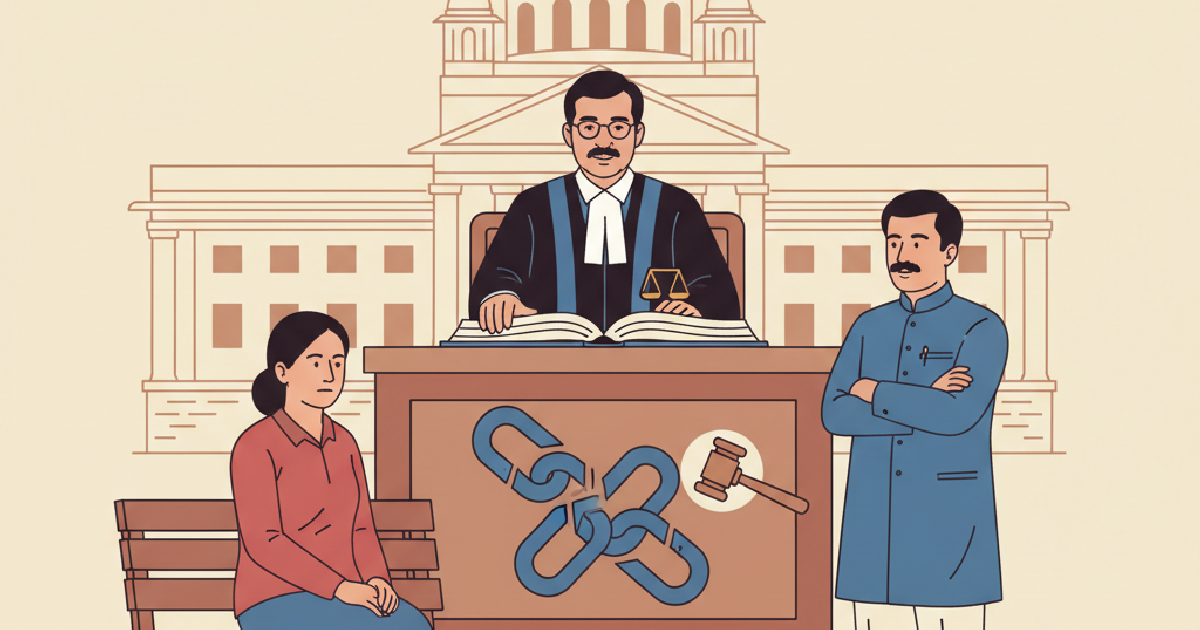
The Allahabad High Court clarified that a woman cannot claim maintenance from a second partner under Section 125 CrPC if her initial marriage remains legally valid and undissolved.
This significant ruling, delivered by Justice Achal Sachdev on July 10, 2026, in the case of Santosh Kumar vs State of U.P. and 2 others, underscores the legal prerequisites for claiming spousal support.
Upholding marital sanctity in maintenance claims
The Allahabad High Court recently reiterated a crucial aspect of family law: a woman cannot qualify as a “legally wedded wife” if she enters into a relationship without formally divorcing her first husband. This judicial clarification directly impacts claims for financial maintenance under Section 125 of the Code of Criminal Procedure (CrPC).
Justice Achal Sachdev’s bench definitively set aside an order from the Family Court, Chitrakoot, which had previously granted maintenance to a woman from her second partner. The High Court found the woman had not met the fundamental requirement of being a legally wedded spouse.
The case at hand: unraveling the claims
The complex familial dispute arose from a criminal revision petition filed by Santosh Kumar. He challenged an August 2025 directive from the Principal Judge, Family Court, Chitrakoot.
That initial order mandated Kumar to pay monthly maintenance to both the woman and their minor daughter.
The woman’s assertions and critical admissions
The woman had initially asserted that her second “marriage” to Santosh Kumar was solemnised through a notarised compromise on June 10, 2006. She claimed this occurred in the presence of witnesses and followed Hindu rituals.
They subsequently lived as husband and wife and had a daughter, now approximately 8 years old.
Her maintenance plea detailed a deteriorating relationship, alleging that Kumar’s behaviour changed years after their daughter’s birth. She claimed he started beating them and refused to provide sustenance, despite earning an estimated Rs 18,000 to Rs 20,000 monthly as a mason.
However, during cross-examination, pivotal facts emerged. She admitted to being married to another man about 15 years prior, with whom she had two children.
Crucially, she also confessed that her union with Santosh Kumar was not formalised through Hindu rites and rituals, and her first husband was still alive when she began cohabiting with Kumar. Though her first husband later passed away, this occurred while she was already residing with Santosh.
The family court’s initial ruling and the revision petition
The Principal Judge, Family Court, Chitrakoot, had initially directed Santosh Kumar to pay Rs 2,000 per month to the woman. An additional Rs 1,000 per month was ordered for their daughter, payable until she reached majority.
This decision prompted Kumar to file a criminal revision petition before the Allahabad High Court. He sought to overturn the maintenance order, particularly concerning the amount granted to the woman.
Trial court’s findings on marital status
The High Court carefully reviewed the trial court’s own records. It noted the trial court had found the woman unable to prove her marriage to Santosh Kumar according to Hindu rites and rituals.
Furthermore, it acknowledged the observation that her first husband was indeed alive when she began living with Kumar. These findings were central to the High Court’s subsequent decision.
Why a “legally wedded wife” status matters
The core of the Allahabad High Court’s judgment hinges on the interpretation of “legally wedded wife” under Section 125 CrPC. This section aims to prevent destitution by providing maintenance to dependents, but it defines specific relationships for eligibility.
Justice Sachdev explicitly stated: “From the perusal of evidence on record, it is clear that the applicant no. 1 does not qualify the term “legally wedded wife” of the opposite party, and the trial court has erred in passing the maintenance order in favour of applicant no. 1 (woman).” This directly addressed the woman’s eligibility.
Section 125 CrPC: A protective framework
Section 125 of the Code of Criminal Procedure is a vital legal provision in India, designed to ensure financial support for vulnerable individuals. It enables wives, minor children, and dependent parents to claim maintenance from those legally obliged to support them.
The underlying purpose is humanitarian: to mitigate poverty and provide a safety net for those unable to sustain themselves. However, eligibility criteria, especially for spouses, are strictly observed.
The Allahabad High Court has consistently ruled that an existing, undissolved first marriage disqualifies a woman from claiming maintenance from a subsequent partner under this section. This consistent stance reinforces the legal sanctity of marriage in such claims.
For instance, while this ruling specifically addresses the validity of a second marriage for maintenance claims, the Allahabad High Court has also ruled that a 25% maintenance for a wife is not mandatory, highlighting the court’s discretionary power in assessing such applications based on individual circumstances.
| Party | Claim/Status | Family Court Order (Monthly) | High Court Ruling |
|---|---|---|---|
| Woman (Applicant No. 1) | Claimed second marriage via notarized compromise | ₹2,000 | Maintenance set aside |
| Minor Daughter | Biological child of both parties | ₹1,000 | Maintenance upheld |
| Santosh Kumar (Revisionist) | Challenged maintenance order | Pays ₹3,000 total | Pays ₹1,000 to daughter only |
| First Husband | Married to woman ~15 years prior; alive during cohabitation with Kumar | N/A | Legally subsisting marriage |
Unwavering protection for minor children’s maintenance
While the woman’s claim for maintenance was rejected due to her marital status, the court consistently protects a child’s right to parental support. The Allahabad High Court affirmed the minor daughter’s right to maintenance from Santosh Kumar.
This aspect of the ruling highlights the judiciary’s unwavering commitment to children’s welfare, regardless of the marital complexities of their parents.
DNA evidence and parental obligations
A crucial piece of evidence in the case was a DNA report. This report conclusively established that Santosh Kumar and the woman were the biological parents of the child.
This scientific confirmation reinforced the father’s legal obligation. Section 125(1)(b) CrPC clearly mandates that a father must maintain his children who are unable to maintain themselves, irrespective of whether they are legitimate or illegitimate.
The High Court’s decision to uphold the daughter’s maintenance, even while overturning the mother’s, underscores this fundamental legal principle. It ensures that children are not penalised for the choices or circumstances of their parents.
Broader implications for second marriages and cohabitation
This ruling from the Allahabad High Court sends a clear message regarding the legal recognition of marital relationships for maintenance purposes. It reaffirms that legal formalities, particularly divorce from a prior spouse, are paramount.
The judgment affects individuals who enter into subsequent relationships without formally dissolving their first marriage. Such relationships, even if long-standing, may not confer the status of a “legally wedded wife” under specific statutes like CrPC Section 125.
Precedent and consistent judicial stand
The Allahabad High Court has consistently ruled that a woman cannot claim maintenance under Section 125 CrPC from a second partner if her first marriage is still legally subsisting. This decision aligns with a broader judicial trend.
Courts across India generally interpret “wife” in Section 125 CrPC to mean a legally wedded spouse. This interpretation is critical for establishing maintenance eligibility.
Live-in relationships versus legal marriage
The ruling implicitly distinguishes between cohabitation and a legally recognised marriage. While live-in relationships have gained some recognition in Indian law for certain purposes, they generally do not equate to marriage for all legal entitlements, particularly spousal maintenance under Section 125 CrPC.
The case underscores that without a valid divorce from the first spouse, any subsequent union, even if solemnised informally or by compromise, does not grant the status of a legally wedded wife for maintenance claims. This legal distinction is crucial for understanding rights and obligations within family law.
Navigating India’s complex maintenance laws
The Allahabad High Court’s judgment serves as an important reminder of the intricacies of India’s maintenance laws. Individuals seeking or resisting maintenance claims must understand the specific legal requirements.
Proving the validity of a marriage, or the lack thereof, is often central to such cases. The onus typically lies on the claimant to demonstrate their legal entitlement.
Importance of legal formalities and due diligence
This case highlights the critical importance of adhering to legal formalities, particularly concerning marriage and divorce. Individuals contemplating second marriages or long-term cohabitation must ensure their previous marital ties are legally severed.
Failure to do so can have significant consequences, as demonstrated by the woman’s inability to secure maintenance. It emphasises the need for legal counsel to navigate these complex personal laws effectively.
Impact of bigamy and legal recognition
Under Hindu law, bigamy is prohibited, and a second marriage contracted while the first is subsisting is void. This legal principle directly influenced the High Court’s decision, as the woman’s relationship with Santosh Kumar could not be recognised as a valid marriage in the eyes of the law for maintenance claims.
The judgment reinforces the legal framework that prioritises the sanctity of the first marriage unless it is lawfully dissolved. This ensures legal clarity and prevents abuse of maintenance provisions.
Looking ahead: clarity and consequences
The Allahabad High Court’s ruling provides valuable clarity on maintenance claims under Section 125 CrPC when a woman has not formally divorced her first husband. It reinforces established legal principles regarding marital validity and its impact on spousal support.
However, the judgment also demonstrates the court’s balanced approach, ensuring that the fundamental rights of minor children to receive maintenance from their biological parents remain protected. This dual consideration shapes the future landscape of family law in similar cases.
Frequently Asked Questions
What defines a “legally wedded wife” for maintenance claims?
For a woman to be considered a “legally wedded wife” eligible for maintenance under Section 125 CrPC, her marriage must be valid according to personal laws, and she must not have a subsisting prior marriage. A formal divorce from any previous spouse is essential.
Can children born out of a non-legal second marriage claim maintenance?
Yes, absolutely. The Allahabad High Court explicitly upheld the minor daughter’s right to maintenance. Section 125(1)(b) CrPC mandates that a father must maintain his children, whether legitimate or illegitimate, if they are unable to support themselves.
What are the financial implications for a man in such a situation?
A man may still be obligated to provide maintenance for his biological children, even if the relationship with the mother is not legally recognised as a marriage for spousal maintenance purposes. However, he would not be required to pay spousal maintenance to the woman if her prior marriage was undissolved.