
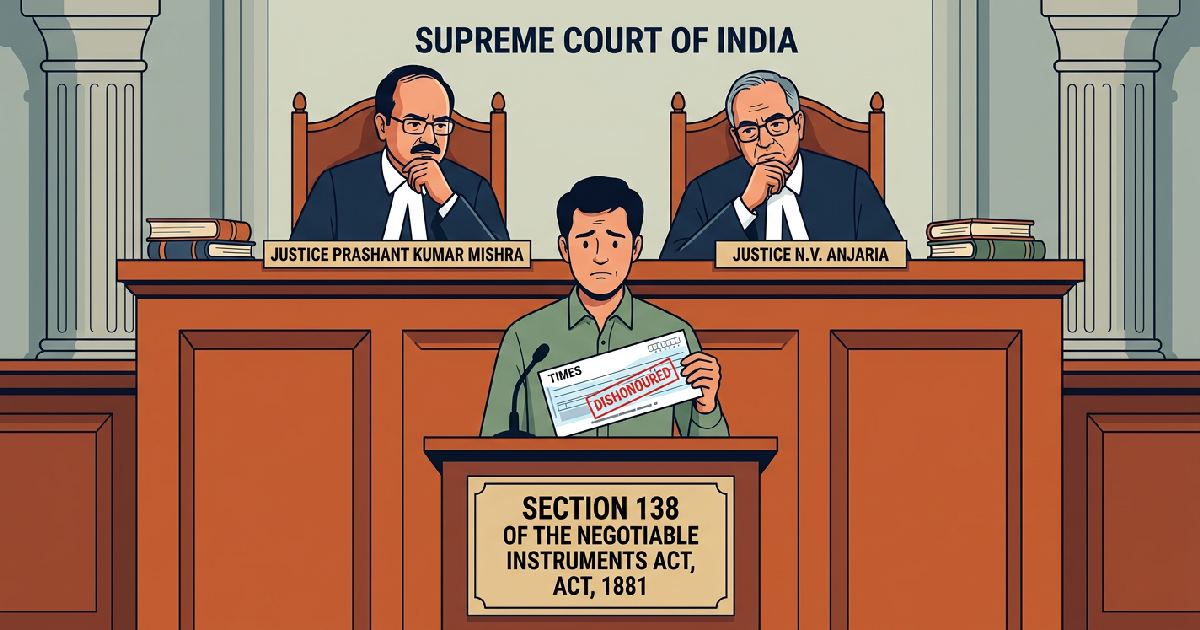
The Supreme Court of India has ruled that an authorized signatory of a Non-Governmental Organization (NGO) who holds plenary control over financial transactions can be held criminally liable as a “drawer” under the Negotiable Instruments Act, 1881. In the judgment of K. Ranganayakulu v. State of Telangana & Ors.
, delivered on June 3, 2026, and published June 7, the court affirmed that individual responsibility persists when a signatory acts as the primary “front face” of an organization. The bench, comprising Justice Prashant Kumar Mishra and Justice N.V.
Anjaria, upheld the conviction of the Treasurer of an NGO named “TIMES” following the dishonour of a cheque issued to a power utility company.
The case focused on a Memorandum of Understanding (MoU) between the NGO and the Andhra Pradesh Central Power Distribution Company (APCPDCL), now known as Southern Power Distribution Company of Telangana Limited (TSSPDCL). Under the agreement, the NGO handled electricity bill collections. The appellant, K. Ranganayakulu, was specifically tasked with signing cheques and authorizing financial remittances.
The bench noted that because the MoU cast no liability on any other office bearer, the signatory was the sole party responsible for the legal consequences of the failed payment.
The ruling clarifies that administrative titles do not shield individuals from prosecution when they exercise total financial control. While the Supreme Court upholds cheque bounce cases across various sectors, this decision emphasizes that the “reality of the business arrangement” determines liability. By acting as the representative for all financial and legal actions, the Treasurer effectively assumed the legal status of the “drawer” of the cheque.
Defining the drawer under Section 138 of the NI Act
Justice Prashant Kumar Mishra and Justice N.V. Anjaria observed that an individual authorized by a company or NGO to sign and issue cheques—including the responsibility of making payments—must be treated as a “drawer.” This status triggers liability under Section 138 of the Negotiable Instruments Act.
The court found that the appellant was the face of the NGO during the execution of the MoU, leaving no doubt regarding his personal accountability for the instruments he signed.
The appellant had attempted to rely on the precedent of Shri Gurudatta Sugars Marketing Pvt. Ltd. v. Prithviraj Sayajirao Deshmukh & Ors. (2024). He argued that mere designation as an authorized signatory should not incur personal liability for a company’s acts.
The court rejected this, noting that signatories can be categorized as drawers when the conditions of Section 141 of the NI Act are met. This aligns with earlier rulings where directors remain liable for cheque bounce issues when they manage the entity’s financial health.
But the court did modify the final sentence, taking into account the appellant’s role as a Treasurer of a society. Rather than immediate imprisonment, the bench shifted the focus toward a substantial financial penalty. This adjustment ensures that the respondent, a public utility, receives the owed funds while maintaining a strict deterrent against financial negligence in the non-profit sector.
Financial penalties and default imprisonment terms
The Supreme Court ordered K. Ranganayakulu to pay a fine of ₹1.5 crore to TSSPDCL. Under the court’s directive, this payment must be made within two months from the date of the judgment. If the appellant fails to pay the fine within this specified two-month window, he must undergo one year of rigorous imprisonment.
| Legal Detail | Specific Court Order / Fact |
|---|---|
| Appellant Case Figure | K. Ranganayakulu (Treasurer, NGO “TIMES”) |
| Financial Penalty | ₹1.5 Crore (15,000,000 INR) |
| Payment Timeline | Two months from the judgment date |
| Default Consequence | One year rigorous imprisonment |
| Respondent Entity | Southern Power Distribution Company of Telangana Ltd. |
This specific case highlights that even in representative roles, the individual who executes the transaction is legally bound to ensure the availability of funds. The court noted that since the MoU explicitly vested all rights and liabilities regarding bill collection with the Treasurer, he could not avoid the consequences by citing his administrative position.
The weight of contractual responsibility
The court’s reasoning was anchored in the specific clauses of the MoU between “TIMES” and the power utility. By reviewing the document, the bench determined that the NGO had effectively empowered the appellant with plenary control over financial transactions. This distinguishes the case from others where a signatory might have a more limited or purely clerical role in the organization.
And current laws surrounding cheque dishonour claims continue to evolve around the degree of control a signatory possesses. In this instance, the “front face” of the organization was deemed the true drawer because no other official was authorized to manage the accounts or ensure remittances reached the power utility.
Implications for authorized signatories and NGOs
The judgment serves as a significant precedent for office bearers in trust-run organizations and NGOs. It removes the perceived safety of the “corporate veil” for those who hold primary signatory power. If a contract or MoU places the burden of financial remittance on a specific individual, they are likely to be held personally liable for a dishonoured cheque under Section 138.
Organizations may need to review their internal MoUs and signatory authorizations to ensure that liability is not unintentionally concentrated on a single individual. The court’s focus on the “reality of the business arrangement” means that judges will look past formal titles to determine who truly manages the funds. This ruling secures the rights of creditors when dealing with representative entities.
Frequently Asked Questions
When was the Supreme Court judgment in this case delivered?
The judgment in K. Ranganayakulu v. State of Telangana & Ors. was delivered on June 3, 2026, and was subsequently published on June 7, 2026.
What is the penalty if the fine is not paid within two months?
If the appellant fails to pay the ₹1.5 crore fine within the two-month window from the judgment date, he is required to serve one year of rigorous imprisonment.
Why was the Treasurer held personally liable in this case?
The court found that the Treasurer was the “front face” of the NGO and held plenary control over financial transactions under the MoU, which designated him as the only person responsible for payments and cheque issuance.