
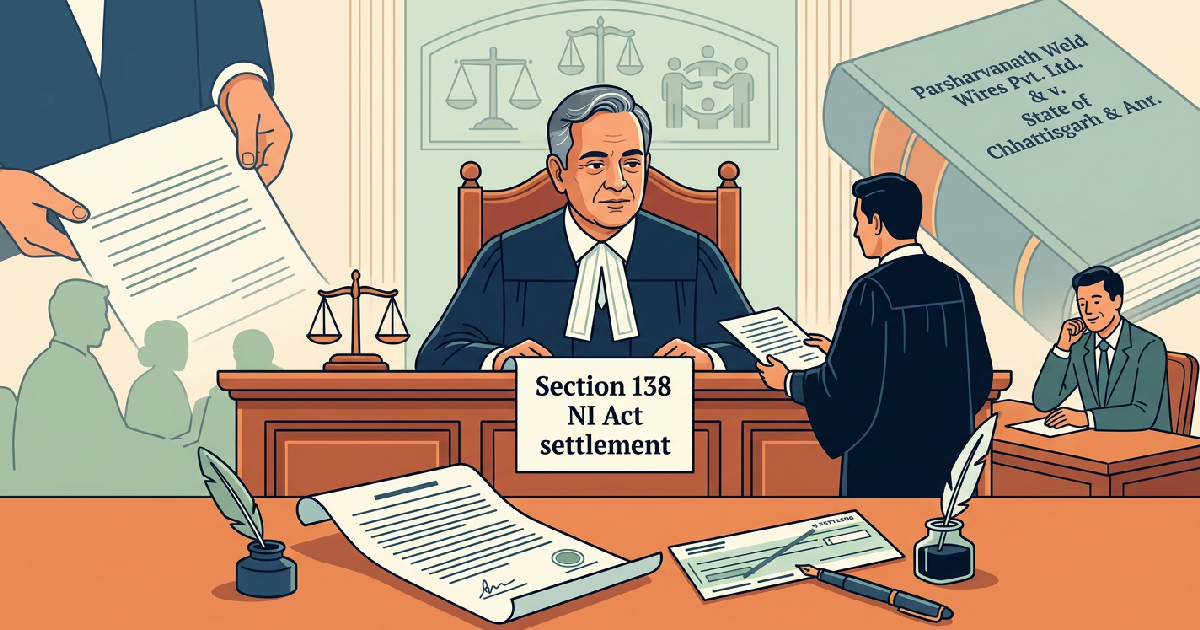
The Supreme Court of India has reaffirmed that convictions for cheque dishonour under Section 138 of the Negotiable Instruments Act, 1881, can be quashed upon a mutual settlement between the parties. In a significant ruling on May 27, 2026, a bench comprising Justice Aravind Kumar and Justice Prasanna B.
Varale set aside the conviction of a company director who had already been taken into custody. The decision in the case of Parsharvanath Weld Wires Pvt. Ltd. & Anr. v. State of Chhattisgarh & Anr. underscores the compensatory nature of the law over purely punitive measures.
The director in the Parsharvanath case was initially convicted in 2014, receiving a one-year simple imprisonment sentence and an order to pay ₹28 lakh in compensation. Despite the conviction being upheld by the Chhattisgarh High Court, the parties reached a settlement just two days after the director was taken into custody on April 23, 2026.
By paying ₹30 lakh as a full and final settlement, the accused paved the way for the Supreme Court to compound the offence and order an immediate release. This highlights how the Section 138 NI Act legal framework prioritizes restorative justice when the financial default is resolved.
This approach stems from Section 147 of the Negotiable Instruments Act, which explicitly makes offences under the Act compoundable. The Supreme Court noted that once a complainant acknowledges full satisfaction of their claim, continuing with a criminal conviction becomes legally unsustainable.
The court’s primary objective in these “quasi-criminal” proceedings is to ensure the payment of money rather than the incarceration of the debtor. This aligns with earlier guidance where the Kerala High Court clarified rules on partial payments and how they impact the validity of dishonour claims.
Legal precedents for quashing cheque bounce convictions
The Supreme Court has relied on several precedents to justify quashing convictions even after they have attained finality in lower courts. In the 2025 case of Gian Chand Garg v. Harpal Singh, the bench observed that once a compromise deed is signed, the prior proceedings “cannot hold water.”
In that instance, the court quashed a sentence for a ₹5 lakh cheque after the parties settled for the original amount plus an additional ₹3 lakh.
Similarly, the case of Virender Singh Dongwal v. Manju Aggarwal showcased the court’s willingness to intervene while the accused was behind bars. Dongwal had been in custody since August 2025 following a conviction in Faridabad. The Supreme Court allowed the appeal and quashed the sentence after a settlement of ₹6,65,000 was reached.
However, the court did require a deposit of 10% of the original cheque amount to the Supreme Court Legal Services Committee, maintaining that delay has a cost. This mirrors other instances where the Supreme Court addressed delay condonation rules for time-barred complaints.
Comparative overview of recent settlement outcomes
The following table details how the Supreme Court has handled specific cases where settlements were reached after conviction or during the appeals process:
| Case Title | Original Cheque Amount | Settlement Amount | Outcome/Decision Date |
|---|---|---|---|
| Parsharvanath Weld Wires v. State of Chhattisgarh | ₹28,00,000 | ₹30,00,000 | Conviction Quashed (May 27, 2026) |
| Gian Chand Garg v. Harpal Singh | ₹5,00,000 | ₹8,00,000 | Conviction Quashed (Aug 11, 2025) |
| Virender Singh Dongwal v. Manju Aggarwal | ₹11,37,827 | ₹6,65,000 | Conviction Quashed (Nov 18, 2025) |
| Ghanshyam Gautam v. Usha Rani | Not Specified | ₹1,14,000 | Conviction Quashed (Jan 09, 2024) |
Broader implications for the Indian justice system
The consistent use of Article 142 powers by the Supreme Court to compound these offences reflects a drive to reduce the massive backlog of cheque bounce cases in Indian courts. By allowing settlements to terminate criminal proceedings, the judiciary encourages parties to find commercial solutions rather than clogging the system with prolonged litigation.
This restorative approach ensures that the complainant receives their money faster than they might through the execution of a prison sentence.
For individuals and businesses, this trend provides a clear path to resolving past defaults even at the eleventh hour. However, it also suggests that the threat of imprisonment remains a powerful motivator to bring parties to the negotiating table. As the court moves toward a more compensatory model, the legal emphasis shifts from the “crime” of a bounced cheque to the “remedy” of financial restitution.
Frequently Asked Questions
Can a Section 138 conviction be quashed after the accused is in jail?
Yes. As demonstrated in the Parsharvanath Weld Wires case, the Supreme Court has the authority to set aside a conviction and order immediate release if the parties reach a full and final settlement, even while the accused is serving their sentence.
Is the complainant’s consent necessary for compounding the offence?
Yes. The compounding of an offence under Section 147 of the Negotiable Instruments Act typically requires a signed settlement deed or a statement from the complainant acknowledging that they have received the agreed-upon amount in full satisfaction of the claim.
Are there any additional costs when settling at the Supreme Court level?
The court sometimes imposes a cost for the delay in settling. For example, in the Virender Singh Dongwal case, the court ordered the accused to deposit 10% of the original cheque amount with the Supreme Court Legal Services Committee as a condition for quashing the conviction.