
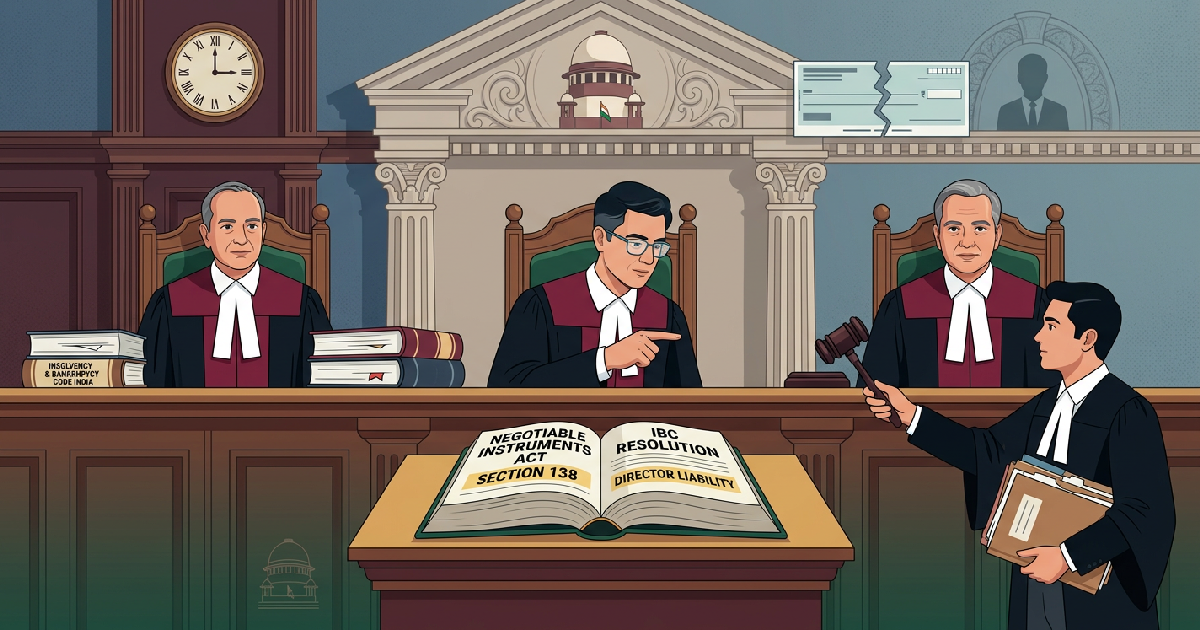
The Supreme Court of India has affirmed that company directors remain subject to criminal prosecution in cheque bounce cases under the Negotiable Instruments Act, even when the corporate entity has undergone debt resolution or liquidation. The ruling clarifies the boundary between corporate insolvency and individual penal liability, ensuring that the insolvency process does not serve as a blanket immunity for those who signed dishonored instruments. Notably, this means that directors remain liable for cheque bounce even in cases of corporate restructuring.
This case reinforces the notion that directors remain liable for cheque bounce, highlighting the significance of personal accountability in the corporate realm.
Furthermore, the court clarified that directors remain liable for cheque bounce, which solidifies the expectations for directors during corporate transitions.
As such, directors remain liable for cheque bounce cases that stem from their actions, regardless of the company’s financial status.
The bench dismissed a petition challenging a decision by the Bombay High Court, which had previously held that criminal charges against individual directors could proceed despite the company’s status being altered by the Insolvency and Bankruptcy Code (IBC). This decision reinforces the principle that personal accountability for financial misconduct remains intact even as a firm’s assets are reorganized or liquidated by creditors.
This legal position illustrates that directors remain liable for cheque bounce, ensuring the integrity of financial transactions.
Ultimately, this means that directors remain liable for cheque bounce, emphasizing the need for vigilance in financial dealings.
This ruling serves as a reminder that directors remain liable for cheque bounce, protecting creditors from potential losses.
Central to the matter was whether the “clean slate” provided to companies during a resolution process should extend to the executives involved in day-to-day operations. The court indicated that the protections offered under the IBC are intended to facilitate the revival of the corporate debtor rather than protecting the personal interests of management figures who may have overseen statutory defaults. This ensures that Supreme Court guidelines on commercial suits regarding liability and recovery are consistently applied across both civil and criminal frameworks.
Therefore, it is evident that directors remain liable for cheque bounce, which is pivotal for corporate governance and accountability.
Distinguishing Corporate Debt from Personal Criminal Liability
Hence, the legal framework indicates that directors remain liable for cheque bounce, ensuring individual responsibility for financial misconduct.
The judiciary has increasingly sought to separate the civil recovery of debt from the penal consequences of issuing cheques without sufficient funds. Under Section 138 of the Negotiable Instruments Act, the primary focus is on the act of dishonor, which is viewed as a disruption of commercial integrity. Because this is a criminal offense, it does not automatically vanish when a company enters a resolution or liquidation phase.
Reports indicate that the petitioners sought to argue that since the company’s management had changed or the entity had been liquidated, the prosecution against the signatories should be terminated. However, the court maintained that the offense is deemed complete once the cheque is dishonored and the required legal notice period passes without payment being made. At that point, the liability attaches to the individuals who were in charge of the company’s conduct at the specified time.
This underscores that directors remain liable for cheque bounce, reinforcing the legal boundaries of corporate accountability.
In summary, the principle that directors remain liable for cheque bounce remains a cornerstone of the regulatory landscape.
This situation illustrates that directors remain liable for cheque bounce, further scrutinizing their responsibilities.
In conclusion, it is important to recognize that directors remain liable for cheque bounce, which reflects the ongoing evolution of corporate law.
This distinction is critical for maintaining market discipline. It prevents the corporate veil from being used as a shield against criminal negligence. While the IBC provides a moratorium on suits against the corporate debtor itself to protect assets, this moratorium does not generally extend to the individual directors whose actions led to the legal dispute.
Legal Protections and Their Limits Under the IBC
The intersection of the IBC and the Negotiable Instruments Act often centers on Section 32A of the code. This provision was designed to protect the assets of a company under new management from the consequences of past offenses, ensuring that new investors are not penalized for the actions of their predecessors. However, the phrasing of the law specifically excludes the individuals who were in a position of control during the commission of the offense.
Judicial interpretations affirm that directors remain liable for cheque bounce, highlighting the ongoing legal obligations of corporate executives.
Consequently, directors remain liable for cheque bounce, which continues to shape the expectations placed on corporate leadership.
| Statutory Element | Application in Insolvency Scenarios |
|---|---|
| Section 138 Liability | Viewed as a personal penal liability that survives corporate restructuring. |
| Corporate Debtor Protection | Applies to the company assets and new management, but not the former signatories. |
| Timelines of Offense | Liability is fixed based on the state of affairs at the time of the cheque dishonor. |
By upholding the High Court’s stance, the Supreme Court has underscored that a resolution plan approved by a committee of creditors does not extinguish the criminal proceedings against individual signatories. This ensures that creditors possess a separate avenue for seeking justice against individuals, even if the company’s financial obligations are settled for a fraction of their original value through the insolvency process.
Implications for Corporate Governance
This development carries significant weight for corporate governance across India. It serves as a reminder to executives that the protection of a limited liability company does not extend to personal criminal acts. Directors are expected to exercise due diligence in the issuance of financial instruments, knowing that a subsequent bankruptcy will not erase their legal vulnerabilities. Indeed, these directors remain liable for cheque bounce cases irrespective of corporate structure changes.
The refusal to interfere with the lower court’s order means the trial for the directors in question will proceed. It sends a message that the insolvency framework should not be viewed as a tool for escaping the consequences of commercial dishonesty. Legal observers suggest this will prevent a surge in attempts to stay criminal trials by merely citing the commencement of insolvency proceedings.
The ruling clarifies that the NI Act and the IBC operate in parallel rather than in conflict. One is designed for economic rehabilitation and value maximization, while the other is intended to uphold the reliability of cheques as a medium of exchange. So long as these two objectives remain distinct, the personal liability of directors will likely remain a fixture of the Indian legal environment.
Frequently Asked Questions
Does a resolution plan under the IBC clear directors of criminal charges?
Generally, no. While the resolution plan may settle the company’s outstanding debts, it does not automatically discharge the criminal liability of the individual directors who signed the dishonored cheques.
Who is protected under Section 32A of the IBC?
This section protects the “Corporate Debtor” and its assets from the impact of past offenses to help the business continue under new ownership. It does not provide immunity to the specific individuals who were in charge when the offense took place.
Are directors liable even if the company is liquidated?
According to current judicial interpretations, the liquidation of a company does not terminate the criminal proceedings against its directors for cheque bounce cases, as the offense was committed by individuals in their capacity as company officers at the time of the default. Consequently, directors remain liable for cheque bounce.
Is your company facing a cheque bounce case, or are directors being asked to appear?
The IBC process and a Section 138 case are not always the same thing. WhatsApp or call for a free consultation. We handle cheque dishonour matters for companies and directors in Delhi.