
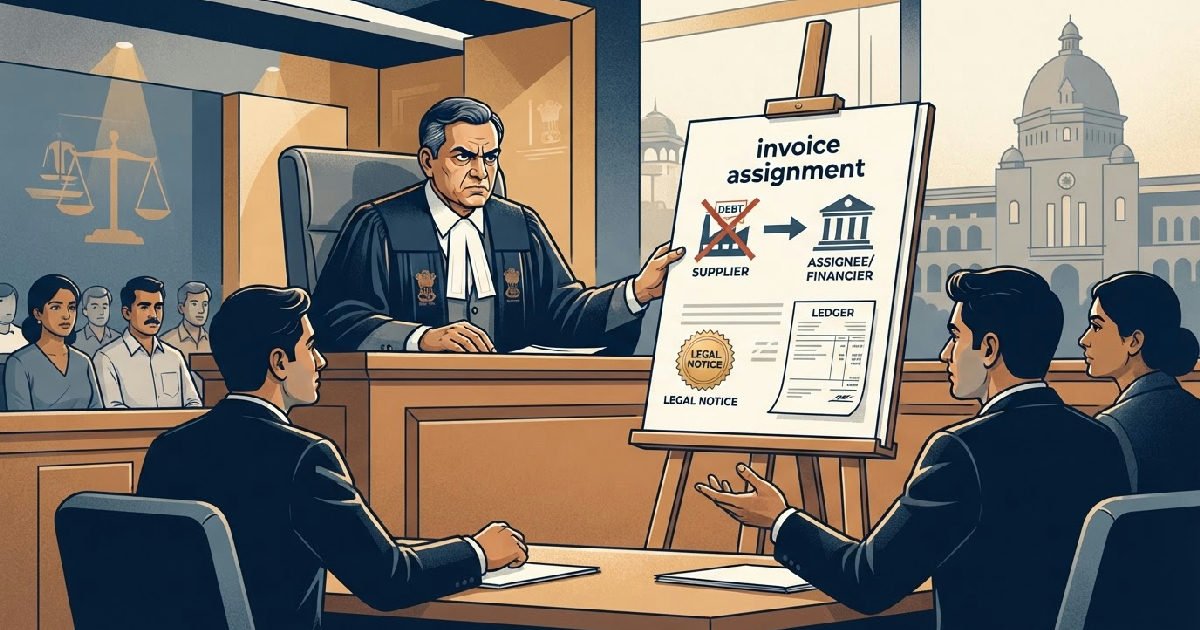
When a supplier sells its receivables to another company, the legal landscape surrounding who can pursue that debt in a commercial suit becomes sharply defined. In Delhi, once an invoice is validly assigned and the debtor has received formal notification, only the assignee possesses the legal standing to initiate recovery proceedings.
This critical distinction prevents confusion and ensures an orderly process for filing a commercial suit.
Invoice assigned to another company in Delhi
Debt assignment is a common practice in modern commerce, allowing businesses to manage cash flow by monetising outstanding invoices. However, the intricacies of India’s legal framework, particularly under the Transfer of Property Act and the Commercial Courts Act, dictate precisely how these assignments translate into litigation rights and obligations.
The practice of assigning receivables, or actionable claims, is firmly rooted in Indian law, primarily under the Transfer of Property Act, 1882. Section 130 of this Act lays down the foundational principles for such transfers, ensuring that rights to a debt can move from one entity to another.
This legal provision is essential for the functioning of financing models where businesses sell their future income streams.
Beyond this, the Factoring Regulation Act, 2011, provides a more specialized framework, particularly relevant when suppliers engage with financiers to sell their receivables. This Act streamlines the process for factoring arrangements, offering a clear regulatory path for such financial transactions.
Moreover, the Reserve Bank of India (RBI) frequently issues guidelines that govern loan assignments, especially impacting banks and Non-Banking Financial Companies (NBFCs), highlighting the regulatory oversight in this sector.
Legal Versus Equitable Assignment Types
In the context of Indian law, assignments typically fall into two main categories: legal and equitable. A legal assignment, as defined by Section 130 of the Transfer of Property Act, 1882, demands specific formalities for its completion. These include a clear intention to assign the debt, communication of this intent to the assignee, and, crucially, express notice to the debtor.
Conversely, an equitable assignment occurs when the transfer happens without formal notice to the debtor. While such an assignment remains valid between the original supplier (assignor) and the new entity (assignee), its effectiveness against the debtor or the wider public is limited. Without explicit notice, the debtor might not be legally bound to acknowledge the assignee’s claim, potentially leading to payment disputes.
The Pivotal Role of Notice to the Debtor
For an invoice assignment to be fully effective and enforceable against the debtor, written notice of the assignment is not merely a formality; it is a mandatory requirement. This notice serves a fundamental purpose: to inform the debtor that the rights to receive payment have been transferred from the original supplier to a new party.
It legally binds the debtor to acknowledge the assignee as the rightful claimant.
Ignoring this notice carries significant legal risks for the debtor. Should a debtor disregard a valid notice of assignment and subsequently pay the original supplier, they may still be held accountable to the assignee. This principle underscores the importance of clear communication in debt transfers.
Importantly, the assignment of a receivable only alters who receives the payment; it does not change the debtor’s underlying obligations or repayment terms established in the original agreement.
Assignee’s Exclusive Right to Sue in Delhi
Once a valid assignment has been executed and the debtor duly notified, the legal standing to pursue recovery for the debt unequivocally shifts. At this juncture, only the assignee possesses the right to file a commercial suit for the recovery of that debt. This clear delineation prevents conflicting claims and simplifies the litigation process.
The original supplier, or assignor, typically steps back from direct litigation once the assignment is complete and noticed. However, exceptions exist. The assignor may need to remain a party to the suit if the assignment was only partial, meaning only a portion of the debt was transferred.
Similarly, if the validity or terms of the assignment itself are disputed, the original supplier’s involvement may be necessary to clarify the matter for the court.
Evidentiary Requirements for Filing a Suit
To successfully file a commercial suit, the assignee must provide compelling evidence to the court. This includes exhibiting the formal assignment agreement that legally transfers the rights to the debt. Furthermore, proof of the notice of assignment provided to the debtor is crucial, demonstrating that the debtor was aware of the change in ownership of the receivable.
Finally, the assignee must present a clear ledger documenting the outstanding debt, detailing the transactions and showing the amount due. These documents collectively establish the assignee’s locus standi and the basis for their claim. Commercial lawyers in Delhi meticulously verify these documents and confirm who owns the invoice at the time of filing to avoid procedural pitfalls.
Navigating Commercial Suits in Delhi’s Courts
Commercial litigation in Delhi operates under a specific legal framework, primarily governed by the Commercial Courts Act, 2015, alongside the Code of Civil Procedure, 1908, as amended for commercial matters. This legislation aims to expedite the resolution of business disputes, including those arising from unpaid invoices and assigned receivables.
A critical determinant for a dispute to be classified as a commercial suit in Delhi is its specified value. The Commercial Courts Act mandates a minimum threshold of ₹3,00,000 (three lakh rupees). Disputes falling below this amount are handled as ordinary civil suits, which typically follow a different procedural path and timeline. This distinction helps allocate resources efficiently within the judicial system.
| Court Type | Minimum Specified Value (₹) | Jurisdiction |
|---|---|---|
| District Commercial Courts | 3,00,000 | Up to 2,00,00,000 |
| Commercial Division of Delhi High Court | 2,00,00,001 | Exceeding 2,00,00,000 |
Court Jurisdiction and Pre-Institution Mediation
The jurisdiction for these commercial disputes is stratified. District Commercial Courts are equipped to handle cases with a specified value ranging from ₹3 lakh up to ₹2 crore. For claims that exceed ₹2 crore, the Commercial Division of the Delhi High Court assumes jurisdiction. This clear division ensures that cases are heard by the appropriate judicial body, equipped to manage their complexity and financial magnitude.
Before proceeding to formal litigation, most commercial recovery cases in Delhi are subject to a mandatory pre-institution mediation process. This step is designed to encourage amicable settlements and reduce the burden on the courts. However, an exception exists for urgent cases where interim relief is required, allowing parties to bypass mediation and approach the court directly for immediate redress.
Crucial Timelines and Documentation for Debt Recovery
Adhering to strict timelines is paramount in Delhi commercial suits. The limitation period for most breach of contract claims, including those involving the recovery of unpaid invoices, is generally three years. This period commences from the date the payment was originally due.
A crucial aspect here is that a written acknowledgment of debt from the debtor can restart this limitation period, offering a lifeline for creditors who might otherwise miss the window. Understanding when limitation starts is vital for successful recovery.
Proper documentation forms the backbone of any successful commercial recovery suit. Key documents include signed contracts between the parties, official purchase orders, and clear delivery acknowledgements. Invoices must specify clear payment timelines, and comprehensive records of all follow-up reminders are also essential. These documents not only establish the debt but also reinforce the assignee’s claim in court.
Consequences of Ignoring a Legal Notice
While ignoring a legal notice doesn’t automatically imply guilt, it certainly introduces significant legal risks. The sending party, if unaddressed, is well within its rights to proceed with formal legal action. This could manifest as a civil suit, a complaint to consumer forums, or even dedicated recovery proceedings, escalating the dispute considerably.
From a judicial perspective, a lack of response might be interpreted as an unwillingness to resolve the matter amicably, potentially weakening the debtor’s defense should the case proceed to trial. In specific scenarios, such as cheque bounce cases under Section 138 of the Negotiable Instruments Act, ignoring a notice can directly lead to criminal prosecution, highlighting the severe repercussions of inaction.
Strategic Legal Counsel in Invoice Assignment Cases
Commercial lawyers in Delhi play an indispensable role in navigating the complexities of invoice assignment and subsequent debt recovery. Their work begins with rigorous due diligence, meticulously identifying potential legal risks, from ownership disputes to contractual vulnerabilities, well before any significant transaction or litigation is initiated. This proactive approach aims to safeguard their clients’ interests.
A primary focus for these legal professionals is to verify the rightful ownership of the invoice on the date a suit is filed. This ensures that the correct party, whether the original supplier or the assignee, is pursuing the claim.
Lawyers also advise on the most appropriate legal recourse, which might range from issuing a formal legal notice to filing a summary suit under Order XXXVII of the Code of Civil Procedure for clear-cut cases, or a more involved regular commercial suit.
They frequently emphasize the critical importance of robust documentation and strict adherence to procedural rules, knowing these are cornerstones of a successful outcome. The award of actual or realistic costs under the Commercial Courts Act, 2015, also means frivolous litigation can be expensive for losing parties.
Who can sue for an assigned debt in Delhi after proper notice?
Once an invoice has been validly assigned and the debtor has received formal written notice of this assignment, only the assignee (the company to whom the debt has been transferred) has the legal right to file a commercial suit for its recovery in Delhi.
What is the minimum value for a commercial suit in Delhi?
A commercial dispute in Delhi must have a minimum specified value of ₹3,00,000 (three lakh rupees) to fall under the purview of the Commercial Courts Act, 2015. Cases below this threshold are treated as ordinary civil suits.
What happens if a debtor ignores a notice of invoice assignment?
If a debtor ignores a notice of assignment and pays the original supplier, they may still be held accountable to the assignee. Ignoring such a notice can also lead the assignee to initiate legal action, with courts potentially viewing the lack of response unfavorably.
The same invoice is now claimed by a different company? WhatsApp or call for consultation.
Related: https://arpitmarwah.com/commercial-lawyers-in-delhi/