
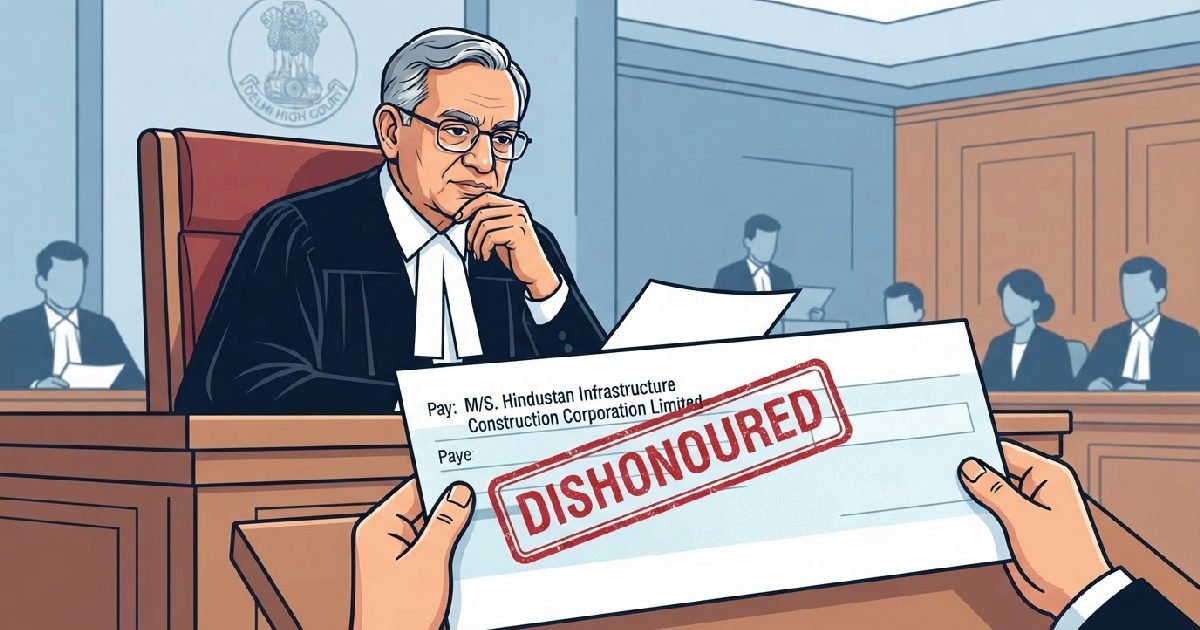
The Delhi High Court, in a significant judgment, has ruled that an unregistered partnership firm can legally file a civil suit to recover funds from a dishonoured cheque. This is an important precedent for unregistered firms as it clarifies their legal standing regarding dishonoured cheques. The decision, delivered on December 13, 2018, by Justice Vinod Goel, provides crucial clarity on the rights of countless unregistered firms, distinguishing between rights arising from contracts and liabilities created by statute.
This ruling came in the case of M/S. Hindustan Infrastructure Construction Corporation Limited & Anr. v. M/S. R.S. Woods International & Ors. The court held that the bar on lawsuits by unregistered firms under Section 69(2) of the Indian Partnership Act, 1932, does not apply to proceedings for a bounced cheque, as the cause of action stems from the Negotiable Instruments Act, 1881.
Understanding unregistered firm cheque dishonour and legal rights
Unregistered firms often face challenges in enforcing their rights, especially in situations involving dishonoured cheques. This ruling sets a precedent that benefits unregistered firms by allowing them to seek legal recourse without the burden of registration.
This interpretation provides a vital legal remedy for firms that, while legally valid, face restrictions on enforcing contractual rights.
Furthermore, the implications of this ruling extend beyond just this case; it serves to protect the interests of unregistered firms in similar situations, empowering them to take legal action when faced with financial disputes.
This case highlights the importance of understanding the rights of unregistered firms and their ability to navigate the complexities of business transactions confidently.
The central issue revolved around a conflict between two major pieces of commercial legislation. The petitioners, M/S. Hindustan Infrastructure Construction Corporation, argued that the suit filed by the respondent, an unregistered partnership firm named M/S R.S. Woods International, was legally invalid. Their defence was anchored in Section 69(2) of the Indian Partnership Act, 1932.
In the context of unregistered firms, the ruling emphasizes that dishonoured cheques create a distinct legal scenario separate from traditional contractual disputes.
This section explicitly states that an unregistered firm cannot sue a third party to enforce a right “arising from a contract.” The petitioners contended that since the payment was originally due under a business contract, the suit to recover money from the bounced cheques was fundamentally an attempt to enforce that contract, and was therefore barred.
However, Justice Vinod Goel rejected this interpretation. The court reasoned that a lawsuit for a dishonoured cheque is not based on the original contract between the parties. Instead, it seeks to enforce a separate, independent liability created by statute—specifically, the Negotiable Instruments Act, 1881. When a cheque is dishonoured, a new cause of action is born, one that is governed by its own specific law.
The court noted that the suit was for the enforcement of liability created under Sections 30 and 37 of the Negotiable Instruments Act. Because the cause of action was the dishonour of the cheques, not a breach of the underlying commercial agreement, the bar under the Partnership Act did not apply.
This distinction is critical, as it separates the instrument of payment from the transaction it was meant to settle.
A closer look at the case details
The case began when M/S. R.S. Woods International & Ors. filed a civil suit to recover a sum of ₹24,41,967. This amount was due from five separate cheques issued by M/S. Hindustan Infrastructure Construction Corporation Limited which were subsequently dishonoured by the bank. The defendants responded not by contesting the debt, but by challenging the plaintiff’s legal standing to sue.
They filed an application under Order VII, Rule 11 of the Code of Civil Procedure, 1908, demanding the rejection of the plaint itself. The basis for this demand was the undisputed fact that M/S. R.S. Woods International was not registered under the Partnership Act. The trial court dismissed this application, leading the defendants to file a revision petition with the Delhi High Court.
The High Court’s decision to uphold the trial court’s order was definitive. It affirmed that the nature of the suit was the determining factor.
By focusing on the statutory liability attached to the act of issuing a cheque that is later dishonoured, the court protected the integrity of negotiable instruments as a reliable means of commerce. The numerous Section 138 cheque bounce cases clogging the judicial system underscore the importance of such clear enforcement mechanisms.
Details of the dishonoured cheques
The civil suit filed by M/S. R.S. Woods International was based on the non-payment of five specific cheques. The details provided in the case filings illustrate the financial basis of the dispute:
The role of judicial precedent in shaping the decision
In its judgment, the Delhi High Court did not operate in a vacuum. It heavily relied on existing judicial precedent, most notably a 2016 decision from the Kerala High Court in the case of Afsal Baker v. Maya Printers. That ruling had dissected the same legal question and arrived at an identical conclusion, providing a strong persuasive authority.
The Kerala High Court had held that “by virtue of Section 30 and 37 of the Negotiable Instruments Act, on the dishonour of a cheque, the statute creates a liability on the drawer, apart from the general law of contracts.”
It clarified that when a suit is based on the instrument itself, and not the original cause of action, the bar under Section 69(2) simply does not apply. The Delhi High Court expressly followed this line of reasoning.
This principle is also supported by a foundational Supreme Court judgment from 2000 in Haldiram Bhujiawala & Anr. v. Anand Kumar Deepak Kumar & Anr. In that case, the apex court made a broad and influential clarification that Section 69(2) does not bar an unregistered firm from enforcing statutory rights or rights under common law.
It only restricts the enforcement of rights that arise directly and exclusively from a contract.
Distinguishing civil recovery from criminal complaints
The legal community has long accepted that the bar under Section 69(2) does not prevent an unregistered firm from filing a criminal complaint. Numerous High Courts, including those in Gujarat, Karnataka, and Bombay, had already ruled that a criminal action under Section 138 of the Negotiable Instruments Act is permissible.
This is because a Section 138 proceeding is punitive in nature; it seeks to penalise the drawer for the offence of issuing a bad cheque.
This ensures that unregistered firms are not disadvantaged in the commercial landscape, allowing them to assert their rights effectively.
The legal ramifications for unregistered firms are profound, as this judgment reaffirms their ability to pursue civil actions without the constraints imposed by registration requirements.
This landmark ruling is a significant victory for unregistered firms, ensuring that they have a clear pathway to recovery in cases of bounced cheques.
The judgment not only empowers unregistered firms but also sets a standard for how businesses can handle cheque disputes moving forward.
The Karnataka High Court, for instance, held in Beacon Industries v. Anupam Ghosh that initiating a private complaint for a criminal offence is not the same as filing a civil suit to enforce a right.
The Bombay High Court later echoed this, stating the term ‘suit’ in the Partnership Act could not be stretched to grant immunity from criminal prosecution. This established a clear path for bad cheque prosecution, regardless of the firm’s registration status.
Ultimately, this ruling is a testament to the resilience and rights of unregistered firms within the Indian legal framework.
Understanding the legal landscape is crucial for unregistered firms, particularly when navigating issues around cheques and financial liabilities.
The court’s decision serves as a guideline for unregistered firms, encouraging them to engage in commerce with a greater sense of security regarding their financial transactions.
What makes the Delhi High Court’s 2018 ruling so important is its specific application of this logic to civil suits for recovery. While a criminal complaint can lead to a fine or imprisonment, it does not automatically ensure the recovery of the original amount for the aggrieved party.
This judgment solidifies the firm’s right to file a separate civil action to reclaim its dues, providing a complete and robust legal remedy.
This ruling reinforces the notion that unregistered firms can stand up for their interests in disputes, creating a more level playing field in commerce.
Implications for unregistered businesses and commerce
This ruling has significant positive implications for the vast number of small and medium-sized enterprises in India that operate as unregistered partnership firms. These businesses often lack the resources or legal sophistication to complete formal registration, yet they are an integral part of the economy. The judgment ensures they are not left without recourse when faced with a bounced cheque.
It strengthens the legal sanctity of cheques as a key instrument in commercial dealings. Had the court ruled otherwise, it could have created a perverse incentive for parties to transact with unregistered firms and then default on cheque payments, knowing the firm had limited legal avenues for recovery. By upholding the firm’s right to sue, the court has reinforced trust in this fundamental commercial tool.
While this decision provides a crucial safety net, legal experts still advise partnership firms to register. Registration provides broader protections, especially for enforcing rights arising purely from contracts, resolving disputes between partners, and claiming set-offs. However, this ruling ensures that a failure to register does not become a fatal flaw when seeking a complete bounced cheque restitution and recovery.
The judgment effectively aligns the treatment of civil suits for cheque dishonour with that of criminal complaints, creating a consistent legal framework. It ensures that the statutory liability imposed by the Negotiable Instruments Act is not undermined by the procedural limitations of the Partnership Act, promoting fairness and accountability in business transactions.
What is Section 69(2) of the Indian Partnership Act?
Section 69(2) is a provision in the Indian Partnership Act, 1932, that places a significant restriction on unregistered partnership firms. It states that such a firm cannot file a lawsuit against a third party to enforce any right that arises from a contract. This rule is intended to encourage firms to register with the Registrar of Firms.
Can an unregistered firm file a criminal complaint for a bounced cheque?
Yes. Multiple High Courts and the Supreme Court have established that the bar under Section 69(2) applies to civil suits, not criminal complaints. An unregistered firm can file a criminal complaint under Section 138 of the Negotiable Instruments Act, as this pertains to a statutory offence and not the enforcement of a contractual right.
Why is a suit for a dishonoured cheque not considered a contractual suit?
A suit for a dishonoured cheque is based on the statutory liability created by the Negotiable Instruments Act, 1881. The cause of action is the act of the cheque bouncing, which is a distinct event governed by its own law. This is different from suing for a breach of the original business contract for which the cheque was issued as payment.