
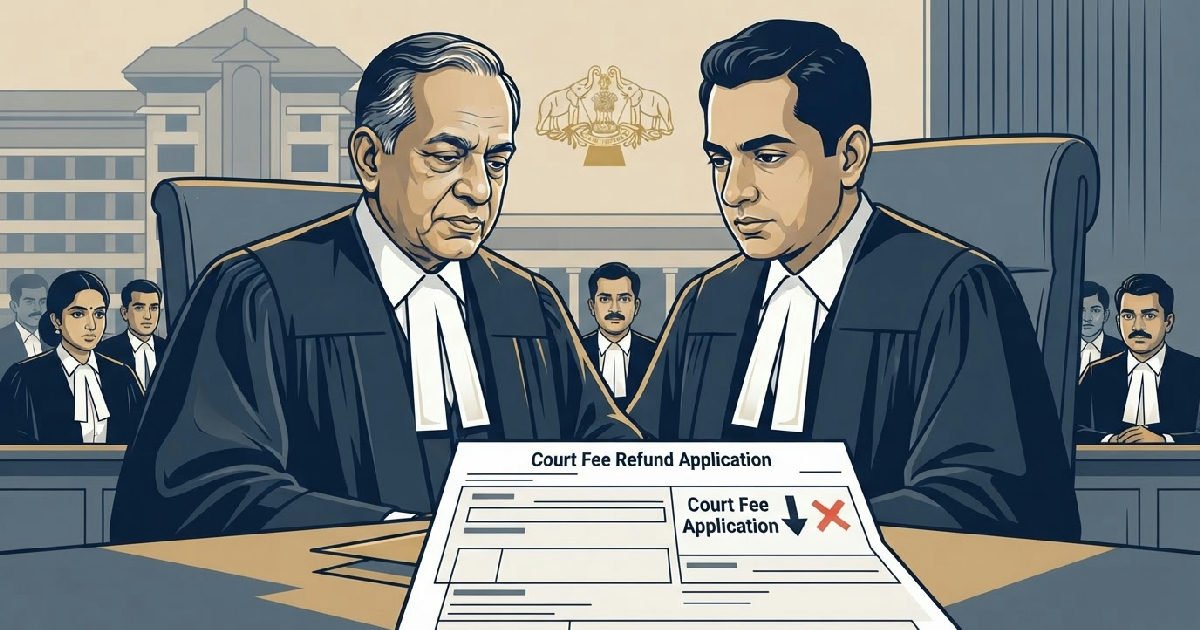
In a significant ruling, the Kerala High Court, presided over by Justice C.S. Dias, has affirmed that a court fee refund cannot be granted once a civil suit has been decided on its merits. This decision particularly applies when the petitioner seeks the return of the plaint and associated fees without first challenging the court’s decree.
The judgment emphasizes the finality of judicial processes, underscoring that a litigant’s participation through a full trial culminating in a decree necessitates an appeal, rather than an attempt to reclaim initial costs. This stance has direct implications for procedural approaches in civil litigation costs across the state.
Kerala High Court’s definitive stance on fee refunds
The ruling stems from a petition filed by S. Surendran, who sought a refund of court fees totaling Rs. 8,18,400 and legal benefit fund stamps worth Rs. 1,00,000. Surendran’s original suit for damages, valued at approximately one crore rupees, had been dismissed by the Court of the Subordinate Judge, Kasaragod, on February 23, 2019.
Following the dismissal, S. Surendran filed an Interlocutory Application on June 28, 2019, requesting the return of the plaint, its documents, and the court fees. This application was subsequently rejected by the lower court. The High Court ultimately described this attempt as “purely experimental in nature” and “untenable and impermissible in law,” reinforcing the principle that a decree must be challenged through proper appellate channels.
Background of the S. Surendran case details
The specific dispute involved S. Surendran against the State of Kerala, represented by the District Collector, Kasaragod, and officials from Kerala State Financial Enterprises Ltd. (KSFE). Surendran had pursued a claim for damages, engaging in a full trial process before seeking a refund.
This chronology proved critical. Justice C.S. Dias noted that the lower court had framed seven issues, conducted a complete trial, and then formulated an eighth issue regarding jurisdiction before dismissing the suit. The court found the suit barred under Section 64(3) of the Chit Funds Act, 1982, and Rule 47 of the Kerala Chit Funds Rules, 2012.
Petitioner’s arguments for fee refund
Advocate M. Sasindran, representing S. Surendran, argued that the dismissal of the suit, based on it being barred by law, should be treated as a rejection of the plaint under Order 7 Rule 11(d) of the Code of Civil Procedure (CPC).
He contended that this interpretation would entitle the petitioner to a refund of court fees and legal benefit stamps under Section 70 of the Kerala Court Fees and Suits Valuation Act, 1959.
The counsel also cited the 1978 decision in Janaki Amma v. Krishnan, where a dismissal under Order 7 Rule 11 was held to be equivalent to a plaint rejection. This precedent was used to buttress the argument that a refund was legally warranted despite the trial having taken place.
The court’s reasoning on refund impermissibility
Justice C.S. Dias, however, clarified the distinction between a rejection of plaint and a dismissal after a trial. He observed that a judgment delivered after a full-fledged trial falls under Section 33 of the CPC and is followed by a formal decree. Such a decree is then appealable under Section 96 of the CPC.
Senior Government Pleader V. Manu, representing the State of Kerala, further argued that Order 7 Rule 11(d) applies only when the plaint itself clearly indicates the suit is barred by law. If not, courts are obligated to frame issues under Order 14 Rule 2 of the CPC and proceed to trial.
Once the adjudicatory process is complete, a party cannot seek the return of the plaint or a refund of fees, V. Manu contended. Standing Counsel for KSFE, Advocate Salil Narayanan K.A., added that S. Surendran could have withdrawn the suit earlier. Instead, the petitioner adopted a “wait and watch” policy.
The proper remedy, Advocate Narayanan asserted, was to file an appeal challenging the decree, not to pursue what he termed an “experimental course” for a refund. The court found the petitioner’s application to be “innocuous” given the circumstances.
Differentiating rejection of plaint from suit dismissal
Understanding the nuances between a plaint’s rejection, a suit’s dismissal, and its return is crucial in civil litigation. Each carries distinct legal implications, particularly regarding the possibility of refiling or obtaining a refund of court fees.
A rejection of plaint typically occurs at a preliminary stage, addressing procedural or legal defects evident in the pleading itself. This is distinct from a dismissal, which usually follows a more extensive judicial process after evidence and arguments.
Key legal distinctions under CPC
The Code of Civil Procedure outlines specific scenarios. Order 7 Rule 11(c), for instance, mandates rejection if required stamp paper isn’t supplied within a set timeframe, an action taken before trial commencement. Order 7 Rule 11(d) applies when the plaint statements clearly show the suit is barred by law.
In contrast, a suit’s dismissal, as seen in S. Surendran’s case, happens after a detailed examination of facts and law, often following a full trial. Here, the lower court identified the suit was barred by law only after formulating issues and proceeding with the adjudicatory process.
This procedural difference was key to the High Court’s decision, as it meant the case had moved beyond the preliminary stages where plaint rejection would apply.
The High Court underscored that if a suit does not appear to be barred from the initial plaint statement, then the court must proceed to the next stage, which involves adjudication. This includes framing issues and conducting a trial to determine the merits of the case before reaching a final decision.
Previous judicial interpretations on refund rules
The Court specifically referenced its own Division Bench ruling in Linsaraj v. State of Kerala, 2017 SCC OnLine Ker 23175. That precedent established that Section 70 of the Kerala Court Fees and Suits Valuation Act, 1959, which allows for refund of fees paid by mistake or inadvertence, only applies when there has been no adjudicatory process.
Since S. Surendran’s case had undergone a full trial, paid the balance court fee, and resulted in a decree, the conditions for a refund under Section 70 were not met. This distinction highlights the judiciary’s consistent approach to the applicability of fee refunds based on the stage of the legal proceedings.
This ruling reinforces established legal principles. It confirms that litigants cannot bypass the formal appeal process for a dismissed suit by seeking a refund of court fees. Such a move is deemed contrary to the spirit of the legal framework surrounding the finality of judicial decrees.
Below is a summary of the key differences in legal outcomes concerning the initial filing of a lawsuit:
| Action | Stage of Occurrence | Grounds | Court Fee Refund Potential | Future Action |
|---|---|---|---|---|
| Rejection of Plaint | Preliminary (before trial) | Procedural defects (e.g., no cause of action, insufficient fees, barred by law on face) | Possible (especially if procedural defect corrected) | Fresh suit generally permissible after correcting defects |
| Dismissal of Suit | After adjudication/trial | Merits of the case, non-appearance, or deemed barred by law after evidence | Generally Not Possible | Appeal against the decree is the primary remedy |
| Return of Plaint | Preliminary (before trial) | Lack of territorial or pecuniary jurisdiction | Generally Not Applicable (plaint transferred, not terminated) | Present in court with proper jurisdiction |
Broader implications for civil litigation costs
The Kerala High Court’s decision is not an isolated event; it reflects a broader judicial approach towards managing litigation and court fees across India. The emphasis on proper procedure and the finality of judicial orders aims to streamline the legal system and prevent protracted disputes over administrative aspects.
Litigants are now more clearly guided to pursue appeals for adverse judgments rather than seeking alternative, less conventional remedies. This reinforces the structured nature of the Indian judicial system, where each stage of litigation has specific rules and consequences.
Supreme Court’s view on fee refunds
The Supreme Court of India, in its 2025 ruling in Jage Ram v. Ved Kumar & Ors., further tightened the criteria for court fee refunds. It clarified that refunds are permissible only when a dispute is settled through recognized Alternative Dispute Resolution mechanisms, such as arbitration or mediation, as specified under Section 89 of the CPC.
Crucially, the Supreme Court explicitly stated that private out-of-court settlements, not facilitated by any ADR authority, do not qualify for a refund of court fees. This stance aligns with the Kerala High Court’s emphasis on formal judicial processes and discourages informal bypasses that could undermine the integrity of fee structures.
Even the Delhi High Court has weighed in on court fees, acknowledging that such charges shouldn’t penalize litigants. While it has allowed refunds in cases where suits were rejected for jurisdictional issues without a merits adjudication, it also highlighted the need for a codified mechanism for the speedy refund of court fees after dispute settlements, recognizing the current hardships faced by litigants.
Pending case burden and court fees
The Indian judiciary grapples with a substantial backlog of cases, a factor that influences many procedural and administrative decisions, including those related to court fees. Data from the National Judicial Data Grid (NJDG) highlights the scale of this challenge. Over 6.23 million cases are pending before High Courts, with civil matters constituting 4.41 million of these.
The Supreme Court itself faces a pendency of 81,306 cases, of which 63,790 are civil matters. A stricter interpretation of court fee refunds, particularly for cases that have undergone full adjudication, could discourage “experimental” applications that add to the judicial workload without resolving the underlying dispute through formal appeals.
Judicial background of Justice C.S. Dias
The presiding judge in this significant Kerala High Court ruling, Justice C.S. Dias, brings extensive experience to the bench. Appointed as an Additional Judge of the Kerala High Court on November 18, 2019, he became a permanent judge on May 25, 2021.
Justice Dias specializes in Civil, Constitutional, Family, and Arbitration laws, a background that provides a robust foundation for complex civil matters. Prior to his elevation, he served as counsel for the High Court of Kerala from 2016 to 2019. He also acted as Retainer Standing Counsel for the Ministry of Railways for nearly a decade, from 2010 to 2019.
His prior roles further include Central Government Counsel from 2012 to 2015 and membership on the National Advisory Committee to the Ministry of Women and Child Development from 2018 to 2019. This diverse legal background underpins his judicial pronouncements, ensuring a comprehensive understanding of procedural and substantive law.
The evolving landscape of court fees in India
Court fees remain a critical, and often contentious, component of accessing justice in India. While essential for funding the judicial system, their structure and refund policies frequently draw scrutiny. The Kerala High Court’s ruling adds another layer of clarity to this complex area, particularly regarding the finality of adjudicated matters.
The debate around court fees isn’t just about refunds; it also involves the quantum of fees. The Kerala High Court Advocates Association (KHCAA) has, for example, filed a Public Interest Litigation (PIL) challenging a recent increase in court fees and the imposition of ad-valorem fees without an upper limit in Kerala.
This PIL argues that the fee hike, introduced through the Kerala Finance Act, 2025, is arbitrary and exorbitant.
Such challenges highlight the ongoing tension between ensuring access to justice and generating revenue for judicial administration. The KHCAA contends that the state’s justification of inflation and infrastructure improvements lacks concrete evidence, suggesting that fee structures need careful re-evaluation to avoid becoming a barrier to litigation. This broader context underscores the importance of every ruling that clarifies fee-related matters.
Outlook: What this means for litigants
The Kerala High Court’s decision sends a clear message to litigants and legal practitioners: procedural integrity and the finality of judicial decrees are paramount. Engaging in a full trial and then seeking a refund of court fees without challenging the underlying decree is not a viable strategy.
For individuals and entities contemplating civil suits, this ruling reinforces the need for meticulous case preparation and a clear understanding of legal remedies. It emphasizes that if a suit is dismissed on its merits, the appropriate course of action is to file an appeal, not to attempt to recoup costs through an application for a plaint return and refund.
This judicial clarity serves to streamline civil proceedings, discouraging “experimental” applications that consume court time and resources. It also pushes litigants to consider the financial implications of proceeding to a full trial, knowing that the court fees, once fully adjudicated, are unlikely to be recovered unless an appeal is successful.
Ensuring proper procedural adherence
The ruling effectively guides legal strategy. It suggests that if jurisdictional or legal bars are apparent, they should be addressed at the earliest possible stage through appropriate mechanisms like challenging the maintainability of the suit. This proactive approach can potentially save both time and significant court fees for all parties involved.
The judiciary’s consistent stance helps manage the immense pressure of case pendency. By clearly delineating when a refund is possible and when it is not, courts aim to reduce unnecessary applications and focus on substantive legal challenges. This ultimately contributes to a more efficient and predictable civil justice system.
Can I get a court fee refund if my suit is dismissed?
Generally, no. The Kerala High Court has ruled that if a civil suit is dismissed after a full trial and adjudication on its merits, court fees cannot be refunded, especially if the decree itself is not challenged through an appeal.
What is the difference between rejection of plaint and dismissal of suit?
Rejection of plaint happens early in a case due to procedural defects visible in the initial filing. Dismissal of suit typically occurs after a trial and examination of the case’s merits, leading to a formal decree by the court.
When is a court fee refund permissible in India?
Court fee refunds are generally allowed in cases where a plaint is rejected for certain procedural issues or, as per Supreme Court rulings, when a dispute is settled through formal Alternative Dispute Resolution (ADR) mechanisms like mediation or arbitration.