
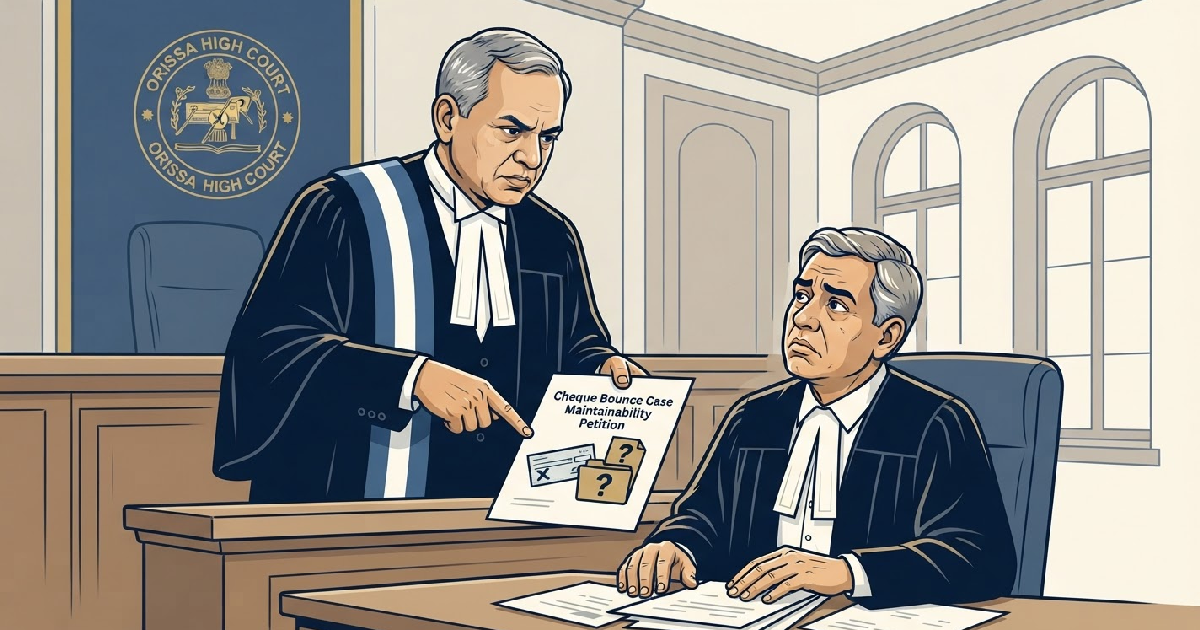
The Orissa High Court has delivered a scathing rebuke to a Judicial Magistrate First Class (JMFC), condemning the magistrate’s dismissal of a petition seeking to determine the maintainability of a cheque bounce case. Justice V. Narasingh, presiding over the High Court, labeled the JMFC’s actions as “judicial harakiri,” underscoring a severe breach of judicial discipline.
This critical observation, made on July 30, 2026, highlights the importance of adhering to directives from superior courts. The JMFC’s refusal to consider the preliminary question of maintainability, despite explicit instructions from the High Court, prompted this strong judicial response.
Judicial Hierarchy Breached in Cheque Bounce Case
Justice V. Narasingh’s bench took serious exception to the JMFC’s conduct. The High Court found that the magistrate had ignored an “unequivocal direction” to address the maintainability of a complaint filed under Section 138 of the Negotiable Instruments Act, 1881 (NI Act).
Instead, the JMFC declared the maintainability petition itself as “not maintainable.” This approach, Justice Narasingh stated, runs “contrary to the settled principles of judicial discipline.” Such actions could “undermine public confidence” in the administration of justice.
Magistrate’s defiance of High Court directive
The core issue revolved around a prior directive from the Orissa High Court. This directive mandated the trial court to specifically consider the question of maintainability upon a petition being filed.
However, the JMFC rejected this application. The magistrate’s rationale was that the petitioner had failed to raise the issue as a preliminary question earlier. The case had, by then, proceeded to the advanced stage of recording the accused’s statement.
Erosion of public trust and judicial discipline
Justice Narasingh’s strong words underscore the potential damage to the judiciary’s foundation. Disregarding superior court orders erodes public trust and compromises the integrity of the justice delivery system.
The judiciary relies on a clear hierarchical structure. This structure ensures consistency and accountability across all levels. Any deviation, as seen in this cheque dishonour case, can create an impression of judicial disarray.
The Premature Filing at Jajpur Road JMFC
The dispute originated from a complaint filed by Opposite Party No. 2 (OP-2) before the JMFC, Jajpur Road. The complaint alleged offenses under Section 138 of the NI Act and Section 318 of the Bharatiya Nyaya Sanhita (BNS).
These allegations stemmed from the dishonour of a cheque amounting to Rs. 2,50,407/-. The petitioner, Sri Ranjit Sahoo @ Ranjeet Kumar Sahoo, challenged the complaint’s validity.
Details of the original complaint
OP-2 issued a demand notice by registered post on December 6, 2024. Subsequently, without receiving an acknowledgement, the complaint case was instituted on January 10, 2025.
The petitioner argued that this filing was premature. He contended that it occurred before the expiry of the statutory period outlined in proviso (b) to Section 138 of the NI Act.
Petitioner’s argument on statutory periods
Proviso (b) to Section 138 stipulates that the payee must demand payment within thirty days of receiving bank information about the unpaid cheque. The third proviso further states that if the drawer fails to pay within fifteen days of receiving the notice, they are deemed to have committed an offense.
Sri Ranjit Sahoo asserted that the complaint was filed even before this 15-day payment window had elapsed. This procedural irregularity, he argued, rendered the entire complaint non-maintainable from the outset.
Consequences for Procedural Justice
The JMFC’s rejection of the maintainability petition had direct implications for the petitioner. It effectively denied him an early hearing on a fundamental legal question, prolonging the proceedings unnecessarily.
Such procedural missteps can lead to significant burdens for litigants. They face extended legal battles, accruing costs and emotional stress, even when initial objections might invalidate the case.
Impact on Sri Ranjit Sahoo and due process
The petitioner was forced to approach the High Court again through a revision petition. This additional legal step added time and expense, directly impacting his right to a fair and timely hearing.
The principle of due process ensures that all parties receive proper legal consideration. Bypassing preliminary objections like maintainability can undermine this fundamental right, pushing litigants into protracted and potentially unwarranted legal proceedings.
Importance of preliminary maintainability rulings
Deciding on maintainability at an early stage is crucial for judicial efficiency. It prevents cases with fundamental flaws from consuming valuable court resources and avoids undue hardship for the accused.
The High Court’s initial direction to the JMFC aimed to ensure this efficiency. Its disregard necessitated further intervention, illustrating the importance of adhering to these procedural safeguards.
Reasserting Judicial Discipline: High Court’s Strong Stance
Justice Narasingh emphasized that while subordinate courts have independent jurisdiction, they cannot “disregard or act in defiance of a direction issued by a superior Court.” This dictum reinforces the bedrock principle of judicial hierarchy.
He observed that the “edifice of the judiciary rests upon a hierarchical system.” To act otherwise would compromise the entire adjudicatory process, making the system unpredictable and unreliable.
Reinforcing the chain of command
The High Court stressed the imperative of judicial discipline by citing the Supreme Court’s judgment in Tirupati Balaji Developers (P) Ltd. v. State of Bihar (2004). This precedent solidifies the binding nature of superior court directives.
Subordinate courts, therefore, must not only acknowledge but also implement instructions from higher courts. This ensures a coherent legal framework and consistent application of justice throughout the judicial system.
‘Judicial harakiri’ as a critical warning
The use of the term “judicial harakiri” by the High Court signals the extreme gravity of the JMFC’s actions. It implies a self-destructive act that undermines the very foundation of judicial authority and public trust.
This strong language serves as a stark warning across the subordinate judiciary. It highlights that defiance of superior court orders will not be countenanced and carries severe implications for the integrity of legal proceedings.
Outlook: Rehearing Mandated for Maintainability Plea
The immediate outcome of the High Court’s ruling is the setting aside of the JMFC’s impugned order. The case, Sri Ranjit Sahoo @ Ranjeet Kumar Sahoo v. State of Orissa & Anr. (CRLREV No. 155 of 2026), will now return to the lower court.
The JMFC is now explicitly directed to first hear the question of maintainability and record a finding. This must occur before proceeding further with the substantive aspects of the cheque bounce case.
The path forward for the JMFC
This directive ensures that the petitioner’s critical objection will finally receive due consideration. The process will restart at the point where the procedural error occurred, aiming to rectify the past oversight.
Only after a reasoned order on maintainability can the JMFC advance the case. This re-establishes procedural rectitude and adheres to the hierarchical principles of the Indian judiciary.
Broader implications for subordinate courts
This ruling sends a clear message to judicial officers throughout the country. It reinforces that judicial independence operates within the framework of accountability and adherence to superior court directives.
The incident may prompt a renewed focus on procedural training and strict compliance with legal protocols. Such oversight is crucial for maintaining the institutional strength and public confidence in the justice system.
Understanding cheque legalities is crucial for both payees and drawers to navigate potential disputes effectively.
| Stage in Cheque Dishonour Proceedings | Action Required / Condition | Statutory Period / Condition | Relevant Section (NI Act) |
|---|---|---|---|
| Demand Notice Issuance | Payee sends notice to drawer | Within 30 days of bank information receipt | Proviso (b) to Section 138 |
| Drawer’s Payment Opportunity | Drawer makes payment to payee | Within 15 days of receiving demand notice | Proviso (c) to Section 138 |
| Complaint Case Initiation | Payee files complaint | Only after 15-day payment window expires | Section 138 |
What does “judicial harakiri” mean in this context?
In this context, “judicial harakiri” refers to an act by a judicial officer that is self-defeating or destructive to the principles of justice and judicial discipline. The Orissa High Court used the term to describe the Magistrate’s defiance of a superior court’s clear directive.
Why is judicial hierarchy important?
Judicial hierarchy ensures a consistent and orderly application of law, maintains accountability, and provides a clear chain of command within the judiciary. It helps prevent arbitrary decisions and fosters public confidence in the legal system’s fairness and predictability.
What happens if a cheque bounce case is filed prematurely?
If a cheque bounce case is filed prematurely, meaning before the statutory notice and payment periods have elapsed, it can be deemed non-maintainable. This could lead to the quashing of the complaint, as procedural requirements under Section 138 of the NI Act must be strictly followed.