
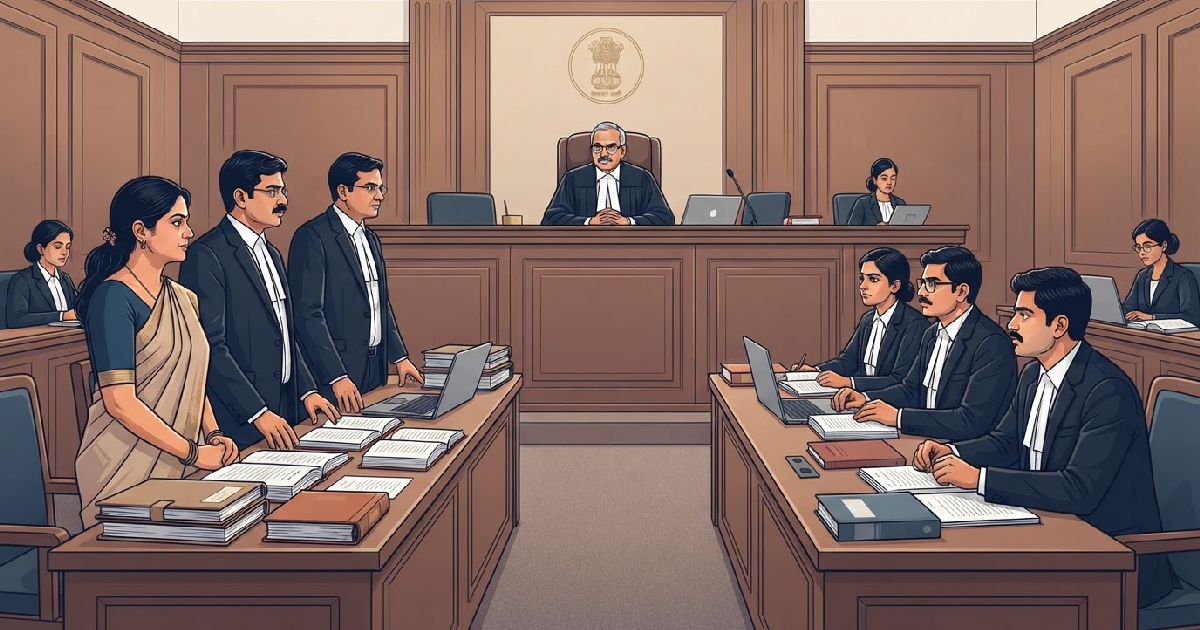
The Jharkhand High Court ordered a fresh hearing in a civil dispute, overturning a lower court’s decision that had improperly rejected an application in an adverse possession case. Justice Subhash Chand, has ordered a fresh hearing in a significant civil dispute, overturning a lower court’s decision that had improperly rejected an application in an adverse possession case.
This ruling, issued on October 22, 2024, directs the Civil Judge, Junior Division, Bokaro, to reconsider an application from defendants Smt. Jyotshna Mishra and Sujit Kumar Mishra against plaintiff Gour Baran Ojha. The application, filed under Order 7 Rule 11-D of the Civil Procedure Code (C.P.C.), sought to reject Ojha’s original plaint.
High Court clarifies procedural rules for plaint rejection applications
This directive from the Jharkhand High Court reinforces the critical importance of procedural correctness within India’s civil legal framework. It clarifies when an application for plaint rejection is maintainable, even at an early stage of litigation. The decision highlights instances where subordinate courts may misinterpret the C.P.C., necessitating intervention for due process.
In its recent order, the High Court of Jharkhand at Ranchi allowed Civil Miscellaneous Petition (C.M.P.) No. 878 of 2022. This petition originated from Smt. Jyotshna Mishra and Sujit Kumar Mishra, who challenged an order by the learned Civil Judge, Junior Division, Bokaro. The lower court’s order, dated June 22, 2022, had previously rejected their application under Order 7 Rule 11-D of the C.P.C.
The High Court found the lower court’s reasoning flawed in deeming the application non-maintainable. The Civil Judge, Junior Division, Bokaro, had rejected the application because the original suit had “not been admitted yet.” Hon’ble Mr. Justice Subhash Chand stated this reasoning contradicted established legal principles and facts.
The original suit and the defendants’ application
The underlying legal battle began with Original Suit No. 05 of 2022, registered on January 10, 2022. In this suit, Gour Baran Ojha, the plaintiff, sought a declaration of title based on adverse possession and an injunction against Smt. Jyotshna Mishra and Sujit Kumar Mishra. The defendants later filed a written statement in the suit.
Subsequently, Smt. Jyotshna Mishra and Sujit Kumar Mishra submitted an application under Order 7 Rule 11-D of C.P.C., alongside Section 151 of C.P.C. This application aimed to reject the plaintiff’s plaint. However, the Civil Judge, Junior Division, Bokaro, dismissed it without evaluating its merits, citing its supposed non-maintainability.
Understanding Order 7 Rule 11 of the Civil Procedure Code
Order 7 Rule 11 of the Civil Procedure Code (C.P.C.), 1908, is a foundational provision in Indian civil litigation. It enables courts to reject a plaint at an early stage if it contains certain legal defects. This power is crucial for preventing vexatious or frivolous lawsuits from progressing, thereby conserving valuable judicial resources.
The C.P.C. itself contains various provisions designed to ensure fair and efficient litigation. Among these are rules that allow for judgments based on clear admissions, facilitating quicker resolutions in uncontested matters, such as Order XII Rule 6 CPC.
The importance of early scrutiny in civil cases
The ability to reject a plaint early in proceedings acts as a powerful tool for judicial efficiency. It helps ensure that only genuinely litigious matters, founded on sound legal principles, advance to trial. Lawyers often use these provisions to challenge the very basis of a lawsuit, aiming for an expedient resolution.
The High Court’s emphasis on the maintainability of such applications, even after a suit is merely registered and notice issued, reinforces this principle. It underscores a defendant’s fundamental right to seek the rejection of a plaint if it is flawed. This right exists regardless of whether the court has formally ‘admitted’ the suit for full trial.
The concept of adverse possession in Indian property law
Adverse possession is a legal doctrine under which a person can claim ownership of land they have continuously occupied for a specified duration, typically 12 years in India. This occupation must be open, hostile, continuous, and exclusive, without the true owner’s permission. It’s a complex area of law, frequently leading to intricate property disputes.
Essentially, this doctrine penalizes landowners who neglect their property rights by failing to assert them against trespassers. For a claim of adverse possession to succeed, the claimant must demonstrate they meet all stringent criteria. Indian courts examine such claims meticulously, demanding substantial evidence of uninterrupted possession.
Challenges in proving adverse possession claims
Establishing adverse possession is notably challenging, as the burden of proof rests heavily on the claimant. They must prove their possession was not permissive and that the true owner was aware, or should have been aware, of their adverse claim. Any break in continuity or evidence of permission can derail the claim significantly.
Cases involving adverse possession often feature intricate factual matrices, demanding detailed documentation and witness testimony. Gour Baran Ojha’s original suit, seeking title based on this doctrine, suggests a potentially lengthy and contentious legal battle. The procedural clarity from the High Court will be crucial for its progression.
Arguments presented in the Jharkhand High Court
During the C.M.P. No. 878 of 2022 proceedings, Mr. Ashim Kumar Sahani, the learned Advocate for petitioners Smt. Jyotshna Mishra and Sujit Kumar Mishra, strongly contested the lower court’s decision.
He argued that once an original suit has been instituted, registered, and notice issued to the defendant, the defendant possesses an inherent right to file an application under Order 7 Rule 11-D of C.P.C. for plaint rejection.
Mr. Sahani stressed that this right exists even before a written statement is filed. In this specific case, the defendants had already submitted their written statement. This fact made the lower court’s rejection on grounds of non-maintainability even more erroneous, he asserted, because the Civil Judge acted against both fact and established law by not deciding the application on its merits.
Respondent’s defense and the High Court’s finding
Md. Nasim Akhtar, the learned Advocate for the opposite party, Gour Baran Ojha, defended the impugned order from the lower court. However, the High Court determined the reasoning of the lower court to be infirm. The bench, presided over by Justice Subhash Chand, concluded that the lower court’s order bore “infirmity” and required interference.
The High Court’s ruling explicitly affirmed that the application under Order 7 Rule 11-D of C.P.C. was indeed maintainable. Consequently, the previous order was set aside. This decision reinforces the principle that defendants’ procedural rights must be upheld from the earliest stages of a lawsuit.
Implications for civil procedure and judicial efficiency
This ruling from the Jharkhand High Court delivers a clear message to subordinate courts regarding the proper application of procedural rules. It reiterates that the registration of a suit and the issuance of notice are sufficient triggers for defendants to exercise their right to seek plaint rejection. The High Court’s intervention aims to prevent unnecessary delays and ensure cases are filtered appropriately.
The clarification provided by Justice Subhash Chand’s order will likely streamline procedural aspects in similar civil disputes across the state. It reduces the scope for lower courts to dismiss technically valid applications on what the High Court deemed to be incorrect procedural grounds. This should enhance judicial efficiency by allowing proper scrutiny of plaints at an earlier stage.
Preventing protracted litigation through proper application
By mandating a fresh decision on the merits of the Order 7 Rule 11-D application, the High Court seeks to prevent protracted litigation caused by procedural missteps. If a plaint is inherently defective, it should be rejected upfront. This prevents the case from consuming court resources and time for all involved parties, serving the broader interest of justice.
The directive underscores the High Court’s role in overseeing the proper administration of justice by lower tribunals. It acts as a necessary check, ensuring that procedural safeguards are correctly applied. This guidance proves particularly valuable in a legal system often criticized for its slow pace, where early dismissal of unmeritorious cases is paramount.
What happens next for the Bokaro adverse possession suit
With the High Court’s order dated October 22, 2024, the case now returns to the Civil Judge, Junior Division, Bokaro. The learned Civil Judge is directed to reconsider the application filed by Smt. Jyotshna Mishra and Sujit Kumar Mishra under Order 7 Rule 11-D of C.P.C. This reconsideration must be conducted “afresh,” providing both parties a full opportunity for hearing.
This means the lower court cannot simply dismiss the application on procedural grounds again. It must now evaluate the substantive arguments presented by the defendants for the rejection of Gour Baran Ojha’s plaint. This evaluation will determine if Ojha’s original suit, seeking title based on adverse possession, contains fundamental defects warranting its dismissal.
Potential outcomes of the fresh hearing
The fresh hearing could result in two primary outcomes. The Civil Judge, Junior Division, Bokaro, might allow the defendants’ application, which would lead to the rejection of Gour Baran Ojha’s plaint. This would effectively conclude the adverse possession suit at an early stage, before a full trial.
Alternatively, the court might reject the application, deeming the plaint valid. If the application is rejected, the adverse possession suit would then proceed on its merits, requiring Gour Baran Ojha to prove his claim in detail. Regardless of the outcome, the High Court’s intervention ensures the procedural aspect of the case is handled correctly and thoroughly, adhering to the letter and spirit of the C.P.C.
| Case Detail | Original Suit No. 05 of 2022 | C.M.P. No. 878 of 2022 |
|---|---|---|
| Court | Civil Judge, Junior Division, Bokaro | High Court of Jharkhand at Ranchi |
| Date of Registration/Order | January 10, 2022 (Suit Registered) | October 22, 2024 (Order Passed) |
| Plaintiff/Petitioners | Gour Baran Ojha (Plaintiff) | Smt. Jyotshna Mishra & Sujit Kumar Mishra (Petitioners) |
| Defendants/Opposite Party | Smt. Jyotshna Mishra & Sujit Kumar Mishra (Defendants) | Gour Baran Ojha (Opposite Party) |
| Key Application/Issue | Declaration of title by adverse possession, injunction | Challenging rejection of Order 7 Rule 11-D application |
What was the main outcome of the Jharkhand High Court’s ruling?
The Jharkhand High Court set aside an order from the Civil Judge, Junior Division, Bokaro, that had rejected an application to dismiss a civil suit. The High Court directed the lower court to reconsider the application afresh, ensuring both parties receive a proper hearing.
Why was the defendants’ application initially rejected by the lower court?
The lower court had rejected the application, made under Order 7 Rule 11-D of the Civil Procedure Code, on the grounds that the original adverse possession suit had “not been admitted yet.” The Jharkhand High Court later found this reasoning to be procedurally incorrect and legally infirm.
What is Order 7 Rule 11-D of the Civil Procedure Code (C.P.C.)?
Order 7 Rule 11-D of the C.P.C. is a provision that allows a court to reject a plaint (the document initiating a lawsuit). In this case, the petitioners filed an application under this rule, which the High Court found was maintainable even though the suit had not yet been formally admitted.