
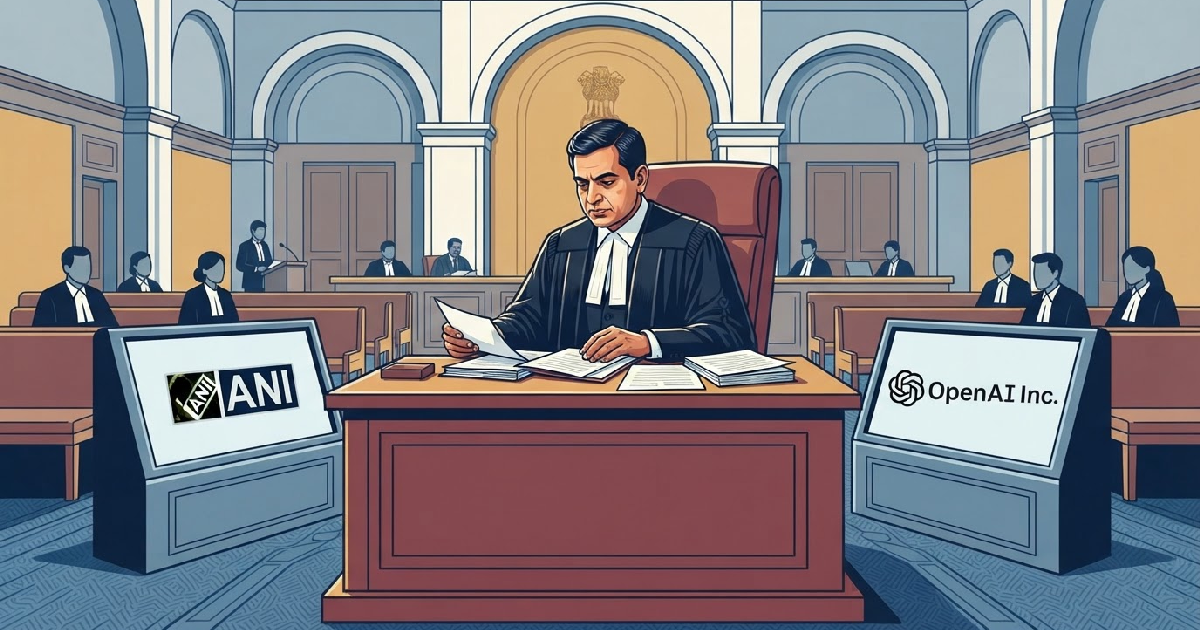
The Delhi High Court, on Friday, July 24, 2026, dismissed an interim injunction application filed by Asian News International (ANI) against OpenAI Inc., the creator of ChatGPT. Justice Amit Bansal ruled that OpenAI’s act of storing ANI’s original works for training its Large Language Models (LLMs) does not, at this stage, amount to copyright infringement under Indian law.
This decision represents a significant development for AI content use and intellectual property rights in India. The court found that OpenAI’s actions fall within the ambit of ‘fair dealing’ under the Copyright Act, declining ANI’s request to block the tech giant’s use of its content.
Court clarifies fair dealing in AI training
Central to Justice Amit Bansal’s ruling was his interpretation of Section 52(1)(a) of India’s Copyright Act, 1957. This critical provision outlines specific exceptions where the use of copyrighted material does not constitute infringement. He determined that OpenAI’s process of storing ANI’s literary works for LLM training fits this ‘fair dealing’ exemption.
The court reasoned that fair dealing encompasses private or personal use, including research, criticism, review, and the reporting of current events. Training AI models, which involves processing vast datasets to learn patterns, was deemed analogous to research rather than direct commercial reproduction.
Outputs not substantially similar
Justice Bansal also concluded that the outputs generated by ChatGPT were not “substantially similar” to ANI’s original works. This finding is crucial in copyright cases, where a clear resemblance suggesting direct copying is typically required to prove infringement. The court found no evidence that ChatGPT “memorized” or “regurgitated” ANI’s content in its responses.
He stated, “I am of the prima facie view that outputs generated by ChatGPT…does not amount to copyright infringement under Section 51, since outputs generated by OpenAI were not substantially similar to ANIs.” This distinction emphasizes the transformative nature of AI generation over mere replication.
ANI’s history of copyright enforcement and allegations
Asian News International, founded in 1971 by Prem Prakash, is a major Indian news agency, supplying content to hundreds of television channels and thousands of newspapers. The agency has historically taken an aggressive stance on copyright enforcement, as seen in past demands for retrospective license fees from YouTubers for using short content clips.
ANI filed its lawsuit against OpenAI in the Delhi High Court in November 2024, registered as CS(COMM) 1028/2024. The news agency alleged that its copyrighted material, including paywalled content, was used without authorization to train ChatGPT. ANI also raised concerns about AI “hallucinations,” where ChatGPT reportedly attributed fabricated news stories to the agency, potentially damaging its reputation.
OpenAI’s defense and initial challenges
OpenAI, an American AI research organization based in California and the developer of ChatGPT, countered ANI’s claims with several arguments. They asserted that their machine learning process is transformative and that basic news facts cannot be copyrighted. OpenAI also highlighted its use of a blocklist for domains, including “www.aninews.in” since October 2024, to prevent future crawling.
Initially, OpenAI challenged the maintainability of the suit in India, citing its lack of physical presence and US-based servers. However, the Delhi High Court ruled in favor of ANI on the territorial jurisdiction point. This confirmed the court’s authority to hear the case despite OpenAI’s global operations.
Public interest and the balance of convenience
Justice Bansal’s decision also weighed the broader societal impact of granting an injunction. He stated that an interim injunction would cause “irreparable injury not only to OpenAI but also to the public at large.” This underscores a judicial recognition of generative AI’s increasing role and potential benefits across various sectors.
The court’s stance on the “balance of convenience” further worked against ANI’s request. This legal principle assesses which party would suffer greater harm if an injunction were granted or withheld. In this context, the court clearly prioritized the public interest and OpenAI’s continued innovation over ANI’s immediate claim for interim relief.
Digital publishers rally against unlicensed AI use
The lawsuit isn’t solely a battle between ANI and OpenAI; it reflects a broader industry-wide concern. In January 2025, the Digital News Publishers Association (DNPA) intervened in the Delhi High Court proceedings. The DNPA represents major Indian media houses, including The Times Group, Hindustan Times, India Today Group, and The Hindu.
Their intervention signals anxieties within the publishing industry regarding AI companies’ reliance on copyrighted material without proper licensing or compensation. These publishers argue that large language models are systematically trained on vast quantities of protected works, potentially undermining their investments in original content creation. This collective action highlights growing tensions over compensation for original works used in determining claimed damages.
Global implications for AI and copyright
The legal challenges faced by OpenAI in India mirror similar high-profile cases globally, particularly in the United States. For instance, The New York Times v. OpenAI, filed in December 2023, alleges unlawful use of newspaper articles to train AI models, threatening its business model. This case notably showed ChatGPT reproducing verbatim paragraphs from copyrighted articles.
By April 2025, twelve US copyright cases against OpenAI and Microsoft were consolidated in New York, all broadly claiming unauthorized use of copyrighted works. Prominent authors like Ta-Nehisi Coates and Sarah Silverman have also pursued legal action against OpenAI and Meta for similar reasons.
These litigations underscore the global tension between content creators seeking fair compensation and AI developers pushing technological boundaries, influencing how the legal process overseas handles emerging tech.
Understanding AI’s content generation methods
A significant technical point in OpenAI’s defense, considered by the court, involved Retrieval-Augmented Generation (RAG) technology. LLMs are trained on extensive datasets, but they don’t always “memorize” information in a way that leads to direct copyright infringement. RAG allows the AI model to retrieve relevant information from external databases in real-time and then use it to formulate responses.
This process differs from merely recalling memorized training data. The Delhi High Court acknowledged this, concluding that RAG-generated outputs do not amount to infringement under Section 51, as they are not substantially similar to the originals. This technical nuance presents a complex challenge for news organizations trying to prove direct infringement.
Future outlook for AI and creative works
This Delhi High Court ruling provides some clarity for AI development and intellectual property disputes in India. While it’s an interim order, the dismissal of the injunction suggests a judicial inclination to support technological innovation under the ‘fair dealing’ doctrine, at least concerning the training of LLMs.
The decision doesn’t fully resolve broader questions about compensation for content creators whose work fuels AI. It primarily addresses whether the act of data storage for training and the generative output constitute infringement. Future stages of this lawsuit, and potential appeals, will undoubtedly explore commercial use, attribution, and the economic impact on news agencies.
For AI companies looking to expand in India, this ruling offers temporary relief, indicating that basic data ingestion for training might not be immediately blocked by copyright claims. However, the global legal landscape for AI remains fluid, with lawmakers grappling with balancing innovation and fair compensation for original content.
| Aspect | ANI v. OpenAI (Delhi High Court) | NYT v. OpenAI (US District Court) |
|---|---|---|
| Key Allegation | Unauthorized use for AI training, verbatim reproduction, "hallucinations." | Unlawful use of articles for training, copyright violation, business model threat. |
| Interim Ruling | Injunction dismissed; training falls under "fair dealing," outputs not substantially similar. | Ongoing; no interim injunction granted/denied yet; case consolidated. |
| Legal Principle | Section 52(1)(a) of Indian Copyright Act (fair dealing). | US Copyright Act, fair use doctrine. |
| Defendant’s Argument | Transformative use, facts not copyrightable, blocklisting, RAG technique. | Fair use, public domain content, transformative output. |
| Status | Interim injunction dismissed; main suit continues. | Consolidated with 11 other cases; trial pending. |
What was the core issue in the ANI v. OpenAI case?
The primary dispute centered on whether OpenAI’s use of Asian News International’s copyrighted content to train its AI models, specifically ChatGPT, constituted copyright infringement under Indian law. ANI also claimed that ChatGPT generated “hallucinations” harming its reputation.
Why did the Delhi High Court dismiss ANI’s injunction request?
The Delhi High Court dismissed the interim injunction primarily because it found OpenAI’s actions of storing ANI’s works for AI training fell under the “fair dealing” exception (Section 52(1)(a)) of the Copyright Act. Additionally, the court found no substantial similarity between ChatGPT’s outputs and ANI’s original works, nor evidence of memorization.
What does this ruling mean for the future of AI and copyright in India?
This interim ruling suggests a judicial willingness to allow AI training activities under fair dealing provisions, at least in the short term. It provides temporary relief for AI developers in India but doesn’t fully resolve the broader questions of content creator compensation or the long-term legal framework for generative AI.