
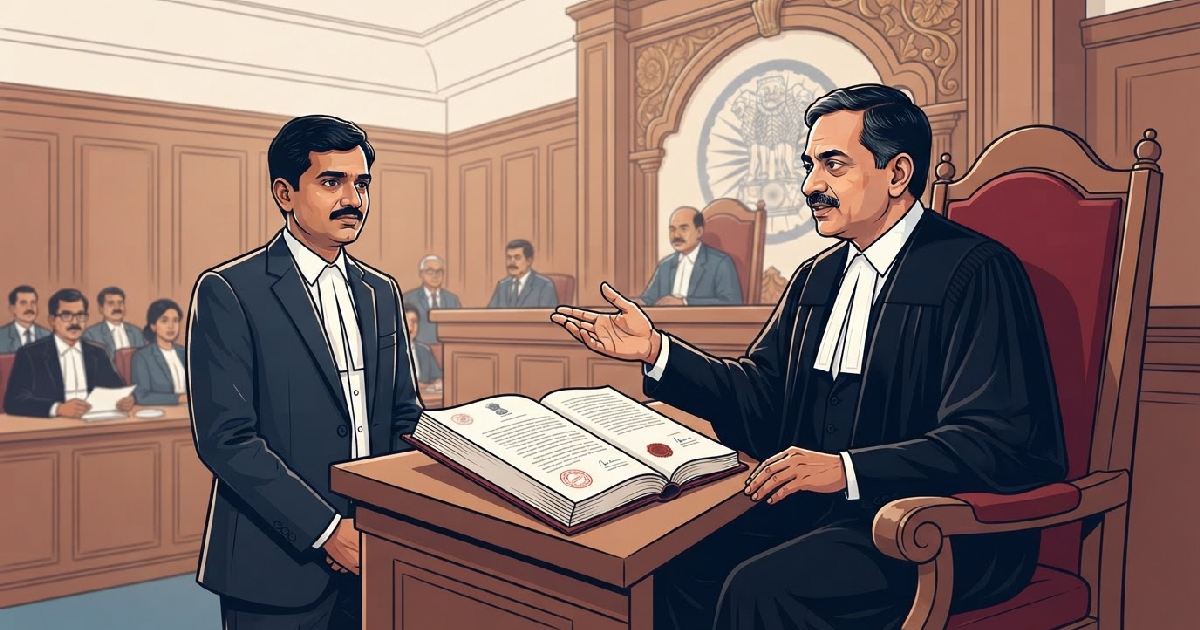
The Supreme Court nullifies a 2010 appellate court judgment because it was passed against deceased parties when the appeal was heard and decided. This decision, issued on November 6, 2025, by Justice Atul S.
Chandurkar, effectively reinstates a 2006 trial court decree in favor of Vikram Bhalchandra Ghongade, the legal heir of the original plaintiffs in a long-running land dispute.
Reversing lower court decisions in property dispute
The apex court’s judgment stemmed from a civil appeal (arising out of Special Leave Petition (Civil) No. 9947 of 2024), where Ghongade sought to execute the initial trial court decree. The ruling underscores critical procedural aspects concerning the abatement of legal proceedings and the necessity of bringing legal heirs on record.
The complex legal battle traces its roots to agricultural land in Village Takarkheda, Taluka Arvi, District Wardha, Maharashtra. Mr. Arjunrao Thakre, an Ex-Army Serviceman and predecessor to the current appellant, was initially allotted Survey Nos. 106 and 107/1. After his death, however, the land was reportedly re-allotted by the Collector, Wardha, to defendant Nos. 3, 4, and 5.
This re-allotment prompted Mr. Thakre’s legal heirs to file RCS No. 181 of 2001, seeking a declaration that the new allotment was illegal. On August 14, 2006, the trial court found in their favor. It decreed that the allotment to the defendants was unlawful and affirmed the legal heirs’ ownership, granting them possession of the land.
The abatement conundrum: a procedural maze
Aggrieved by this decision, defendant Nos. 4 and 5 preferred an appeal under Section 96 of the Code of Civil Procedure, 1908. But a critical development occurred before the appeal could be heard. Defendant No. 4 died on October 27, 2006, followed by defendant No. 5 on September 20, 2010. Crucially, these deaths were not brought to the notice of the first appellate court.
The first appellate court proceeded to hear counsel for the parties on September 28, 2010. On October 20, 2010, it partly allowed the appeal, modifying the trial court’s decree. This decision restricted the plaintiffs’ entitlement to only a portion of the land originally allotted to Mr. Arjunrao Thakre.
High court restores second appeal after initial dismissal
The original plaintiffs then filed a second appeal under Section 100 of the Code of Civil Procedure, 1908. This appeal was initially dismissed as abated by the Registrar (Judicial), who noted that defendant Nos. 4 and 5 had died during the pendency of the first appeal and their legal heirs had not been brought on record within the limitation period.
However, the High Court intervened on December 3, 2012, restoring the second appeal. It acknowledged that the factual position regarding the deceased defendants was undisputed. This meant the second appeal should not have been dismissed on abatement grounds.
Withdrawing the second appeal
Following the restoration, the original plaintiffs chose to withdraw the second appeal. They argued that the first appeal itself had abated due to the deaths of defendant Nos. 4 and 5, implying that the trial court’s original judgment was the only valid decree in force. The second appeal was subsequently dismissed as withdrawn, leaving the legal landscape ambiguous regarding which decree held sway.
Vikram Bhalchandra Ghongade’s long fight for justice
The journey to justice for Vikram Bhalchandra Ghongade and his family has been protracted, marked by several judicial hurdles. After the second appeal’s withdrawal, Ghongade sought to execute the original trial court decree dated August 14, 2006. He filed Regular Darkhast No. 22 of 2022 before the executing court.
Ghongade contended that the first appeal had abated, rendering the trial court decree executable. But the executing court disagreed. It ruled that since the first appeal was decided on October 20, 2010 – before the 90-day period for bringing defendant No. 5’s legal heirs on record had expired (defendant No. 5 died on September 20, 2010) – it couldn’t be deemed abated at that point.
Executing court and high court dismiss Ghongade’s petition
The executing court concluded that the trial court’s decree had merged with the modified decree of the first appellate court. Therefore, it dismissed Ghongade’s execution application with costs, denying him the relief he sought. This decision left Ghongade in a precarious position, effectively preventing him from reclaiming the ancestral land.
Undeterred, Ghongade challenged this order by filing Writ Petition No. 5791 of 2023 before the High Court. However, on March 11, 2024, the High Court upheld the executing court’s decision and dismissed his petition. This further solidified the lower courts’ stance against the execution of the original trial court decree.
Supreme Court’s decisive pronouncement on nullity
The Supreme Court, after hearing Vikram Bhalchandra Ghongade in person and counsel for the respondents, rendered a clear and unequivocal judgment. Justice Atul S. Chandurkar articulated that the executing court had erred in dismissing the execution petition as not maintainable. The apex court scrutinized the procedural lapses that had plagued the case for years.
It emphasized that both defendant Nos. 4 and 5 had died before the first appeal was even heard on September 28, 2010, let alone decided on October 20, 2010. The court found that their legal heirs were never brought on record. This rendered the first appellate court’s decree, which was passed in favor of dead persons, a complete nullity.
Understanding Order XXII Rule 6 of the Civil Procedure Code
The Supreme Court specifically referenced Order XXII Rule 6 of the Code of Civil Procedure, 1908. This rule stipulates that if a party dies between the conclusion of a hearing and the pronouncement of judgment, the proceedings do not abate. The judgment would then have the same force as if it were pronounced before the death.
However, Justice Chandurkar pointed out that this rule did not apply to the present case. Both defendant Nos. 4 and 5 had died *prior* to the hearing of the appeal on September 28, 2010. Therefore, the appeal was decided despite the death of the appellants, and critically, without their legal heirs being substituted.
The court explicitly stated that the judgment pronounced in the first appeal on October 20, 2010, was a nullity because it was in favor of parties who were no longer alive. This meant the adjudication lacked legal force. This legal principle, pertaining to a court rule allowing judgments, is vital for ensuring due process and the fair administration of justice.
Precedents reinforcing the ruling
To bolster its position, the Supreme Court cited several precedents. Decisions in Rajendra Prasad and another vs. Khirodhar Mahto and others and Amba Bai and others vs. Gopal and Others were referenced. These cases collectively affirm that a judgment passed against or in favor of a deceased person, where legal heirs were not substituted, is without effect.
The court further relied on Bibi Rahmani Khatoon and others vs. Harkoo Gope and others. This case highlighted that if an appeal abates due to the failure to substitute legal heirs, the original judgment (the trial court’s in this instance) becomes final. The same principle applies when a judgment is a nullity.
Implications for legal practice and due process
This ruling from the Supreme Court serves as a stark reminder of the rigorous procedural requirements in civil litigation, particularly concerning the substitution of legal heirs. It reinforces the principle that judicial proceedings cannot continue effectively against or in favor of a non-existent party. Ignoring such a fundamental procedural aspect can invalidate an entire judgment.
For legal practitioners, the judgment underscores the critical importance of diligently monitoring the status of parties throughout the appellate process. Failing to inform the court of a party’s demise and subsequently bringing their legal representatives on record can lead to prolonged disputes and ultimately, the nullification of favorable outcomes.
Safeguarding the rights of litigants
The ruling also champions the rights of litigants like Vikram Bhalchandra Ghongade. It ensures that procedural oversights by courts or opposing parties do not unfairly prejudice those seeking to enforce legitimate claims. The Supreme Court’s decision confirms that a decree obtained through proper legal channels at the trial level should not be easily overturned by appeals fraught with procedural irregularities.
It acts as a check on lower courts, reminding them that while the abatement period provides a timeframe for substitution, the fundamental principle remains that a judgment cannot be legally rendered against or for a deceased individual. The legal system relies on living, identifiable parties to resolve disputes effectively.
Analysis of the procedural timeline and judicial oversight
The journey of this case through various judicial tiers highlights areas where procedural diligence could have prevented years of litigation. The fact that the first appellate court heard and decided an appeal without knowledge of the appellants’ deaths points to a significant oversight. This error ultimately led to the nullification of its own judgment.
The executing court’s interpretation, which prioritized the 90-day abatement period over the fact that the appellants were already deceased *before* the hearing, was also deemed incorrect by the Supreme Court. This indicates a need for careful consideration of the sequence of events and the precise application of procedural rules.
| Event | Date | Outcome / Status |
|---|---|---|
| Trial Court Decree | 14.08.2006 | Plaintiffs declared owners, entitled to possession. |
| Defendant No. 4 Dies | 27.10.2006 | Prior to first appeal hearing. |
| Defendant No. 5 Dies | 20.09.2010 | Prior to first appeal hearing. |
| First Appellate Court Hearing | 28.09.2010 | Heard after both defendants deceased. |
| First Appellate Court Judgment | 20.10.2010 | Partly allowed appeal, modified decree. (Now nullified) |
| High Court Restores Second Appeal | 03.12.2012 | Acknowledged first appeal likely abated. |
| Executing Court Dismisses Execution | 2022/2023 | Held trial court decree merged with appellate decree. |
| High Court Upholds Dismissal | 11.03.2024 | Affirmed executing court’s order. |
| Supreme Court Judgment | 06.11.2025 | First appellate decree nullified; trial court decree executable. |
The enduring importance of the trial court decree
With the Supreme Court’s ruling, the original decree passed by the trial court on August 14, 2006, is the only legally enforceable decision. This means that Vikram Bhalchandra Ghongade can now proceed with the execution of that decree, a process he began in 2022. The long-standing property dispute should finally see a resolution that aligns with the initial judicial finding.
The case underscores a fundamental tenet of justice: that procedural correctness is not merely a formality but a cornerstone of valid legal outcomes. When an appeal is decided without the proper parties in existence or their legal heirs on record, the entire process is tainted, and the resulting judgment loses its legal sanctity.
What this means for landowners in Maharashtra
This decision offers crucial clarification for landowners, particularly in cases involving succession and property disputes. It serves as a reminder that the death of a party to a lawsuit significantly alters the procedural requirements. Vigilance in updating court records and ensuring the proper substitution of legal heirs is paramount to avoid similar prolonged and complex legal battles.
For those involved in land disputes, the Supreme Court’s firm stance against procedural irregularities provides a measure of confidence. It reaffirms that substantive justice, guided by accurate and complete party representation, will ultimately prevail even after years of legal back-and-forth.
What does it mean for a judgment to be declared a “nullity”?
When a judgment is declared a “nullity,” it means the court considers it to have no legal force or effect from the very beginning. It’s as if the judgment never existed. This typically happens when there are fundamental procedural flaws, such as a judgment being passed against a party who was already deceased and whose legal heirs were not brought onto the record.
Why is it important to substitute legal heirs in a lawsuit?
Substituting legal heirs is crucial because a lawsuit involves parties who can legally represent their interests. When a party dies, their rights and obligations pass to their legal heirs. If these heirs aren’t brought into the legal proceedings, the court cannot properly adjudicate the matter, and any judgment passed can be challenged as invalid or a nullity.
How does this Supreme Court ruling affect future property disputes in India?
This ruling reinforces the strict adherence to procedural law, especially concerning the abatement of proceedings due to a party’s death. It provides a clear precedent that if an appellate court decides an appeal against deceased parties without their legal heirs being on record, that appellate judgment can be challenged as a nullity.
This means greater scrutiny will be applied to such procedural aspects, aiming to prevent similar protracted legal battles and ensure justice for rightful claimants.