
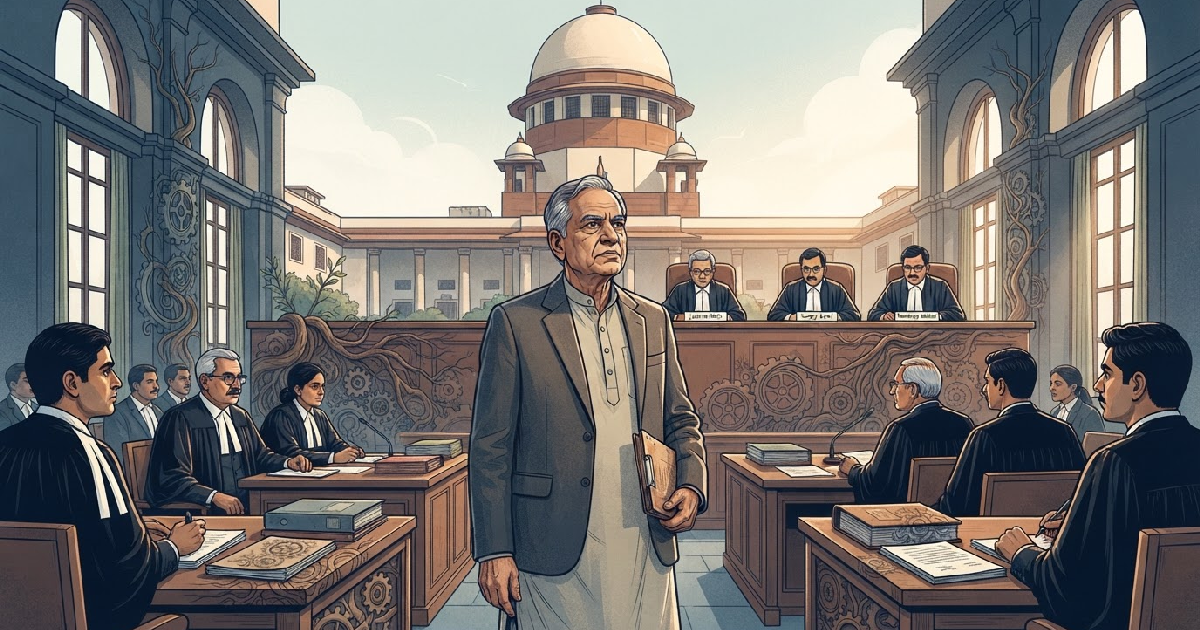
The Supreme Court of India faced a challenging docket on July 21, 2026, most notably continuing its review of Dr. Abdul Hameed’s case. This complex appeal stems from the 1996 Samleti bus explosion, a matter that has seen Hameed incarcerated for almost three decades.
Proceedings in New Delhi also highlighted a significant judicial recusal from a high-profile bail petition. Furthermore, a critical ruling concerning the Juvenile Justice Act was delivered, underscoring the diverse and demanding nature of the apex court’s daily work.
Three Decades in Limbo: The Dr. Abdul Hameed Appeals
The core of the day’s criminal appellate jurisdiction list involved Dr. Abdul Hameed v. State of Rajasthan, a case that has dragged on for nearly three decades. A bench comprising Justice Vikram Nath, Justice Sanjay Karol, and Justice Sandeep Mehta heard the matter.
Hameed, identified as Accused No. 9, has spent almost twenty-nine years behind bars, reflecting the extraordinary duration of this prosecution. The Supreme Court’s current involvement signifies a crucial stage in a legal saga that began in the mid-1990s.
The Enduring Legacy of the Samleti Bus Explosion
At the heart of Dr. Abdul Hameed’s protracted legal battle lies the 1996 Samleti bus explosion. Prosecutors have alleged this act of violence was part of a broader campaign designed to instill fear and destabilize public order.
The case was initially registered under FIR No. 39 of 1996. The investigation linked Accused No. 8, Riaz Ahmad Sheikh (also known as Maulvi), to the manufacturing of the bomb used in the explosion. The court has stressed the importance of constitutional values in such grave cases.
Divergent Verdicts from Lower Courts
The path to the Supreme Court for this case has been marked by differing conclusions at various lower court levels. This complexity is typical of long-running, multi-accused prosecutions, presenting a challenge for definitive judicial outcomes.
Initially, two individuals were convicted in connection with the explosion; one received a death sentence, and the other life imprisonment. However, seven other accused persons, including Mohammad Ali Bhatt, Mirza Nisar Hussain, and Kulwinderjit Singh, were acquitted due to insufficient evidence presented against them.
Scrutinising Evidence in a Protracted Case
The prosecution’s case against Dr. Abdul Hameed and others has relied on an array of evidence collected over many years. This extensive body of material reflects the prolonged nature of the investigation and legal proceedings.
Key pieces of evidence include detailed travel records, statements provided by co-accused individuals, and extensive telephone records. Furthermore, diaries allegedly recovered during the investigation and intelligence inputs have also played a role in the prosecution’s narrative.
The Quest for Justice Amidst Decades of Litigation
The Supreme Court’s continued engagement with the Dr. Abdul Hameed appeals underscores the immense challenges inherent in cases spanning nearly three decades. Such delays can profoundly impact all parties involved, testing the limits of the justice system.
While the specific outcome for Dr. Abdul Hameed on July 21, 2026, was that “pending application(s), if any, shall stand disposed of,” this procedural step indicates the appeals remain active. The apex court is navigating a dense evidentiary record and intricate legal arguments.
Broader Judicial Proceedings on a Busy Day
Beyond the high-profile Samleti bus blast case, the Supreme Court of India was actively engaged with several other significant matters on July 21, 2026. These included a rare judicial recusal and important pronouncements in other criminal and civil appeals.
The Court’s diverse docket highlights its role as the final arbiter across India’s complex legal landscape. It continues to address a wide range of legal issues, from fundamental rights to intricate civil disputes and criminal appeals.
Supreme Court Judge Recusal Raises Questions
In a notable development, Justice Shree Chandrashekhar recused himself from hearing a bail petition filed by advocate and activist Surendra Gadling. This marks the third time a Supreme Court judge has withdrawn from this particular case in the past year, with no reasons publicly assigned for these recusals.
The bail plea is connected to the 2016 Surjagarh iron ore mine arson case, also known as the 2016 Gadchiroli arson case. The matter was listed before a bench comprising Justice Prashant Kumar Mishra and Justice Shree Chandrashekhar, but Justice P.K. Mishra confirmed Justice Chandrashekhar’s inability to proceed.
The Supreme Court subsequently ordered the bail plea to be heard by a different bench, away from Justice Shree Chandrashekhar, demonstrating the seriousness with which such procedural matters are handled. For context on high court decisions, a similar petition dismissal occurred in the Uttarakhand High Court recently.
Juvenile Justice Act and an Appeal’s Dismissal
On the same day, a bench of Justice J.B. Pardiwala and Justice Ujjal Bhuyan presided over Criminal Appeal No. 3299 of 2026, titled X v. State of Bihar & Anr. The appeal, arising from SLP (Crl.) No. 5633 of 2026, was ultimately dismissed by the Court.
This judgment delved into the Juvenile Justice (Care and Protection of Children) Act, specifically Section 101(2), which concerns the assistance of experienced psychologists and medical specialists. The Court also referenced the landmark decision in Shilpa Mittal v. State (NCT) of Delhi, underscoring the complex classification of offenses under juvenile law.
The appellant had been declared a juvenile under Section 94(2)(i) of the JJ Act. They were apprehended while allegedly attempting to flee after slitting the throat of the deceased with a knife. Crucially, the weapon involved in the incident was reportedly discovered at the appellant’s behest.
Civil Appeal Receives Leave to Proceed
Justice Sanjay Karol also heard a significant civil appeal, Madan Mohan (Dead) Through LRS. v. Thakar Dass (Dead) Thr. LRS. This case, Civil Appeal No. of 2026 (@Special Leave Petition (Civil) No. 12435 of 2019), saw the Supreme Court grant leave.
Granting leave means the Court has agreed to hear the appeal on its merits, indicating that it raises substantial questions of law or fact. This decision allows the civil dispute to proceed to a full hearing before the apex court.
Complex civil procedure rules often guide these initial stages, allowing the Court to identify crucial legal issues for review. For more on such procedural elements, you can explore aspects of court rules allowing judgments based on clear admissions.
The Challenge of Protracted Criminal Justice
The case of Dr. Abdul Hameed, stretching over nearly three decades, epitomizes the significant challenges inherent in India’s criminal justice system. Such prolonged legal battles raise serious questions about the right to a speedy trial and the immense human cost of delayed justice.
Accused individuals, irrespective of guilt or innocence, endure years of uncertainty and incarceration. Moreover, these extended timelines strain judicial resources and can diminish public confidence in the efficiency and fairness of legal processes. The Supreme Court’s continuous oversight in this case becomes paramount.
Balancing Justice and Expediency
The apex court consistently navigates the delicate balance between ensuring thorough due process and expediting justice. Cases involving complex investigations and multiple appeals, like the Samleti bus explosion, often test these boundaries severely.
Justice must not only be done but must also be seen to be done within a reasonable timeframe. The ongoing appeals for Dr. Abdul Hameed underscore the constant judicial effort to uphold constitutional guarantees while addressing severe criminal allegations.
Implications for Future Prosecutions
The Supreme Court’s handling of these protracted cases sets important precedents for future prosecutions. It reinforces the need for lower courts to diligently manage caseloads and for investigative agencies to present robust, timely evidence.
The emphasis on constitutional values in cases involving violence with explosives also serves as a strong reminder. It highlights that even in the face of grave crimes, adherence to established legal principles remains non-negotiable for the judiciary.
Supreme Court Decisions: July 21, 2026 Overview
| Case Title | Lead Judge(s) | Primary Outcome / Status | Key Area |
|---|---|---|---|
| Dr. Abdul Hameed v. State of Rajasthan | Justices Nath, Karol, Mehta | Pending applications disposed of | Criminal Appeal, terrorism |
| Surendra Gadling Bail Petition | Justice Shree Chandrashekhar (recused) | Recusal, matter relisted | Bail, judicial ethics |
| X v. State of Bihar & Anr. | Justices Pardiwala, Bhuyan | Appeal dismissed | Juvenile Justice Act |
| Madan Mohan (Dead) Through LRS. v. Thakar Dass (Dead) Thr. LRS. | Justice Sanjay Karol | Leave Granted | Civil Appeal |
What is the significance of a judge’s recusal in a Supreme Court case?
A judge’s recusal indicates they are withdrawing from a case, usually due to a perceived conflict of interest or bias. This ensures fairness and impartiality in judicial proceedings. While reasons aren’t always public, it’s a critical step to maintain public trust in the judiciary’s integrity.
How does the Juvenile Justice Act apply to serious offenses in India?
The Juvenile Justice (Care and Protection of Children) Act provides a specialized framework for addressing offenses committed by minors. It focuses on rehabilitation and social reintegration. Even for serious offenses, the Act mandates specific procedures and considerations, including assistance from psychologists, to determine culpability and appropriate measures.
What are the implications of a criminal case spanning nearly three decades?
A case stretching over such a long period raises significant concerns regarding justice delayed and its impact on the accused, victims, and the legal system. It can lead to prolonged incarceration, emotional distress, and difficulties in preserving evidence, highlighting systemic issues in judicial efficiency and the right to a speedy trial.